
Equal parts George Orwell and unrestrained teenage hormones, director Will Gluck’s One Night Only imagines a dystopian America where a religious administration has banned premarital sex. The preposterous prohibition is enforced through biometric sensors that detect certain hormonal spikes and summon SWAT teams to thwart your carnal endeavors.
The only caveat to this prudish regime, like some raunchy remake of 2013’s The Purge, is a single day of the year when the unwed are permitted to copulate: “one night only,” hence the title of the film. From this absurd premise, Gluck fashions a surprisingly sweet romantic comedy about two people searching for meaning in intimacy amid a culture that increasingly reduces affection to hedonistic pursuit.
From the outset, we are introduced to Owen (Callum Turner). Today is the big day, and like any well-intentioned romantic, he takes his girlfriend to a fancy sushi restaurant where he plans to propose. His grand gesture is met with: “I want to sleep with someone else tonight,” followed by her kind and confident reassurance that “we will get through this.” Owen is understandably less convinced (they do not get through it).
One Night Only is best understood as a satire of contemporary dating culture, where sex is often treated as casually as a hug or handshake and dating, for many, becomes less a search for a life partner than an indefinite pursuit of fun. Gluck simply literalizes the arrangement. Everyone is handed a government-sanctioned evening to dispense with courtship, commitment, and romantic pretense altogether.
Meanwhile, Allie (Monica Barbaro), another millennial romantic and aspiring singer whose day job amounts to recording dainty advertisements for psoriasis medication, vies for a Valentine of her own. She goes out with a friend, drinking tequila shots to “finding love on the least romantic night of the year.” Allie at least harbors some skepticism about flinging herself upon the first available prospect, calculating that “there is roughly a 2.81% chance of good sex on a one-night stand.”
Her friend is less discriminating. Within minutes, she abandons their pact and runs off with an African prince, wishing Allie luck on her way out — not two minutes after complaining that the impromptu fling she found the previous year had ghosted her. There is something faintly Truman Show-esque about Owen and Allie: two lonesome, quixotic figures searching for authentic connection inside a world whose absurd customs everyone else seems perfectly content to accept.
The narrative unfolds over this sole day of permissible promiscuity. With only hours remaining to do the deed, Gluck sends us through a densely populated New York awash in parks, parking lots, restaurants, bars, and subway stations, as eager strangers carnally leap upon one another wherever space permits. The city becomes a giant singles mixer stripped of whatever residual decorum dating culture had left.
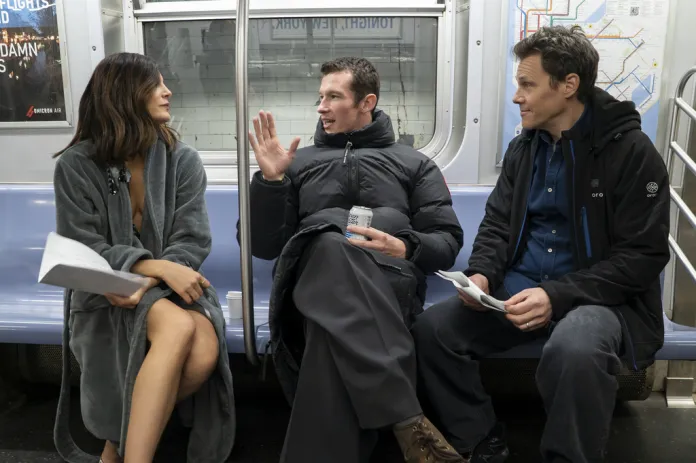
Frustrated by their inability to find or hold on to meaningful relationships, Allie and Owen separately decide to make the most of their day of unbridled, unattached sex and pounce upon the first fleeting opportunity that presents itself. Their mutual desperation eventually brings their paths together.
From their first encounter, Turner and Barbaro share a palpable, playful chemistry. Gluck’s affinity for romantic comedies is evident in their banter and push-pull dynamic, as both remain reluctant to acknowledge their obvious attraction and insist they are interested only in an impulsive hookup. The premise continually conspires against them. Working against the clock, Owen downloads a dating app and ventures into the park to find his match, only to wind up zip-tied to a tree and robbed.
Allie’s adventures on this carnal odyssey are scarcely more successful. She approaches men at different bars, hoping for some semblance of chemistry, only to be met with immediate, graphic propositions for bedding. Having spent some time in the online dating app world before getting engaged, I can confirm from experience that, despite the conveniences they have borne, these apps have also helped jettison subtlety and degrade the social norms surrounding dating and relationships. Courtship is inefficient by design. Efficiency has not necessarily improved it.
ANDREW TATE IS A MAN’S FEMINIST
Despite its ribald premise, the film’s core tenet is as traditional as it gets. Though several of their efforts to score are seemingly foiled by fate, Allie and Owen are repeatedly reunited and drawn toward one another because each is searching for something more serious than a fleeting fling. The film isn’t making the case for prohibiting premarital bedroom relations — neither are Christians or Republicans! — but it agrees entirely with conservatives that sex detached from meaningful relationships can become a vapid pursuit of pleasure that leaves its participants empty and searching for the next high.
One of the film’s more poignant scenes arrives in the third act, when Allie and Owen ask one another about their favorite part of sex. They cherish the lingering moments afterward: lying beside someone meaningful, sharing the quiet intimacy that follows, and knowing the person beside you will still be there when morning comes. For all the film’s raunchiness, One Night Only reminds us that a culture obsessed with maximizing sexual freedom has somehow made intimacy harder to find.
Harry Khachatrian (@Harry1T6) is a film critic for the Washington Examiner. He is a software engineer, holds a master’s degree from the University of Toronto, and writes about wine at BetweenBottles.com.