
North Korea has previously sent approximately 15,000 troops to join Russia’s war against Ukraine. That’s not all. North Korea has also provided Russia with hundreds of thousands of artillery shells and dozens of ballistic missiles. But Pyongyang is now escalating. As Reuters reported last week, “A North Korean missile unit has begun deploying to western Russia and could be equipped with 120 ballistic missiles and six launchers for strikes against Ukraine.”
But will Ukraine make North Korea pay a price for this new aggression?
Ukraine’s HUR military intelligence service has carried out numerous assassinations of Russian military officers inside Russia since the war began. It has conducted operations against Russian irregular forces in Africa. Ukraine is also strongly suspected of responsibility for a November 2022 explosion that damaged Russia’s Nord Stream 2 gas pipeline to Europe. And just last month, Ukrainian drones struck an Iranian cargo vessel in the Caspian Sea (Iran has provided extensive support to Russia’s war effort, primarily through attack drones).
There’s no question that North Korean dictator Kim Jong Un has given Ukraine ample cause for new action.
After all, this North Korean missile deployment is plainly designed to help Russia exploit Ukraine’s crisis-level deficit of Patriot air defense munitions. While Ukraine has developed ingenious ways of intercepting the legions of drones that Russia throws at it every night, ballistic missile intercepts require the Patriot system (due to their systemic military underfunding, the European anti-ballistic missile systems in Ukraine’s possession are limited in capability and armament). And while Ukraine is pleading for more Patriot interceptors, the United States is reluctant to provide them due to its own deep shortfall amid the Iran war (this shortfall greatly undermines U.S. deterrence of China).
Russian President Vladimir Putin thus wants Kim’s help in pummeling Ukraine while it’s down and before the U.S. or Ukraine’s other partners provide Kyiv with added means of pressuring Russia in reciprocity. Putin sees escalating missile attacks as a means both to degrade Ukrainian resolve and to broadcast a punitive response to Ukraine’s extraordinarily successful drone campaign inside Russia. But Ukraine’s big fear is that Russia will be able to smash its energy infrastructure and freeze Ukraine’s population as winter approaches.
Hence why expansive Ukrainian retaliation against North Korea might be on the table. But how to do so?
The most direct way to strike back would be by targeting the North Korean cargo ships that deliver munitions to Russian ports just across the border. These Russian ports connect to railway networks, which then speed supplies toward Ukraine. But as in my screenshot below (from MarineTraffic.com), there is only a very small area in which Ukraine could intercept North Korean vessels at sea. It would be possible, but extremely complex. That leaves the option of targeting North Korea cargo ships while they are at port. Again, however, this would be very complex.
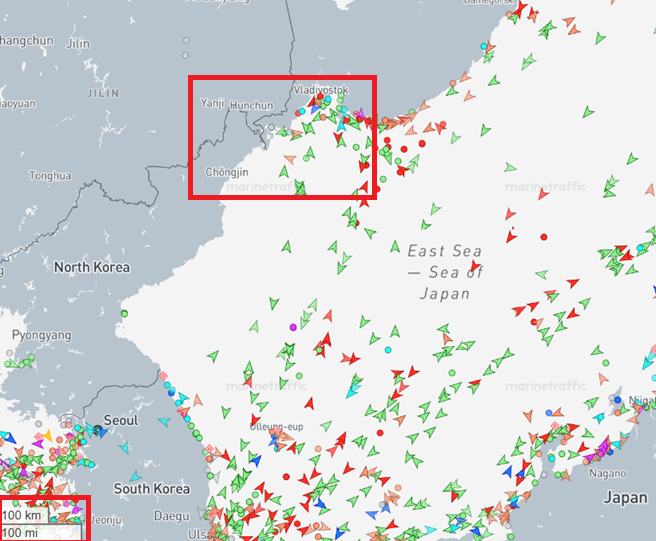
An easier but challenging option would be for Ukraine to target North Korean cargo ships that secretly deliver coal and other supplies off the coast of Vietnam and other Southeast Asian nations. This option might feasibly allow Ukraine to assemble and then deploy its superb sea drones from land. Still, secrecy would be imperative if Ukraine were to avoid diplomatic fallout from the nations from which it launched said drones. Alternatively, Ukrainian operatives could target North Korean intelligence and military officers and their networks around the world. This would be easier, the primary risk again being the affront caused in the nation in which any attack took place. But while limited in effect, this option would produce an element of friction in North Korean calculations and at least marginally undermine Kim’s sense that he has garnered prestige from this war.
Unfortunately, the U.S. necessity in deterring or, if necessary, defeating a Chinese invasion of Taiwan precludes further near-medium-term U.S. supplies of Patriot munitions to Ukraine. But there are other options to bolster Ukraine. As has been argued by others, the U.S. could provide Ukraine with bombs capable of striking Russian and North Korean ballistic missile launchers hiding behind the front lines. The West should also impose heavier and more punitive costs on Russia for its growing aggression on NATO territory. The Trump administration should back these efforts, in that Russia has earned North Korea’s support by bolstering its nuclear intercontinental ballistic missile program — a direct threat to the U.S. homeland.
PENTAGON SHOULD INVESTIGATE ADM. BILL OWENS’S CHINA COLLUSION
Ukraine’s current strategy is to boost its drone-centered resistance to ground offensives, isolate Russian forces in Crimea, and continue with deep strikes inside Russian territory. Kyiv is slowly but surely increasing Russian popular pressure on Putin to reassess his cost-benefit analysis of this war. And to make Kim consider whether he is throwing good money after bad.
All that said, North Korea should face more direct consequences for the harm it is causing to innocent people.