
In this semiquincentennial year, 1776 is on many Americans’ minds. But in The Louisiana Purchase: The Grand Bargain and the Making of America, Louisiana State University Shreveport professor Alexander Mikaberidze turns our attention to another epochal year in the early republic: 1803.
He gives a thorough and engaging account of the fateful transaction that doubled the size of the young nation, as well as all that led up to it. In doing so, he casts doubt on some well-worn clichés about the purchase (“four cents an acre”) and explains the many shifting forces of people — European, American, and native — and political currents that led it to come to pass.
When the Revolutionary War ended, the United States found itself in possession of a vast, mostly unsettled region between the Appalachians and the Mississippi River. It was the realization of a part of the former colonists’ ambitions. Long banned by royal decree from settling over the mountains, the pent-up populations of the coastal states now spilled through the Cumberland Gap to take possession of the vast interior.
That led to two problems. The first — the reason for King George’s ban on settlement — was conflict with the native tribes already living there. The second was that the newly settled lands had one natural outlet for trade: the mouth of the Mississippi, the tributaries of which drained the land on the other side of the divide. Unless American farmers could send their produce down the river, they faced the arduous and expensive transport back over the mountains to find a market for it. The mouth of the river, dominated by the city of New Orleans, was in foreign hands — an existential threat to the livelihood of every American west of the Appalachians.
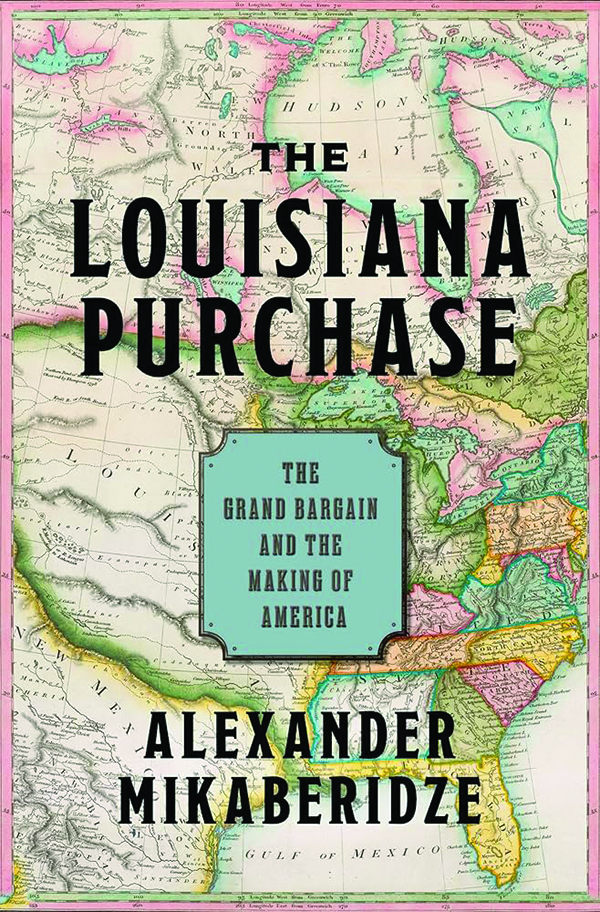
By Alexander Mikaberidze; Oxford University Press; 624 pp.; $29.99
As valuable as New Orleans was to the growing American population in the west, it had always been a losing enterprise for its colonizers — starting with the French. Louisiana — the name then applied to the whole Mississippi watershed — seemed full of possibilities to the French explorers who first traversed it. They traded with the natives, erected some forts, and gave their best effort at forming the kind of colony the English had on the Atlantic coast. But it was a continual challenge to gain immigrants and build up the critical mass of population needed to make a successful society.
Unlike the profitable colonies of the Caribbean, with their sugar and tobacco, or of French Canada, with its fur trade, Louisiana’s potential remained untapped. When France lost the French and Indian War, the territory was partitioned between Britain and Spain, with the river as the dividing line. But Spain found the same problems: immigrants were few, and profits were none. The biggest influx, ironically, were French settlers of Acadia, expelled by the English when they took possession there. These refugees found the former French colony still close enough culturally to make a new home, and Acadians became Cajuns. After a rebellion in 1768, they settled into life under the Spanish flag.
Spain tried to cure the problem by doling out generous land grants to anyone who would agree to become a loyal subject of the Spanish king — and promised to otherwise leave them alone. They created an early exercise in the American melting pot but failed to make the colony profitable and attracted many settlers whose loyalty was transactional. As long as that tolerance remained, and as long as American commerce was allowed to flow through New Orleans, things stayed calm on the river frontier.
The French Revolution and the subsequent wars across Europe saw Napoleon triumphant in France and dreaming of restoring the glory of France’s lost colonial empire. That meant bringing in Haiti — then undergoing its own slave-revolt-turned-revolution — and pressuring Spain to restore Louisiana to French control.
The second part was accomplished easily enough. Spain, by this time, was the very junior partner in Napoleon’s wars and in no position to resist the man who would soon declare himself emperor. Haiti was a thornier problem. Faced with the contradictory desires for French control, a return to lucrative sugar production, and the continued liberty contained in France’s revolutionary ideals, Napoleon opted for the first two — and failed to achieve them. Haitian resistance and tropical disease defeated the French army, and renewed war with Britain meant that French shipping would not be permitted to revive that remunerative trade, in any case.
Napoleon grasped immediately that all this rendered Louisiana inaccessible and worthless to France. And America’s intense desire for it meant that France would lose it anyway. He performed a volte-face on the question of colonies and now desired to sell off the vast North American expanse it had just extorted from Spain. President Thomas Jefferson’s envoys had for years been pestering the Spanish and now the French to sell it to them. Now, Talleyrand, Napoleon’s foreign minister, inquired whether they might not want the whole thing — cheap.
France’s Navy Minister, Denis Decres, opposed the deal. He saw Louisiana as a land of great possibilities, imagining that in a century’s time, its resources could be exploited, and its port at New Orleans could dominate Caribbean commerce — the forefront of a mighty empire.
Decres was correct about all but the identity of that empire. Louisiana would fill in and prosper but under American, not French, control. Under American suzerainty, though, immigrants flooded in. American freedom and opportunity made the Stars and Stripes a beacon for immigration from Europe — far more so than the colonies of the countries from which those would-be pioneers sprang.
In his book, Mikaberidze makes a fair point when he disputes the famous price tag of “four cents an acre.” That was what France got for it, but the actual costs of incorporating this vast territory — partly unexplored, mostly under the actual control of Native Americans — would be much higher. But Jefferson’s vision — and Decres’s — proved out: The states that arose out of the Louisiana Purchase would come to provide homes for millions, and prosperity for a growing nation. Those possibilities were always real, but not for a colony. Only as a part of a nation could Louisiana’s potential be realized. The book fleshes out an area of American history about which most Americans know only the basic facts and does so in prose that is engaging and accessible. Readers expecting a narrow focus on the topic might be surprised to find that the first 200 pages are a history of French colonization of North America before Louisiana really takes off as a settlement. It is a topic the author addresses skillfully, but perhaps at greater length than is necessary. For those interested in the purchase above all, the first few chapters may feel like a slog.
The Louisiana Purchase would leave that nation not just multiplied but transformed. Faced with the treaty’s six-month deadline, Jefferson and his allies in Congress were forced to rush through a process not contemplated in the Constitution, one that would have appalled them had the Federalists proposed it four years earlier, when they held office. Meanwhile, the remaining Federalists in Congress took up strict construction arguments that they had scoffed at when they held a majority.
But more than that, Louisiana changed the philosophy of the nation. The federal government acquiring new territories and erecting new states within them was a death blow to the etiology of federalism. In the Jeffersonians’ telling (before Louisiana), the states were superior to the federal government because they came before it and created it. It possessed only what powers it was granted, acting essentially as the states’ agent.
REVIEW: MOLLIE HEMINGWAY’S ‘ALITO’ DIVES INTO HOW THE JUSTICE RESHAPED THE SUPREME COURT
The tale was reversed now, and along with Jefferson’s reluctant acceptance of the need to stretch his powers to get the deal done, the Old Guard Republicans of the Revolutionary generation were destined for oblivion. Their successors would still favor local control and “states’ rights,” but never to the extent that their forebears did before the purchase.
This book’s subtitle, The Making of America, is no mere marketing boast; the American nation that arose in 1776 was transformed and nearly made anew by the actions of 1803.
Kyle Sammin is the managing editor of Broad + Liberty.