
JEANNETTE, Pa. — Nearly 263 years ago this August, Col. Henry Bouquet marched a relief column into a stand of oak and hickory forest west of Fort Ligonier and fought one of the most consequential battles of the colonial frontier.
Most Americans have never heard of the battle, nor will they visit its grounds. But it decided whether the king’s colonies west of the Allegheny Mountains would survive the summer of 1763.
Today, that ground — 213 wooded and open acres along Route 993 in Penn Township, Westmoreland County — is preserved as Bushy Run Battlefield, a Pennsylvania state historic site. A National Historic Landmark, it is one of the only sites in the nation dedicated exclusively to the story of Pontiac’s War.
That story starts in spring 1763, when Ottawa war chief Pontiac laid siege to Fort Detroit, igniting the largest pan-tribal uprising the British crown had faced in North America.
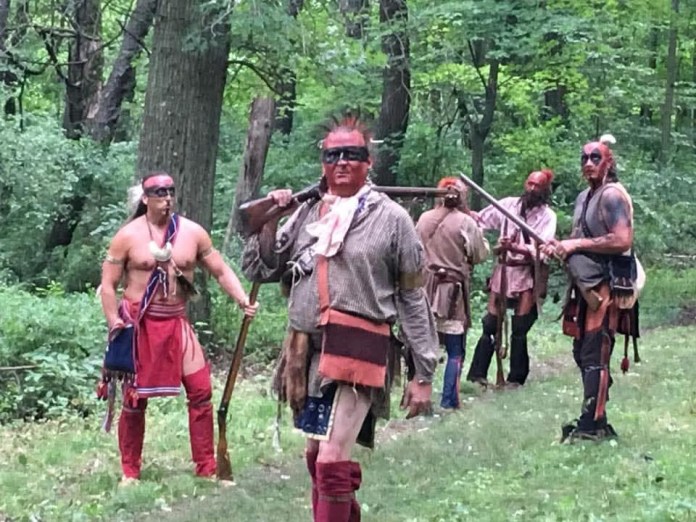
Carried by wampum belts and the teachings of Delaware prophet Neolin — who preached that Native Americans had to cast off British goods, forts, and ways to survive — Pontiac’s message reached the Seneca and Mingo of the upper Allegheny, the Ohio Delaware near Fort Pitt, and the Shawnee and Sandusky Wyandot, uniting rival nations in a shared push to drive the British back over the mountains.
In western Pennsylvania, that coalition was led by Guyasuta, an influential Seneca-Mingo chief who had once guided a young George Washington through the very Ohio Country he now fought to defend.
By late June, Guyasuta’s Mingo were joined by Delaware and Shawnee warriors converging on Fort Pitt. On July 28, roughly 400 Delaware, Shawnee, Wyandot, and Mingo fighters assaulted the fort itself, killing seven inside its walls. Twelve British forts came under attack that summer, and eight fell. But Fort Pitt held.
Swiss-born Bouquet, a veteran of the Sardinian and Dutch armies who’d joined British service during the French and Indian War, had spent nearly a decade winning colonial trust with his knack for adapting European tactics to Indian-style warfare. When Fort Pitt came under siege, he assembled a relief force at Carlisle — light infantry from the Highland 42nd and 77th Regiments and the Royal American 60th — and pushed west with a garrison and a fort full of military stores at stake.
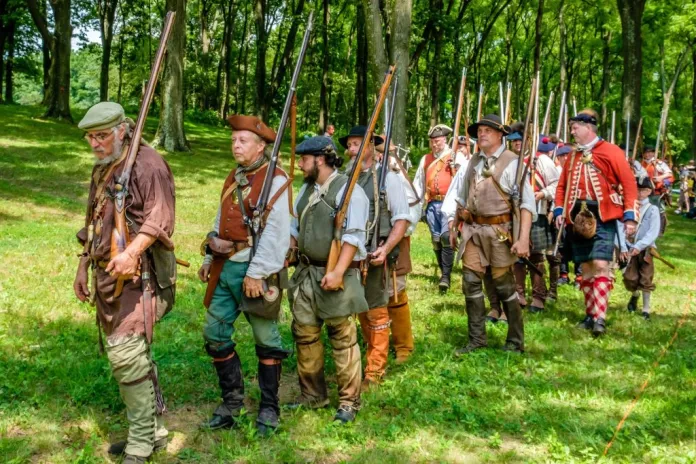
At Fort Ligonier, he made the fateful call to leave his pack horses behind and press on, planning to rest at Bushy Run Station before crossing the treacherous Turtle Creek narrows under cover of darkness.
He never got the chance. Word had already reached Guyasuta that Bouquet was coming, and on Aug. 1, the chief broke off the siege of Fort Pitt entirely to intercept him.
About a mile short of Bushy Run, after a grueling 17-mile march, Bouquet’s advance guard was struck around 1 p.m. on Aug. 5 by a combined force of Delaware, Shawnee, Mingo, and Wyandot warriors. An estimated 300 to 500 fighters all moved through terrain that they knew and the British did not.
SALENA ZITO — ON THIS DAY: THE CROWDS OF PHILADELPHIA, THE GUNS OF NEW YORK
The forward companies drove off the attackers and gave chase, only to discover that the retreat was bait. The moment the pursuit broke off, the warriors turned back, and hidden parties on the flanking high ground poured fire into the column. The British held, charged with bayonets, and cleared hill after hill.
But the enemy simply reappeared elsewhere, until reinforcements let Guyasuta’s fighters encircle the whole detachment, cut it off from water, and strike the provision convoy in the rear. One local account holds that Bouquet and Guyasuta traded pistol shots across the chaos, and neither man hit his mark.
Fighting stopped at nightfall, with the British still holding the field. They stood battered, not broken. The column formed a defensive circle, with wounded and horses at the center, using flour sacks as makeshift breastworks, bracing through a sleepless night for a renewed assault at dawn. Two Delaware chiefs were among the dead, part of an estimated 20 to 60 Native American casualties overall.
Dawn on Aug. 6 is when Bouquet’s reputation was made.
Reading the desperation of his position, he staged a deliberate feint: Two companies appeared to fall back toward the center, as if collapsing. The warriors, reading it as retreat, rushed forward in a disorganized charge — straight into a trap.
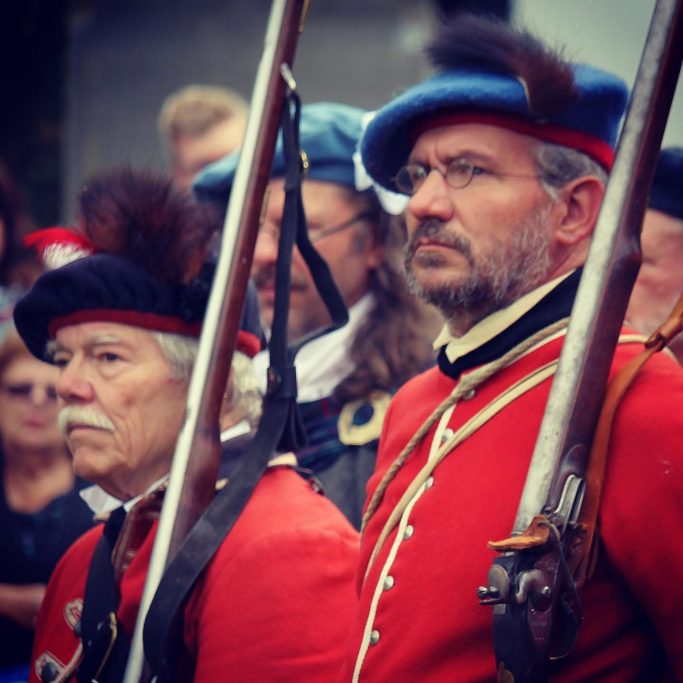
Troops concealed along the perimeter opened their ranks, and the “retreating” companies wheeled and struck the attackers’ flank. A close-range volley and bayonet charge shattered the assault and sent Guyasuta’s coalition fleeing, opening the road to Fort Pitt for good.
Bouquet relieved Fort Pitt on Aug. 20, ending its two-month siege.
News of the victory set church bells ringing through the night in Philadelphia, and King George III sent word of his praise.
Bushy Run didn’t end Pontiac’s War. Fighting ground on in the Great Lakes for two more years before Pontiac made peace at Fort Ontario in Oswego, New York, in July 1766. But it did break the alliance’s momentum in the Pennsylvania and Ohio Valley, forcing Guyasuta’s warriors to disperse and unraveling the siege network that threatened the entire chain of forts and settlements behind it.
Fort Pitt held. Fort Ligonier held. And with them, the fragile line of western Pennsylvania settlement held too. This is why old county histories called it plainly the battle that “relieved the posts of Fort Pitt and Ligonier, saved the western frontier of the Province,” a verdict historians still largely echo.
SALENA ZITO — YOUNG WASHINGTON: HISTORY’S ULTIMATE GRITTY ORIGIN STORY
None of this is a museum footnote anymore. It’s a living exhibit. Bushy Run’s visitor center houses a museum and theater that screens the orientation film “The Road to Bushy Run.” Nearby are self-guided trails that span roughly 90 wooded acres and are restored to feel much as they did in 1763. The grounds here are open 8 a.m. to dusk year-round.
The site has had its own recent fight to survive: an F1 tornado tore through the park in June 2024, sparing buildings but flattening much of the tree canopy — including ground where the ambush and encirclement once played out. This led to the cancellation of that year’s reenactment and months of cleanup by the Pennsylvania Historical and Museum Commission.
On Aug. 1 and 2, 2026 — almost exactly 263 years after Guyasuta broke off the siege of Fort Pitt to intercept Bouquet — the Bushy Run Battlefield Heritage Society will host its annual commemoration, drawing thousands to watch reenactors restage the feint, encirclement, and bayonet charge that broke the siege, alongside living-history camps, museum speakers, and children’s activities. They are all free to attend.
Reenactment coordinator Rob Malley framed the event in TribLive as more than a spectacle. Rather, it’s a deliberate effort to build the next generation of history buffs who might otherwise never encounter a battle that the textbooks largely skipped, let alone the Delaware, Shawnee, Mingo, and Wyandot warriors, and the Seneca-Mingo chief who led them and who fought just as hard to keep it from being fought at all.
There’s a reason a place such as Bushy Run doesn’t just teach history through placards and glass cases and instead teaches it through people willing to sweat through wool regimentals in the August heat, load a flintlock the way it was loaded in 1763, and stand in the clearing where men once fought hand-to-hand for their lives.
Reenactors are living historians, not hobbyists playing dress-up. They translate a paragraph in a textbook into the weight of a haversack, the smell of black powder, the sound of a company wheeling on command. They cannot make the past painless, and they don’t try to.
What they do is make it real enough that a child standing at the tree line can feel, if only for an afternoon, just what it meant to wait through a sleepless night behind a wall of flour sacks.
That is what keeps a battle like this from disappearing into a footnote. Not the marker by the road, but the men and women willing to put the past back on its feet, year after year, all so the next generation doesn’t just read what happened here — they feel it.
MAGAZINE — THE LAST FOUNDING FATHER: HOW JAMES MONROE PAVED THE WAY FOR AMERICA’S GREATNESS
Two hundred sixty-three years on, the forest has grown back differently, and the fort at Pittsburgh is long gone. But for one August weekend a year, the ground still remembers both a colonel who marched into an ambush he didn’t see coming and won by pretending to lose, and a Seneca-Mingo war chief who came close enough to destroying an entire British column that history might have turned out very differently.
Like Thermopylae, it still asks whether courage and skill can outweigh sheer numbers. And here, on a wooded hillside in Westmoreland County, the answer, for one summer, was yes.