
American children are notorious for their finicky and mercurial tastes at the dinner table. Their bland, narrow, ever-shifting palates have driven many a parent to the precipice of despair. One Michigan restaurant has a children’s menu that features the sort of lowest-common-denominator foods that children will eat the most often, including chicken tenders and grilled cheese sandwiches. These offerings come with titles of what many children will blurt out anyway, such as “I Don’t Want It” and “Extra Gross.” The restaurant also offers suggested alcoholic pairings for the parents to help them cope with their children’s predictable and privileged outbursts.
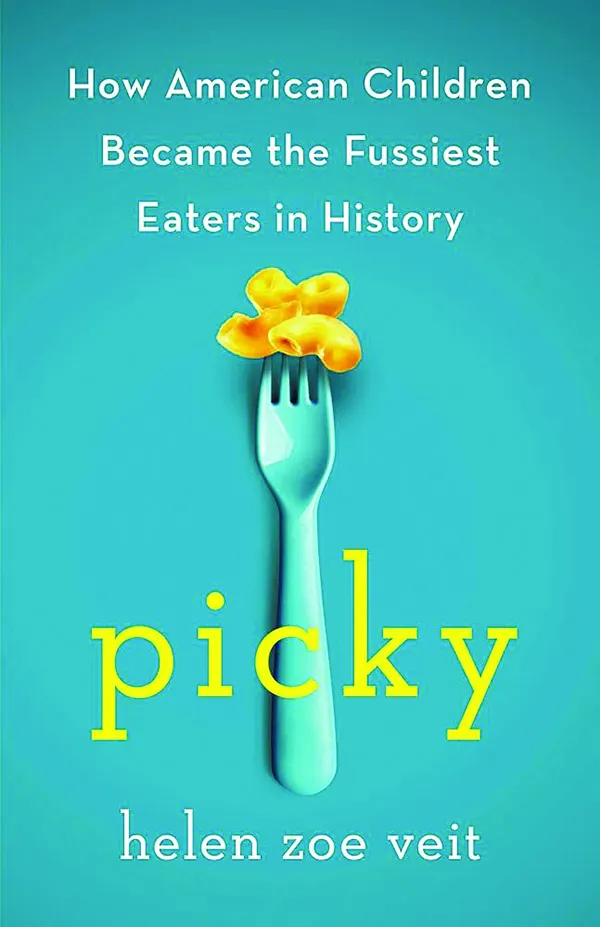
“It’s a joke, but it’s funny because we’re living in a culture where kids often don’t want to eat meals, and parents are exhausted by the struggle,” writes food historian Helen Zoe Veit in the introduction to her short but likely authoritative new book Picky: How American Children Became the Fussiest Eaters in History. Those of us who have the nagging sense that the young didn’t used to be tiny food strikers in training can look to this book for a fuller understanding of how mass food avoidance happened.
The reformers and experts take on a lot of critical ballast in these pages. There were two broad waves of food reformers. The first wave came in the 19th century, from roughly 1820 to 1880, and then the next wave rose early in the 20th century, a product of the Progressive Era. Without solid medical science to guide them, the 19th-century reformers theorized like crazy. They looked at the problems of infant and childhood mortality and schemed not at how to prevent disease or extend medical care but rather at how to improve children’s diets.
One such reformer was William Alcott, a doctor who was related to the author of Little Women and who sounds like a real peach. “Whenever he met a woman whose child had died, he immediately asked her what kinds of foods she had fed them,” Veit writes. Of course, most of these grief-stricken mothers “only stared back at him as if he had asked a rude question” (which he most certainly had). Still, Alcott felt “utterly justified” in repeating it, because, “to him and other nineteenth-century reformers, it was maddening that a veil of politeness was thrown over the parental feeding errors that they believed were killing so many children.”
This first round of American food reformers was diverse, disorganized, and ultimately not persuasive to most Americans of their day, who kept right on feeding their children what they were eating. Still, they laid the groundwork for the next wave of reformers by arguing for the physical and moral superiority of bland diets, for avoiding certain “dangerous” foods, and for having tiered offerings for parents and for their children. They essentially invented the concept of “children’s food” for the next generation to refine.
The early decades of the 20th century in America are known as the Progressive Era because of the reforms and changes that were ushered in. These included the progressive income tax, the curtailment of most child labor, and mandatory school attendance. Many old attitudes toward food were put on the chopping block as well. It must have seemed like a great idea at the time.
Parents turned to the insights of “published experts” in what came to be called “scientific parenting.” Suddenly, what American children ate was a concern that captivated the broader American public. This is the time when “children’s food” went mainstream.
What the second wave of experts had to offer Americans was not uniformly bad advice. This wave was more professional than the first wave of reformers. They really did try to get the science right, and thus, “for all their shortcomings, published authorities possessed some genuinely useful information about nutrients, food safety, hygiene, and human development,” Veit writes. Yet, in hindsight, much of what they were dispensing was “pure baloney.”
Another thing that was baloney was the second wave of reformers’ overreliance on psychology, particularly of the now thoroughly discredited Freudian variety. When children would mount resistance to various foods, this was not seen as a natural part of the learning and weaning process but rather as a manifestation of id, ego, and other mental models then in vogue.
Folks who were into scientific parenting were informed that if they tried to push children too hard to eat the food that had been prepared for them, by hook or by crook, this would trigger negative psychology and the children would rebel. Better to cater to their taste and let them explore and expand their palates over time. This promised expansion did not occur.
The most devastating critique that Veit levels against this approach is to show what it has wrought. Parenting guru Dr. Benjamin Spock was one of the second wave food experts. He thoroughly rejected the idea that sweets should be reserved until after dinner as a carrot for the children eating their food. He also promoted the idea that children should eat or not eat as they pleased.
His advice would prove enormously popular and dead wrong, as we can see from the foods he thought children would just naturally open up to over time. These include beef heart with tomato sauce, salmon soufflé, liver loaf, cream of lima bean soup, and tomato aspic. “These were still normal children’s foods to him,” Veit writes. “But within a few years, thanks in part to Spock’s own advice, those kinds of ‘children’s dishes’ would virtually disappear.”
Spock eventually admitted that he had been wrong in the 1970s, but by then it was too late, as “American ideas about children’s tastes had fundamentally changed. Fast food, processed food, and nutritionally empty snacks and sweets had become mainstays.” That status quo has more or less persisted until the present day.
A GRIM FISCAL ANNIVERSARY LOOMS
The results are what my 5-year-old son Auggie would call, “Um, not good.” Americans are fatter and unhealthier than they can afford to be. There is some evidence that food pickiness is making us shorter by robbing children of enough nutrients at critical points in their development.
This book is not simply an extended harangue. It is meant to tell Americans “how we got into this mess,” and also how to escape. Veit delivers many concrete, simple steps to help unpickify your children. Though note well: Simple and easy are two monstrously different things.
Jeremy Lott (@jeremylottdiary) is the father of two young children, who WILL eat their cauliflower.