
“The world needs to see this with its own eyes.” Those were the words President Donald Trump’s Ambassador to Israel Mike Huckabee shared with me as we walked through Hadassah Medical Center in Jerusalem.
At first, I thought he was speaking about Israel broadly. By the end of our visit, I realized he was talking about something much more specific. He was talking about the difference between reading about a place and experiencing it.
As someone who has spent years working inside major broadcast newsrooms, I know firsthand the realities journalists face every day.
Tight deadlines, limited access, shrinking resources, and relentless turnaround times often leave little opportunity for the kind of immersive reporting that complex international stories deserve. The result is not necessarily inaccurate journalism. Too often, it is incomplete journalism.
After years in network news, I reached a simple conclusion: if we expect journalists to provide nuanced reporting on one of the world’s most complex regions, we have to give them greater access to it. That conviction ultimately led me to create ShieldGiving’s journalist delegations to Israel.
The mission has never been to shape what journalists think or report. It is to create opportunities for them to ask difficult questions, engage directly with people on the ground, and gather the kind of firsthand context that cannot be replicated from a newsroom thousands of miles away.
That is why I intentionally scheduled our most recent delegation to coincide with the JNS International Policy Summit. I wanted participants to hear from as many voices as possible before forming their own conclusions.
Throughout the week, journalists, broadcasters, and digital creators engaged with diplomats, policymakers, military leaders, innovators, and medical professionals representing a broad range of perspectives. I conducted interviews with senior leaders and had the privilege of speaking on the summit’s main stage. The objective was never to elevate one narrative over another. It was to expose participants to as many perspectives as possible because understanding rarely comes from hearing one voice. It comes from listening to many.
Our experience extended well beyond conference halls. We walked the streets of Tel Aviv and Jerusalem, welcomed Shabbat with Israeli families, explored bustling markets, shared meals featuring Israel’s remarkably diverse cuisine, and met with leaders, including George Deek, Israel’s special envoy to the Christian world. Every conversation added another layer of understanding.
Yet, no experience better captured the purpose of the delegation than our visit to Hadassah Medical Center in Jerusalem, one of Israel’s leading academic medical centers, internationally recognized for groundbreaking medical research, innovation, and a philosophy it calls “building peace through medicine.”
Before traveling to Israel, Hadassah President and CEO Ellen Finkelstein described the institution’s mission and spoke passionately about its philosophy of “building peace through medicine.” It was an inspiring idea, but like so many things in journalism, hearing about it was not enough. I needed to see it for myself.
Walking through Hadassah’s halls, I understood exactly what she meant.
Jewish, Muslim, Christian, and Druze physicians, nurses, researchers, and medical professionals worked side by side with one shared mission: saving lives.
Patients were treated not according to religion, ethnicity, or nationality, but according to medical need. In operating rooms, emergency departments, cancer centers, neonatal intensive care units, and research laboratories, humanity came before politics.
That reality deserves far more attention than it receives.
Too often, Israel is viewed almost exclusively through the lens of conflict. Conflict is undeniably newsworthy, but it is not the whole story. Institutions such as Hadassah remind us that another story exists alongside the headlines. It is a story of scientific innovation, medical excellence, compassion, and coexistence lived every single day.
Can one hospital bring peace?
Not by itself.
But it can demonstrate something profoundly important. People of different faiths, backgrounds, and histories can work together every day in pursuit of a common purpose. At Hadassah, coexistence is not a slogan. It is a daily reality.
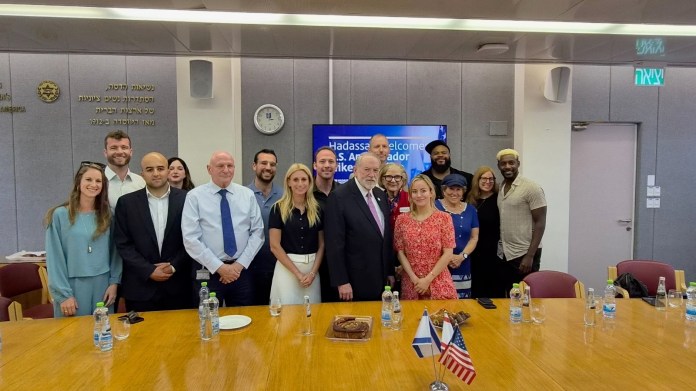
That is why Huckabee’s words have stayed with me.
“The world needs to see this with its own eyes.”
He was not suggesting that visitors come to Israel to have their opinions confirmed. He was making a far more compelling point. No headline, social media clip, or secondhand account can replace firsthand experience.
As journalists, we ask our audiences to value eyewitness reporting, original sourcing, and direct observation.
We should hold ourselves to that same standard whenever possible.
When I think back on everything our delegation experienced, from participating in the policy summit and interviewing leaders to meeting diplomats, policymakers, innovators, and medical professionals, walking the streets of Jerusalem and Tel Aviv, and experiencing the country’s remarkable diversity firsthand, it is Hadassah that stays with me.
Not because it answers every question about Israel or resolves every disagreement, but because it reveals something too often missing from the public conversation: a place where Jewish, Muslim, Christian, and Druze physicians, nurses, researchers, and patients come together every day around one shared purpose, saving lives.
Sometimes the most important story is not found at a podium or inside a conference hall.
Sometimes it is found in the quiet corridors of a hospital, where coexistence is not debated. It is practiced.
In an age of instant opinions and endless headlines, the most responsible journalism still begins the old-fashioned way: by showing up, asking questions, listening carefully, and seeing the story with your own eyes. Hadassah Medical Center reminded me that some of the world’s most important stories are not found in press releases or political debates. They are found in the places where people choose humanity over division, one patient at a time.
FORGET IDENTITY POLITICS. THIS IS WHAT ALLYSHIP ACTUALLY LOOKS LIKE
Huckabee was right. Some stories cannot be fully understood from afar.
They have to be seen with your own eyes.
Ariella Noveck is a journalist specializing in antisemitism and Middle East affairs, with extensive experience covering Jewish communities worldwide.