
As America celebrates its 250th birthday, it only seems right to pay reverence to the gentleman farmer from Mount Vernon who helped make this nation great. This, of course, refers to the “father of his country,” George Washington. He was a highly respected and beloved general, who took a ragtag outfit and turned them into a well-oiled military machine. He was a great albeit reluctant president who always preferred peace and tranquility to the dog-eat-dog world of politics.
Washington exemplified Thomas Carlyle’s “great man” theory as an American hero for his time. He wasn’t perfect — no one is, of course — but he strove for perfection. He served his country with honor, dignity, grace, courage, and, when need be, a strong hand.
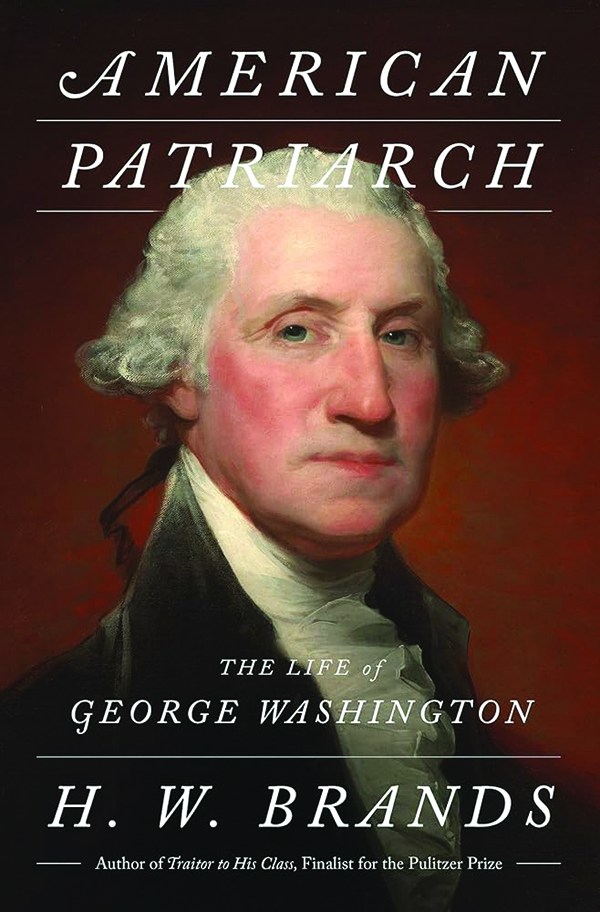
Historian and author H.W. Brands’s new biography of Washington, American Patriarch, is an exquisite examination of this towering presence of early America. The book relies heavily on Washington’s vivid pen-and-ink analyses, including personal letters and journal entries. Readers will walk away with firsthand accounts of what this gentle giant in American politics saw, heard, witnessed, and experienced in his incredible life.
Born into a Virginia family where his father and grandfather “became land rich,” the road that Washington traveled wasn’t necessarily heading to Damascus. He was an “eldest son,” Brands writes, “but of his mother rather than his father. He wasn’t first in line of inheritance, but neither would he be left out. He wouldn’t become the face of the family. He might become a planter, but first he’d have to do something else.” This could have involved studying in England, but his father had died when he was 11 and he remained at home. Washington did have a “facility” for mathematics, which aided his abilities in “surveying land,” though whether or not it would have helped him chop down a cherry tree remains unclear.
All kidding aside, Washington’s “adventure in surveying hooked him on the profession.” Brands notes that it not only “sharpened his ability to tell good land from mediocre and poor,” but “taught him that others were making a lot more money from buying and selling land than he was from surveying it.” He eventually left surveying behind in 1750 and purchased large swaths of the Shenandoah Valley, which made him a very wealthy man.
In between those two life events, he accompanied his half-brother Lawrence on a seafaring adventure to Barbados in 1751 with the idea of curing the latter’s bout of consumption (or tuberculosis). It almost led to imminent disaster. Washington contracted smallpox, and it took almost a month to “regain his feet.” Imagine where America might be if he hadn’t been among the lucky few to survive smallpox.
American Patriarch focuses extensively on Washington’s military career. His first military excursion was in Ohio in 1753. His journal entries often displayed a brutal honesty about the army and its conditions. “The snow increased very fast and our horses daily got weaker,” Washington wrote in one journal entry at their camp in Fort Le Boeuf, which, Brands notes, was “within the drainage of the Ohio River.” The horses, Washington wrote, eventually became “weak and feeble, and the baggage heavy, as we were obliged to provide all the necessaries the journey would require, that we doubted much their performing it.”
Washington’s relationship with an Indian ally, Chief Tanacharison, also known as the “Half King,” was depicted in granular detail by the future president. Preparing to return South, and attempting to encourage the Indians to follow this path, he wrote, “I went to the Half King and pressed him in the strongest terms to go.” French Captain Jacques Legardeur de Saint-Pierre attempted to foil Washington’s plan. He “handed over the guns” to the Indians, Brands writes, and “offered liquor” as an enticement to stay longer. Washington refused to budge: “I taxed the King so close upon his word that he refrained, and set off with us as he had engaged.”
There was even a harrowing incident with the French in 1754. “I fortunately escaped without a wound, though the right wing where I stood was exposed to and received all the enemy’s fire and was the part where the man was killed and the rest wounded,” he wrote in a letter to his younger brother, John Augustine “Jack” Washington. “I can with truth assure you I heard bullets whistle, and believe me there was something charming in the sound.”
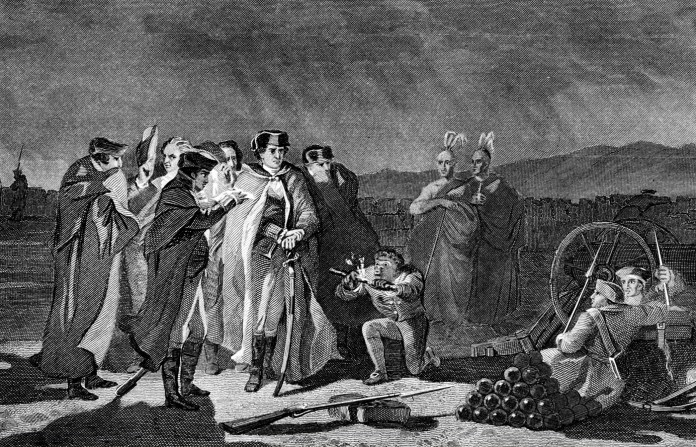
King George II of England, upon receiving word about Washington’s remarks, made this terse retort: “He would not say so, if he had been used to hear many.” Brands pushes back vigorously. “George was wrong,” the author writes. “The monarch misunderstood Washington. The mistake was natural, for most men recoil from war and the danger it entails. Washington was one who didn’t. He was part of the small class who find war invigorating and seductive.”
Washington would soldier on, fight more battles, and struggle with weather conditions that would have proven fatal to lesser men. At Valley Forge, he wrote that “by death and desertion, we have lost a good many men since we came to this ground” but that “contrary to my expectations, we have been able to keep the soliders from mutiny or dispersion.” His wife, Martha, joined him at Valley Forge in spite of the fact that she “hadn’t expected to be an army wife.” There’s also Yorktown, the site of the last great military victory by the Continental Army in the Revolutionary War. Washington was forced to deal with the treasonous actions of Benedict Arnold and Major John Andre during this siege, the latter of which was depicted in a letter to British General Henry Clinton as a “spy from the enemy” and “employed in the execution of measures very foreign to the objects of flags of truce.”
Brands spends several fascinating chapters on Washington’s presidency from 1789 to 1797. He was elected unanimously by the electoral college twice. While there were moments of agreement and disagreement with Founding Fathers, including Thomas Jefferson and Alexander Hamilton, his importance to the young nation was understood. Jefferson, in particular, may have “decried the direction of the country” under Washington but “thought things would get worse if Washington weren’t president.” How so? “Jefferson judged Washington a check on the more egregious aspects of Hamilton’s federalism, and he did his best to get the president to consent to serve a second term.”
Washington did serve a second term, but his thoughts often drifted to Martha, Mount Vernon, and farming. He didn’t want to die in office, and still had things to accomplish in retirement. “Agriculture has ever been amongst the most favourite amusements of my life,” he wrote to English agriculturalist Arthur Young, “though I never possessed much skill in the art, and nine years total inattention to it has added nothing to a knowledge which is best understood from practice.” He had received Young’s books on this discipline, and told the expert “with the means you have been so obliging as to furnish me, I shall return to it (though rather late in the day) with hope and confidence.”
The gentleman farmer would tend to the land until his death on Dec. 14, 1799. The patriarch of America had done his duty to the best of his ability, and a grateful nation saluted the great man and leader who had walked among them.
Michael Taube, a columnist for the National Post, Troy Media, and Loonie Politics, was a speechwriter for former Canadian Prime Minister Stephen Harper.