
In March 1982, about 6,000 people gathered in Detroit to launch what they hoped would become America’s democratic socialist movement. The average age in the room was somewhere north of 60.
The founding chairman was Michael Harrington, a Catholic intellectual who had advised Martin Luther King Jr. and wrote The Other America: Poverty in the United States, the book that helped inspire President Lyndon Johnson’s War on Poverty. He coined a slogan for his new organization that was either a sober assessment of political reality or a subtle admission of defeat, depending on your view: the left wing of the possible.
For the next three decades, the Democratic Socialists of America largely confirmed the slogan’s second interpretation. The organization remained small, aging, and politically marginal. Harrington’s strategy had linked American socialism to the Democratic Party, but the party itself was moving along a different trajectory.
During the 1990s and early 2000s, Democratic administrations became associated with policies many socialists opposed: NAFTA, financial deregulation, and a broader bipartisan foreign-policy consensus. Rather than reshaping the party from within, the DSA spent much of its early existence watching the institution it had attached itself to move in directions it had little power to influence.
Then 2008 arrived, and everything the DSA had been saying about capitalism started happening on live television.
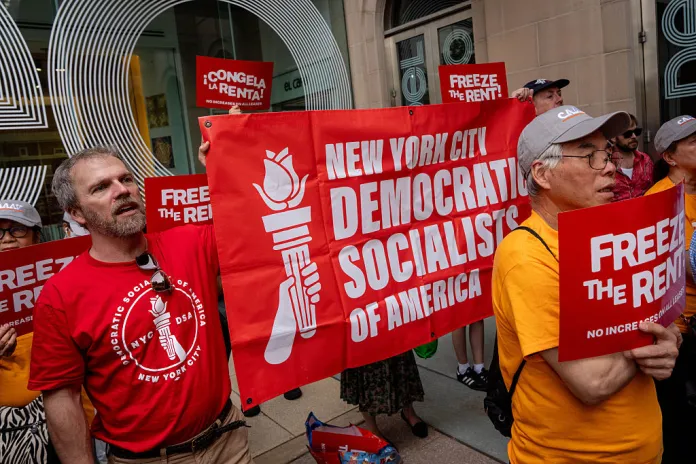
Young Americans watched banks receive bailouts while they graduated into a collapsed job market, carrying student debt that dwarfed anything previous generations had known. Housing costs climbed. Healthcare costs rose faster than wages. Home ownership drifted further out of reach. What had once been abstract critiques of the economic system suddenly felt personal.
By the time Sen. Bernie Sanders (I-VT) launched his 2016 presidential campaign, he was walking into a generation economically primed for exactly his message. The DSA did not create that audience. The financial crisis did.
The organization’s transformation was almost immediate. The average member age dropped from the 60s to the high 20s. Membership surged. The DSA became a landing pad for people activated by the Sanders campaign.
What landed, however, was a very different organization than Harrington had built.
The intellectuals and labor organizers who had spent decades nurturing a small socialist organization suddenly found themselves outnumbered by people whose primary political formation was a presidential campaign. Experienced cadre mixed with first-time activists. Veterans of older socialist projects found themselves sharing space with a generation shaped by social media, student debt, identity politics, and growing distrust of institutions.
Unlike many socialist organizations that fractured through ideological disputes, the DSA itself claims to have been born from a merger rather than a sectarian split, giving it, at least on paper, a stronger instinct for coalition-building than many of its predecessors. Whether that instinct survives the acquisition of power remains an open question. History suggests that power has a way of exposing disagreements that were easier to ignore in opposition.
In the end, the DSA became younger, larger, louder, and more ambitious.
It also became more influential.
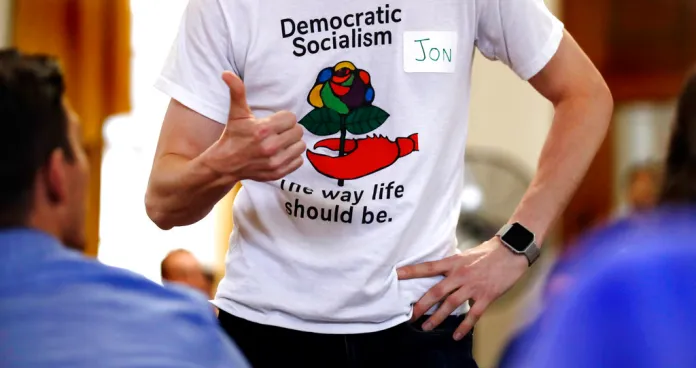
In June 2018, a 28-year-old former bartender from the Bronx defeated a 10-term incumbent in a primary that almost nobody outside New York was watching. Alexandria Ocasio-Cortez’s victory did for the DSA what Sanders had begun. Socialism no longer felt merely morally serious. It felt electorally viable.
Membership continued to climb. New chapters appeared across the country. Candidates openly identifying as socialists began winning local and state offices. The organization expanded beyond activist circles and into electoral politics.
For most of its history, understanding the Democratic Socialists of America was largely an academic exercise. The organization was small enough and marginal enough that its internal debates mattered primarily to its members.
That is no longer true.
Today, DSA-affiliated and DSA-backed politicians hold seats in Congress, influence Democratic primaries, and increasingly compete for executive authority in some of America’s largest cities. New York, Chicago, Los Angeles, Seattle, and Portland have all become arenas where socialist ideas are tested not merely as protest slogans but as governing propositions.
Even Washington, D.C., has now joined the list. Janeese Lewis George, backed by the D.C. Democratic Socialists of America, won the Democratic mayoral primary in June and is widely expected to become the next mayor of the capital. In a city where the Democratic primary is often the election that matters most, her victory represents another milestone in the movement’s evolution from activist organization to governing force.
It also raises the possibility of a highly visible confrontation between a socialist mayor and the Trump administration. Whether that confrontation ultimately occurs is almost beside the point. The fact that it is now plausible illustrates how far the movement has traveled from Detroit in 1982.
The DSA’s significance cannot be measured by membership alone. Its activists cluster in urban districts where Democratic primaries frequently determine who governs. In many of those districts, a few thousand highly motivated volunteers can shape outcomes. Its influence also extends beyond elections into the institutions that produce and transmit political ideas: academia, journalism, nonprofit groups, advocacy organizations, and public policy.
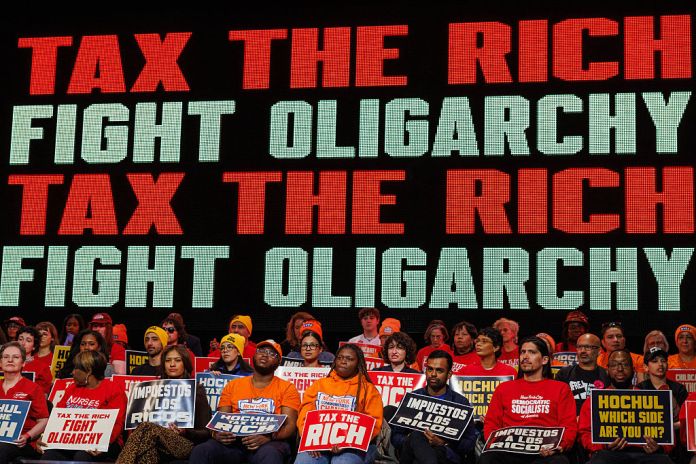
The result is an organization whose reach exceeds its numbers.
Every successful political movement eventually confronts a challenge that opposition movements rarely have to consider. Growth brings influence. Influence brings responsibility. Responsibility requires compromise. And compromise inevitably creates factions convinced that the movement has drifted from its original purpose.
History is filled with movements that discovered governing is harder than protesting, and that success often creates more internal tension than failure. The larger the coalition becomes, the more difficult it becomes to maintain agreement about what victory actually looks like.
The DSA is now approaching that moment.
SCOTT WIENER: WELCOME TO THE PARTY, PAL
The organization is no longer fighting for relevance. It is increasingly wrestling with the consequences of having achieved it.
Whether one supports or opposes socialism is ultimately less important than understanding it. The question is no longer whether the DSA matters. The question is what kind of movement it has become — and what happens when a movement built for opposition begins acquiring power.
The left wing of the possible has never been wider.