
How quickly things change. At the outset of the war in Iran and in the aftermath of the U.S. military incursion into Venezuela, various pundits and partisans played a version of Where’s Waldo? involving Vice President JD Vance while observing that Secretary of State Marco Rubio was virtually ubiquitous. “Vance finally emerges from hiding,” read a Democratic press release back in March, zinging the veep for appearing at a high-dollar fundraiser (as if Democrats never have those).
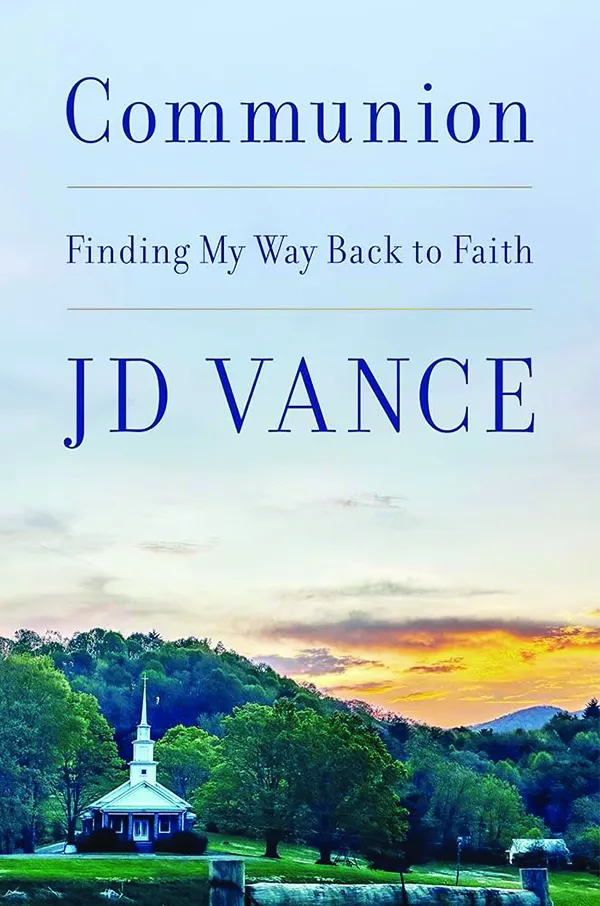
Now, if anything, the opposite is true of President Donald Trump’s top understudies. Vance is out front and center in the Trump administration’s efforts to wind down the war and negotiate a lasting peace deal. But that’s not the only reason the vice president is everywhere: Vance has also been promoting his new book Communion: Finding My Way Back to Faith, a follow-up of sorts to his bestselling memoir Hillbilly Elegy: A Memoir of a Family and Culture in Crisis, this time focused on his religious journey and relationship with God.
That path took Vance from a youthful evangelical Protestantism to an almost complete loss of religious faith and practice in early adulthood and then across the River Tiber to the Catholic Church.
As he often does with his preferred flavor of conservatism or even his conception of the American nation-state, Vance grounds his faith less in abstractions than in rootedness and personal connectedness. “[W]hen Mamaw told me that God loved me, I felt meaningfully altered by that fact,” he writes. “When I scribbled Bible verses on letters to my mother, I did so because I believed they contained wisdom from God Himself. When I prayed every night — for a better future, for stability, for a permanent address, for my family’s happiness — I knew someone was listening.”
“When my great-grandmother lay on her deathbed, her friends and family gathered around and sang church hymns and gospel songs,” Vance continues. He quotes “Amazing Grace” and then adds, “I still have the tape recordings. And I can still hear the voices of great-aunts and grandparents singing those songs to me as a child.”
Perhaps foreshadowing his eventual conversion to Catholicism, Vance writes that his “faith was never just about ideas and intellect. The core of my faith was instead the rituals and emotions of religious practice.” Though few people spend more time thinking about theology and doctrine than Catholic converts.
So why then did Vance fall away? “What paved my path to atheism wasn’t books or ideas,” he writes, “it was sadness and a sense of betrayal.” He likens the temporary loss of his faith to a “divorce” and general unmooring from his upbringing.
Vance says that what brought him back was that after attaining worldly success — educational, professional, and financial — he began to question whether he was actually a good person. (Perhaps it is a good thing he began to contemplate this question before going into politics, a vocation where your opponents will confidently tell you that you are a terrible person, “irredeemable” as Hillary Clinton would say.) He wanted to be a better man and a better father.
It’s a familiar story to me, even if my own journey kept me in a Methodist church like the one famously depicted on Vance’s book cover, rather than a Catholic one (at least for now). At the zenith of my atheism, and the nadir of everything else, I saw the witness of good Christian family members who had something I lacked but wanted. C.S. Lewis and studying came later.
Vance’s marriage to a non-Christian woman of Hindu background adds another interesting dimension to Communion. Usha Vance is clearly the most important person in his life, a valued political counsel and someone who, along with their children, has often humanized him and smoothed his rougher edges. The book is dedicated to her, saying that it was she “who taught me to think on those things that are honest, just, pure, and lovely.”
Is this a 2028 campaign book? Vance surely addresses many political questions and controversies. He once again explains another important conversion in his life: from Never Trumper to sidekick of the president (to paraphrase George W. Bush, Vance misunderestimated Trump). “One of the reasons Donald Trump’s first campaign took the country by storm is that he spoke in visceral, moral terms about basic fairness,” Vance writes. He acknowledges that his infamous remark about “childless cat ladies” was a mistake, both a political misstep and a failure of Christian witness. It may be a result of his third conversion, from political pundit — where provocation can be as important as persuasion, especially in the internet age — to a political practitioner attempting to win elections and subsequently govern in a deeply divided country.

Communion comes amid new tensions between Catholics and evangelicals, who grew increasingly aligned over shared social values during the 1980s and 1990s. Some theological differences have percolated, on Israel and Gaza (where Vance’s conservative detractors often have less charitable explanations of his motives), along with foreign policy more generally, as younger traditionalist Catholics, shaped by missteps in the post-9/11 war on terrorism, begin to succeed Bush-era Catholic neoconservatives. Vance’s Iran diplomacy, eyed warily by Catholics and Protestants alike among congressional Republicans, is clearly influenced in part by his interpretations of just war theory.
Vance has himself quarreled with Pope Leo XIV over the Trump administration’s handling of foreign policy and immigration. One might have found it plausible that Trump and the first American pontiff could become partners in peacemaking (at least I did). That certainly doesn’t seem to be in the cards.
War isn’t the only area where military veteran Vance’s application of Catholic social teaching to thorny political debates might raise Republican eyebrows. He praises Teamsters Union President Sean O’Brien’s speech to the 2024 Republican National Convention, noting that “some GOP donors complained that he sounded like a socialist.”
“The president ignored these complaints,” he adds. “I thought Sean’s arguments echoed a lot of the themes from traditional Christian social teaching.”
“[S]omething happened in the 1990s, as Christian conservatives fused with the Republican Party, is that we were taken advantage of,” Vance writes elsewhere in the book. “Most Christians don’t care about lower taxes for global corporations or institutional investors. They may have been actively hostile to those things.”
Vance does, however, address social conservative discontent with the second Trump administration compared to the first (when Trump had a more conventionally Republican evangelical vice president in Mike Pence). “One of the most challenging issues for Christians is abortion,” he writes. “Roe v. Wade’s demise has revealed the political unpopularity of our position.” He recounts his unsuccessful attempts as a freshman senator from Ohio to defeat a ballot initiative to enshrine legal abortion in the state constitution.
“Given a choice between one of extreme and another,” he writes, referencing the strict pre-Roe abortion law still on Ohio’s books, “the pro-life side got blown out.”
“Some people argue we should give up on the idea of protecting the unborn,” he went on. “I take a different view: Prudence is the better part of virtue. If your political argument on the abortion question — or any other — fails to persuade your fellow Americans, you have to make a better argument.”
You can quibble with these political arguments, as some of Vance’s fellow pro-lifers surely will. His periodic zinging of libertarians on economics, while useful in his calls for a more family-friendly GOP domestic policy, potentially alienates his best allies on foreign policy.
Overall, however, Vance appears to be gently trying to stitch the Make America Great Again coalition back together. Communion is written in a way that is highly accessible to non-Catholic Christians. He subtly goes beyond Trump’s defenses of Christianity’s place in American culture.
When Trump selected Vance as his running mate in 2024, many commentators thought the once and future president was putting a (red MAGA?) hat on a hat. Both had a populist-nationalist spin on conservatism; both sought to appeal to working-class whites despite their own material success and financial comfort (though Vance famously came from a more hardscrabble background, with more direct exposure to the struggles of the Appalachian communities from whence he came).
Instead, the choice of Vance — strongly encouraged by Donald Trump Jr. — represented a kind of doubling down on the Rust Belt. Despite the initial liberal ridicule that he was “weird,” bizarre jokes involving furniture, and a little too fixated on working women, Vance proved a much more effective campaigner and able debater than the Democrats’ everyman VP pick, Gov. Tim Walz (D-MN).
W. JAMES ANTLE III: FOR VANCE, IRAN DEAL PRESENTS OPPORTUNITY AND RISK
The Vance pick also coincided with Trump once again sweeping Pennsylvania, Michigan, and Wisconsin (Ohio wasn’t even a swing state that year, with the Trump-Vance ticket carrying it by more than 11 points), as he did in 2016, but not 2020.
Whether that sets up Vance well to succeed Trump remains to be seen. Communion is preoccupied with other, weightier questions. It’s a compelling read for those looking for the permanent things in a fast-changing world.
W. James Antle III (@jimantle) is executive editor of the Washington Examiner magazine.