
The sacred rituals of the Church of Jesus Christ of Latter-Day Saints were once as secretive as the Skull and Bones. White-shirted missionaries knocked down doors across the Third World, Book of Mormon in hand, but the logistics of what came later were largely kept a mystery to outsiders.
Closed-door “endowments” with hands appearing behind veils. Handshakes and “tokens.” Mysterious garments worn under everyday clothes. It all occurs in temples with their doors firmly locked to those who were not initiated into the enigmatic religion.
On a recent trip to Salt Lake City, I learned first-hand that the era of secrecy is over. It ended partially by necessity and partially by choice. And while the doors still aren’t open, the church is cracking as many windows as possible.
The LDS church has accepted that in the age of the internet and the hidden camera, there is no way to be an organization that is both massive in membership and taciturn in its rites. If the world is prying into what we do, the church seems to think, we might as well set the record straight.
“Certainly, the temple has undergone a shift in how we talk about it,” Jasmine Rappleye, a prominent LDS influencer, told me in her office at the Ancient America Foundation. “There’s some things we promise not to disclose, but everything else in the temple points to the Lord — and so we can talk about the general principles of and purposes of the temple. And the church has become more open about the temple for many, many years.”
Rappleye traces this movement back to at least 2019, when David Bednar, a member of the Quorum of the Twelve Apostles, acknowledged at the general conference that “many church members are unsure about what appropriately can and cannot be said regarding the temple experience outside of the temple.”
Up to this time, discussion of what happens in an LDS temple was taboo. But Bednar asserted that while members should not “discuss the holy information that we specifically promise in the temple not to reveal,” they “may discuss the basic purposes of and the doctrine and principles associated with temple ordinances and covenants.”
Now, most LDS members speak about the distinction between practices that are “sacred” and those that are “secret.”
Take, for instance, the ubiquitous holy garments worn by members of the church under their day-to-day clothes. Discussion of these used to be off-limits, and many believers were not made aware of them until becoming a full-fledged member of the faith.
Yet nowadays, believers discuss them openly. The LDS church has published informational videos about those garments on YouTube — something that many people I talked to remembered as a watershed moment. LDS influencers even share garment style tips on Instagram.
“A lot of people are trying to figure out, ‘OK, what kind of modern clothing can I wear that isn’t showing my sacred religious clothing?’” said David Snell, an LDS apologist who makes videos defending and debating the faith. “So you have a lot of creators, generally female creators, that are out there saying, ‘Look at this garment-friendly outfit that I have.’”

Much rejoicing was had in 2024, when the LDS church announced it was authorizing the use of sleeveless temple garments for believers in hot climates. I was told that they sold out the second they arrived at the stores in Salt Lake City and remained a coveted item for months as overheated templegoers bought them up in bulk.
Michael Goodman, a professor of religious education at Brigham Young University who speaks with the soft compassion of a world-class grandfather, told me that he doesn’t feel threatened by the sunshine illuminating what goes on within the temple. But he does fear how those outside the faith could misunderstand or misconstrue his faith’s rites and rituals without the requisite knowledge for appreciating them.
“I don’t feel, personally, that any approach to speaking truth is going to negate or cheapen the ultimate truth,” he explained. “I do believe that there are things which are not meant for public consumption, just like there’s things in a family life that are not meant for public consumption. And those I would be cautious about.”
Goodman notes that my question about the symbols on LDS garments is one of the few that believers generally don’t answer for an outsider. But in the classroom at BYU, where over 99% of the students are members of the church?
“If I can take my freshman class and walk them through what some of those symbols mean and where that clothing comes from and how it’s symbolically connected to Exodus or whatever it is — I don’t think I’m hurting anyone,” he contended. “I think I’m actually helping them have a greater depth.”
This is what believers seem to be weighing when they delineate between the “secret” and the “sacred.”
I did not go to Salt Lake City to “EXPOSE!” or “UNCOVER!” LDS practices. As a religious person, I had no interest in cheap sensationalism. There would be no point to such a mission anyway. As one LDS believer I met noted with frank honesty, anything one could want to know can be found online — whether the LDS church wanted it out there or not.
The internet is replete with grainy hidden camera footage inside LDS temples. An entire cottage industry of “ex-Mormons” has emerged in which former believers divulge every ordinance and ritual they can remember as forbidden knowledge.
Temple exposés vary in tone. Some seem to come from a place of sincere hurt — former believers who feel genuinely slighted and betrayed by their past faith. Others seem to come from a place of gleeful spite, as if cashing in on their LDS upbringing for attention.
The pivot away from secrecy seems to be a conscious effort to push back on narratives that frame the church as a cult or otherwise nefarious organization. And Latter-Day Saints are going to extreme lengths to further this sunshine campaign. For example, because nonbelievers such as myself cannot enter an actual temple, the church offers a recreation of temple facilities open to tours.
The LDS headquarters sent an employee to walk me through this visitor center, which provided access to mock-up facilities such as the Baptistry, the Celestial Room, and the Sealing Room. In case you’re wondering, it lined up with the information and videos shared by former believers. No funny business on their part!
But what about the most serious secrets? What about the secrets that the LDS church has explicitly kept under wraps, even among its own members, for decades?
There is one ceremony, one supreme ritual, that was once legendary in its capacity to nuke any conversation with LDS authorities. A religious rite so esoteric and guarded that even LDS believers who had been in the church for decades did not know about its existence.
It is the Second Endowment — the secret, final ordinance of the LDS church that confers the fullness of the priesthood upon the recipient and makes their “calling and election sure.” In layman’s terms, unless you do something such as apostatize or murder, you’re guaranteed to become a god in the hereafter and spend eternity with your family reigning over your own planet as the kings and high priests of the Almighty.
It is conducted in the most sacred space on Earth for LDS believers — the Holy of Holies, a sanctuary in the center of the Salt Lake City temple. It is given exclusively by invitation from the prophet and president of the church himself. For most of LDS history, few believers ever even glimpsed the door to this room. Fewer still ever went inside.
One of the only confirmations the LDS church ever offered that the Second Endowment exists was an old teacher’s guide for instructing incoming believers on temple rituals. It ominously warned: “Do not attempt in any way to discuss or answer questions about the second anointing.”
Several interviews exist with former high-ranking LDS members who claim to have received this ordinance, but I was curious what the popular sentiment about it was in this age of sunshine and transparency. I was cautioned by well-informed sources that I could not, under any circumstances, bring this up in conversation, let alone during interviews. I was told in hushed tones that it would burn goodwill and torch my entire reporting trip to even hint at the subject.
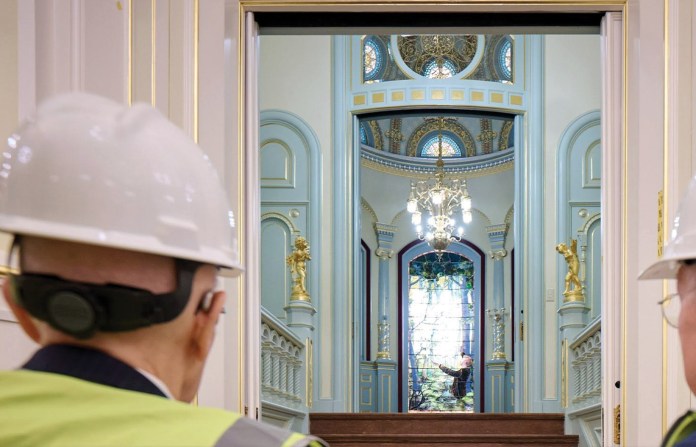
Imagine my shock when I saw that the official media department of the LDS church had shared a photograph of President Dallin Oaks in a hard hat, looking directly into the Holy of Holies — the first publicly known photograph of that sanctuary since the early 20th century.
Imagine my surprise when I found a video of Rappleye reacting to that photo, speaking openly about the Second Endowment. Imagine how confused I felt as I cautiously brought this subject up with LDS believers, and they nodded and shrugged and told me that they know about it but haven’t thought that hard about it.
“I saw [the LDS church posting the Holy of Holies on Instagram] as a cool historic moment that would probably draw a lot of attention, and with that, there often comes negative attention or questions about what the function of that room is or former members of the church wanting to bring it up for shock factor or criticize it,” Rappleye told me. ”I figured I could contribute positively to the conversation and circumvent some questions or some criticisms by just having a little bit of an explanation of what that room’s purpose is and why I believe [the Second Endowment] is a beautiful part of our temple liturgy.”
With the demystifying of the Holy of Holies and Second Endowment, it seems that the LDS church has sincerely chosen to let go of its secrets. Former LDS believers tell me the church of today and the church they left are so radically different in this regard that they hardly recognize it.
Andrew Reed, a smartly dressed professor of church history and doctrine at BYU, told me he fears the one thing lost in this transparency campaign is “reverence for sacred things.”
“There are things that are important enough, holy enough, kind of meaning-making enough for us as individuals and as Latter-Day Saints that we don’t want to just put those out in the world to normalize it or to kind of create a kind of profane version of it. Because we would lose its significance.”
Reed compared the experience of the church’s rituals and ordinances to the love he has for his children. He can try to explain that love in words — written out on a page. He could, hypothetically, take photos of his religious observances and show them to the world and explain what they mean. Both would be lackluster and insufficient to the experience within him.
“If we normalize every single thing — so that there’s no mystery to it, or there’s no miracle behind it — I think we would lose something about why it matters,” he told me, his hand tapping the table with each keyword.
“If you were to take, for example, the resurrection of Jesus and offer a physiological explanation of how that happens, even if it was just marginally a scientifically defensible position, have you eroded from the Catholic mind or the Christian mind, something of the significance of that event?” he continued.
If one is looking for a cheap thrill, learning about religious ceremonies they’re not supposed to see, one can search for LDS ordinances on YouTube. One has been able to do that for over a decade.
PENTAGON UPDATES RELIGIOUS CLASSIFICATION LIST AFTER SPARKING CRITICISM FROM MORMON SENATORS
If one wants to shock and scandalize believers with forbidden questions they’re not supposed to have access to, there aren’t too many opportunities in Salt Lake City anymore. People talk about their sacred garments now. You can tour a Celestial Room. Influencers talk about the Second Endowment on social media.
For better or worse, the Latter-Day Saints are giving the curious masses what they want.
Timothy Nerozzi is the senior foreign affairs reporter for the Washington Examiner and a 2025-26 Robert Novak journalism fellow at The Fund for American Studies.