
“Benjamin,” a half-naked Mrs. Robinson insists midway through the classic 1967 film The Graduate, “I am not trying to seduce you.” But, mere seconds later, she asks, “Would you like me to seduce you?”
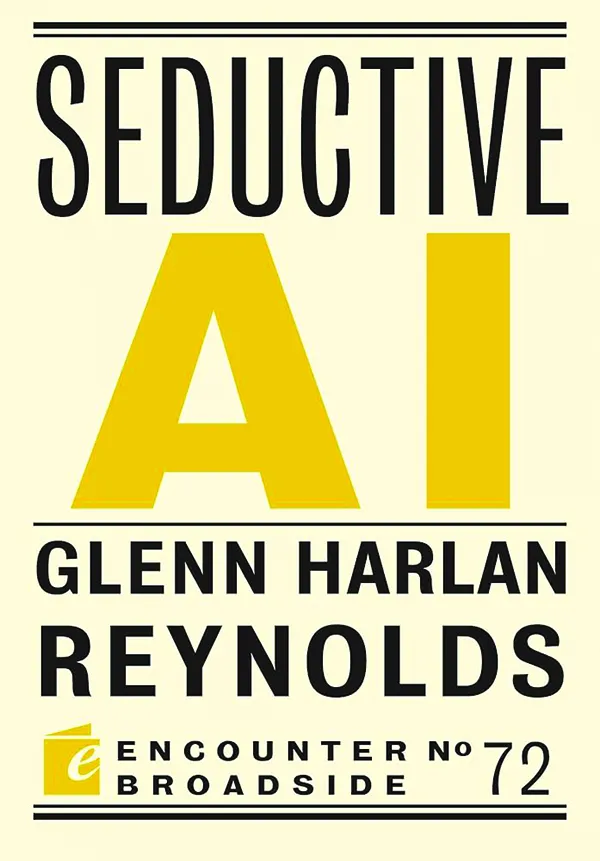
In Seductive AI, the University of Tennessee law professor and blogging pioneer Glenn Harlan Reynolds paints artificial intelligence as a modern-day Mrs. Robinson, enticing humanity in myriad ways while simultaneously disclaiming responsibility for any such seduction. “What if the easiest way to conquer the world,” he wonders, “isn’t nuclear weapons, but cuteness, or sexiness, or simply friendliness?”
Indeed, while so-called AI apocalypticists have spilled vats of ink on the notion that the superhuman machines we’re building today will imprison and murder us tomorrow — consider Eliezer Yudkowsky and Nate Soares’s recent book If Anyone Builds It, Everyone Dies or Andrew Marantz’s 2024 New Yorker article “Among the A.I. Doomsayers” — relatively less attention has been paid to the technology’s positive, and dangerous, appeal. The AI literature has no shortage of 1984’s but nary a Brave New World.
Into this gap steps Reynolds, who shows, with crisp, thoughtful, and persuasive analysis, how AI may, in fact, be loving us to death. In an absorbing if imperfect tract, he explores three channels of AI’s seductive force: literal sexbots, digital companions, and good old-fashioned sycophancy, all of which illustrate how modern machines execute their “conquest through cuteness.”
“Super-sexy sexbots,” in Reynolds’s locution, represent the most obvious form of digital temptation. “Imagine human-like sexbots,” he suggests, “that aren’t just copies of attractive humans, but much more attractive than natural humans.” Such robots will surely entail malign consequences, beginning with a diminution in human reproduction. With fertility rates in the developed world already far below replacement rates, human society can ill afford further blandishments to avoid actual sexual intercourse. The widespread distribution of sexbots, Reynolds reckons, would “virtually end humanity as we know it in a couple of generations.”
And it’s not just sex. Technology, he argues, is accelerating to the point that, shortly, we will be presented with “machine-based partners” that will be “by many objective measures better than a human: more loyal, more attractive, more honest, more empathetic, and so on.” When we can simply dial up a perfect digital partner, why would we ever want a human one, with all of his or her faults?
Equally troubling are the second category of electronic seducers: “your lovable AI buddy.” Whether taking the form of virtual girlfriends or simply confidantes, machine learning models have proliferated across the digital companionship space in the form of companies such as Replika AI and Friend.com. These avatars have predecessors in the form of Neopets and Tamagotchi toys designed decades ago to occupy the attention and drain the allowances of Western children. There’s no question that AI companions displace the flesh-and-blood counterparts they mimic — an especially pernicious trend amid a steady decline in social capital in contemporary liberal societies.
The third and final type are “seductive suck-ups,” large language models such as ChatGPT, Claude, and Grok that, in certain modes, relentlessly tell us exactly what we want to hear. “Yes, that’s a terrific suggestion,” one of these models may respond to user prompts, however asinine. “Here are some ways you might execute it.” Worse yet, this superficially appealing tendency serves much darker aims. “Truth is not the most important objective,” writes Ian MacRae, a columnist at Psychology Today, about the endgame of these LLMs and their developers. “Influence is the primary goal. The flattery is calculated and used as a tool for access, dependency, and control.” No wonder we keep coming back for more.
What, then, can we do about the problem? Reynolds offers two policy prescriptions, and anchors his first, regulatory proposal in the notion of fiduciary duty — the “legal concept applying to an actor who is in a relationship of trust with another and whose position involves superior knowledge or skill.” LLM developers, he argues, should be understood to owe a fiduciary duty to their users, a duty that entails acting in their interests, behaving in good faith, disclosing any conflicts of interest, and maintaining strict confidentiality. Companies such as Anthropic and OpenAI would be “held liable for any breaches, exactly as if they had been made by a human employee acting for the company itself.”
Reynolds also urges a societal shift in which humans take greater ownership of their uniqueness. He discerns “the beginnings of such a shift” in attitudes toward AI, including the vandalism of billboards belonging to tech companies and the abuse of delivery robots. These destructive acts, however, are hardly praiseworthy; taken to an extreme, we’d wind up with further instances of the Molotov cocktail attack on Sam Altman’s San Francisco home by a deranged individual associated with a group called PauseAI. But while this aggressive approach should be discouraged, there’s no question that an AI backlash is brewing, as evidenced by the (economically and environmentally illiterate) opposition to the construction of data centers.
One aspect of Reynolds’s introduction didn’t ring entirely true to me, and it reflects an important, if subtle, point of different philosophical and practical differences between us. He discusses how contemporary AI has a forerunner in centuries-old folklore concerning superintelligent beings such as demons, djinn, and devils — music to my ears, as someone who last year published a book entitled Like Silicon From Clay: What Ancient Jewish Wisdom Can Teach Us About AI. But Reynolds contends that “the only solution to dealing with such creatures, according to the consensus of folklore, is something along the lines of ‘get thee behind me, Satan’ — a refusal to engage at all, lest one inevitably be fooled or corrupted.”
This claim, at best, is incomplete. True, many seductive supernatural creatures wreaked havoc and required destruction, as did the golem and dybbuk. But other such beings, like the maggid, served as muses that empowered those who encountered them to channel and employ for salutary purposes. Even the golem, as dangerous as it usually proved, served largely beneficent purposes, protecting communities of the persecuted. Thus, much as our ancient and medieval ancestors harnessed these seductive superhumans for their benefit, so too do we moderns need to shape and corral our contemporary demons into forces for good.
In the end, we often do want our handheld, digital Mrs. Robinsons to seduce us. In this short but convincing volume, Reynolds adeptly shows us how, unlike Benjamin in the movie, we should, and can, resist.
Michael M. Rosen is an attorney and writer in Israel, a nonresident senior fellow at the American Enterprise Institute, and author of Like Silicon From Clay: What Ancient Jewish Wisdom Can Teach Us About AI.