
Hamas’s massacre and hostage-taking on Oct. 7, 2023, marked the start of a bloody war against the terrorist group in Gaza and a broader regional conflict over the Middle East’s balance of power. Far from the battlefield, accusations of colonialism, apartheid, and genocide against Israel have reached a fever pitch. Liberal essayists, representatives of international institutions, and student activists have repeated these charges until what began as a set of provocative claims has hardened into a type of received wisdom.
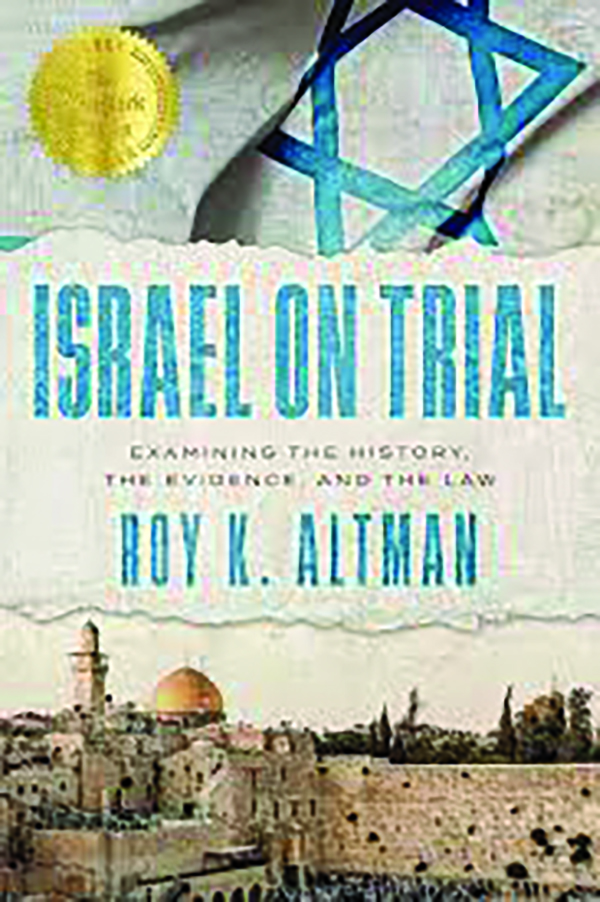
Enter United States District Court Judge Roy K. Altman, who responds to these accusations with a pointed question: Are they true? His new book, Israel on Trial: Examining the History, the Evidence, and the Law, is his answer. It is a valuable contribution to the public discourse, both for its substance — the book is dense with history and analysis — as well as its author, who is a well-respected jurist. At the same time, the book is not without its shortcomings. Altman sometimes argues past his opponents, and at other times overstates his case.
Altman begins with the claim of colonialism. His argument is straightforward: Israel cannot be a colonial endeavor since the common thread across all forms of colonialism, whether extractive or settler, is that the population is foreign to the land. And since Jews are indigenous to the land of Israel, they, by definition, cannot be foreign to that land. To prove his point, Altman takes the reader through an impressive array of evidence, including archaeological findings dating back to the Merneptah Stele (a 13th-century BCE Egyptian inscription that constitutes the earliest known references to Israel), DNA studies linking contemporary Jewish populations to ancient Levantine peoples, and the continuous historical presence of Jews in their land, documented across millennia of recorded history.
While these pieces of evidence are certainly necessary, they are not sufficient. To respond to the modern, sophisticated anti-Zionist, one must also address the more practical version of the colonialism charge: Whatever the ancient origins of the Jewish people, the Zionist movement and state of Israel, as it actually exists, is settler colonial in nature. Altman’s extensive archaeological and historical proof does not touch on this. A more direct rebuttal comes from writer Adam Kirsch in his slim 2024 volume, On Settler Colonialism. Kirsch demonstrates that Israel lacks every structural feature that defines colonialism. It has no mother country “obligated to defend it, or to accept millions of refugees if it falls”; and its founders did not come in search of a higher standard of living, or with a foreign power financing it, or to economically exploit the native population. Above all, its population had and has nowhere else to go. This is why any strategy to inflict terrorism on Israelis, a la Frantz Fanon, until they leave the land will never work.
Altman’s chapters on the legal legitimacy of Israel, the reasons Palestinians have not obtained an independent state, and claims about pre-Oct. 7 Gaza are solid corrections to hostile dogma. He goes through the legal criteria not only to demonstrate Israel exists as a legitimate state today, but that its founding was legally legitimate as well. In the following chapter, he documents six proposals to create two states that were rejected by the Palestinians “not because they disagreed with this or that provision of any proposed deal, but because they have always insisted on a single Arab state.” And in the subsequent chapter after that, he debunks the claims of Gaza as an “open-air prison” prior to Hamas’s Oct. 7 terrorist attack.
Altman then arrives at the much-discussed claims of apartheid and genocide. On apartheid, Altman correctly notes that Arab Israelis have equal political and social rights under Israeli law. Their representation in higher education and politics demonstrates this. But, again, the more relevant charge, made by those who approach these questions with nuance, concerns the West Bank. The key point here is that the Oslo Accords, which both sides signed, placed Palestinian population centers under Palestinian Authority governance. Thus, it is no scandal that they are not citizens of Israel or given all the rights it entails. After all, they are governed by a different political entity. At the same time, this is too clean a story. In the West Bank, attacks on Palestinians by Hilltop Youth lawbreakers are acknowledged across the Israeli political spectrum as a real problem that the current government does not care to address in a serious way. This does not amount to apartheid, but reality is messier than Altman lets on.
On genocide, the gravest of all the charges, Altman is on solid ground. Whether Israel’s military campaign has been, on the whole, moral or strategically wise is a separate question entirely. The relevant question is whether it meets the legal definition of genocide. He starts with that definition. Under International Court of Justice precedent, genocide requires specific intent to destroy a people, either in whole or in part, as such. The pattern of conduct must be “such that it could only point to the existence of such intent.” Reports from Amnesty International and Human Rights Watch sidestep this. The former wrote that the standard yields “an overly cramped interpretation of international jurisprudence,” but it is clear Israel’s actions could reasonably suggest intentions other than genocide.
For example, one could point to the fact that Israel was attempting to root out Hamas, which had built hundreds of miles of tunnels beneath a densely populated Gaza and embedded its military infrastructure within civilian institutions. Hamas engineered a battlefield where any regime-change war would exact a horrifying civilian toll. In Altman’s words, “Hamas has deployed the cheat codes on the laws of war.” This does not give Israel carte blanche or rule out evidence of violations of the laws of war, but civilian suffering is not itself proof of genocidal intent.
That said, the weakest parts of the book come when Altman overstates his case. He argues Palestinians are the real colonialists and foreigners in the land of Israel, despite DNA studies showing they are also indigenous to the Levant. He argues that Palestine is not a legitimate state, without distinguishing between the descriptive claim that Palestine does not currently fulfill the criteria for statehood and the normative claim that there should not be a Palestinian state. And he argues that Jordan is already a Palestinian state. These arguments fall outside the scope of what Altman set out to prove and make the book feel more partisan than it needs to be.
DOES ISRAEL NEED AMERICA’S HELP?
There are also a few misstatements of fact. For example, in the introduction, Altman claims it was illegal for a Jew to enter Gaza or the Palestinian areas of the West Bank before Oct. 7. But no law makes it illegal for a Jew qua Jew to enter Area A of the West Bank. The Israel Defense Forces issues a standing directive prohibiting Israeli citizens from entering due to safety hazards, but that is a different claim. Later, Altman writes that the massacre of 69 Jewish residents of Hebron occurred in 1936, when in fact it occurred in 1929.
Altman is at his best when he sticks to what he set out to prove, and at his weakest when he insists on proving more, or proving something disconnected from the central claims being made by Israel’s detractors. Readers willing to engage these questions honestly will find the book worth their time.
Jack Elbaum is a public opinion researcher in Washington, D.C.