
There are a disproportionate number of dental offices in western Hungary because Austrians frequently cross the border for cheap, high-quality tooth care. About 15 minutes from a border post that is about as relevant today as it was at the height of the Habsburgs, you can tour “the Hungarian Versailles,” the ancestral home of the Eszterhazys, arguably the most powerful family of the old empire. In the late 18th century, Joseph Haydn was a composer in residence for several decades. More recently, Soviet troops sacked the place on their implacable march into the heart of the Third Reich. The palace, now a walkable museum, has several old wooden doors crudely stenciled with hammers and sickles.
Decline, fall, and the uncomfortable sense that some things lost will never be recovered are enduring themes in Central European literature because reminders of past glories (and horrors) are right down the street from a dentist offering a two-for-one deal on crowns. Enter Nelio Biedermann, a Swiss university student and the newest contender for the title of Next Great European Novelist. His second novel, Lázár, chronicles the tumultuous history of a noble Hungarian family, not all that different from the Eszterhazys, from the end of the 19th to the middle of the 20th century.
The success of an ambitious historical epic written by a young male author is worth remarking upon. American publishers have decided that men no longer read books. It is an open question whether the lack of prominent male authors is a cause or a consequence of this state of affairs, but the ambitious, tortured, and unapologetically masculine novelist, once a fixture of the American literary scene, is suddenly in short supply.
European readers, by contrast, still have plenty of time for difficult men, whether it’s France’s Michel Houellebecq, Norway’s Karl Ove Knausgard, or Britain’s David Szalay, all of whom deal in typically masculine (and even conservative) themes. These figures coexist more or less comfortably with the likes of Sally Rooney and Elena Ferrante. American readers and editors should take note: A more ecumenical, less politically fraught approach to literature is possible.
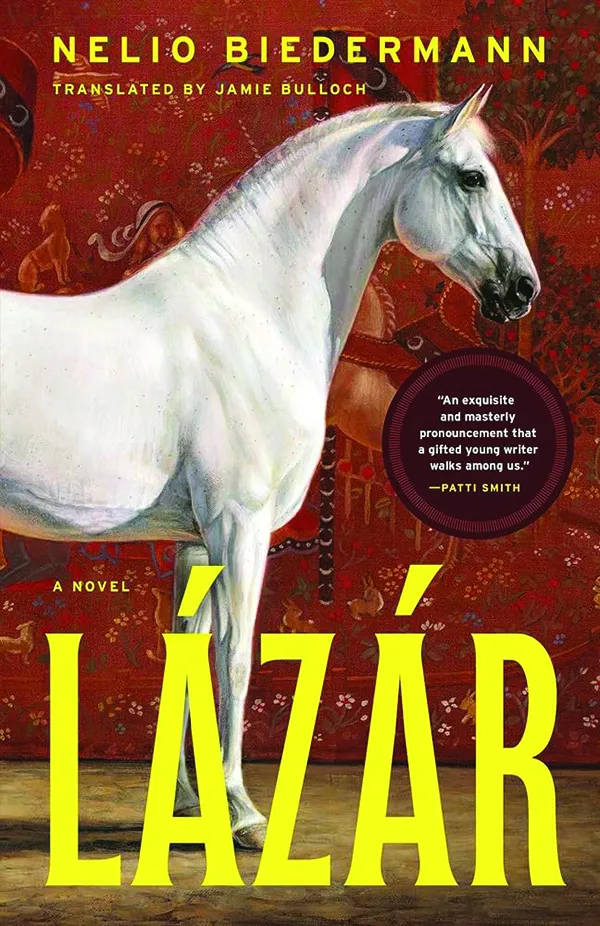
Biedermann has turned to a familiar setting for this early effort. Though Swiss, he is descended from an aristocratic Hungarian family who left their ancestral home, fleeing war and revolution. The late Habsburg era and its aftermath have long fascinated readers, scholars, and aspiring novelists, even those who lack Biedermann’s pedigree. Decline and fall is an irresistible theme for literary types, and the empire’s final decades make for a colorful blend of old-fashioned pageantry and modern problems.
Because he is Swiss and writes about one family’s changeable fortunes, Biedermann inevitably gets compared to Thomas Mann, but the great Habsburg novelist Joseph Roth and the Hungarian-Serbian-Jewish-Montenegrin-Yugoslav writer Danilo Kis are better reference points. Like Biedermann, these authors dealt with the overlapping identities of late 19th- and early 20th-century Mitteleuropa. Length is another reason the long-winded Mann is a bad comparison. Lázár is a brisk read, coming in at just over 250 pages. Kis, a master of the short story, and Roth, who chronically frustrated his editors by turning in short manuscripts, were also economical writers. And, also like those writers, Biedermann blends fantastical elements with real history.
The book begins with the birth of Lajos von Lazar, a boy with translucent skin, at the family estate in southwestern Hungary. There is a dark, mysterious forest, a half-mad uncle, and a seemingly ageless servant. This fairytale atmosphere gradually recedes as the empire collapses and the ugly forces of fascism, nationalism, and communism are unleashed across the region.
Biedermann doesn’t spend much time on the late Habsburg era or the empire’s traumatic disintegration during World War I. This is a curious choice for a story about Hungarians — the end of the old regime, which stranded friends and family members on the wrong side of newly created national borders, is still modern Hungary’s defining catastrophe. Rather than dwell on this earlier period, though, Lázár is more preoccupied with the rise of Nazism and its consequences for the titular family.
Perhaps this is because Biedermann’s own family arrived in Switzerland after World War II. But the book’s focus on the Nazis (and, later, the Soviets) suggests that Biedermann doesn’t trust his readers to know much European history beyond the basics, a tendency that bleeds into his prose. At one point, he baldly writes that Lajos’s father’s descent into alcoholism embodies the decline of the Habsburgs, something that most readers should be able to grasp without the authorial prodding. After the old baron dies in a drunken fall, we are told that his son Lajos “learned early on that as a man you kept your emotions to yourself or dealt with them with alcohol.” These declarations are the literary equivalent of getting hit in the face with a two-by-four.
There are a few possible reasons for this clumsy approach to storytelling. The first is that Biedermann is a young writer who is still finding his footing. The second is that something was lost in translation from the original German. The third is that Biedermann is all too aware that his readers lack the patience and subtlety for anything but the most direct approach. The book brings to mind repetitive Netflix dialogue written for phone-addled viewers.

Lázár also indulges in some weird 21st-century fixations. Not one but two characters are sexually aroused by feet. Lajos’s mother secretly cuts herself. After seeking counseling to overcome a brutal instance of childhood bullying, Lajos speculates that Hitler might have benefited from talking to a good therapist.
DOES HUNGARY’S OPPOSITION HAVE ORBAN ON THE ROPES?
Other parts of the book are more compelling. The Holocaust in Hungary is especially tragic because the country was home to the most assimilated and successful Jewish community in Europe. I won’t ruin Lajos’s response to the Nazi occupation for the reader, but it captures the dilemma faced by so many decent people of the time, who weren’t fascist sympathizers or virulent antisemites but weren’t particularly heroic, either.
Lázár’s unlikely success began in Germany, where it spent 29 weeks on the bestseller list. Much of this enthusiasm stems from a very Teutonic strain of historical nostalgia. It is not very politic for Germans to lament the passing of the Third Reich or Wilhelmine Germany or even the numberless German communities in Eastern Europe that were destroyed after World War II. But the tale of a noble family’s survival amid the disintegration of the Habsburg Empire is a safe way to mourn a bygone era of German cultural, political, and economic dominance across Central and Eastern Europe. Biedermann is a promising young author, but his book’s unlikely success is about more than the trials and tribulations of the Lazars. It’s a lament for the passing of Mitteleuropa.
Will Collins is a lecturer at Eotvos Lorand University in Budapest, Hungary.