
As we mark the 250th anniversary of the Declaration of Independence, our historical memory naturally favors the loudest, most immediate demonstrations of 1776. We celebrate the public readings in city squares, the ringing of bells, and the toppling of King George III’s statue in New York. Yet the most enduring lesson for a country once again debating the role of institutions comes from a colony that chose restraint over spectacle.
The Revolution’s most instructive narrative regarding the preservation of ordered liberty belongs to a colony that backed independence early and unequivocally but chose to remain officially silent until October 1776: Connecticut.
This brief delay was a profound reflection of Connecticut’s deep commitment to lawful process. It offers a timeless reminder that the legitimacy of self-government depends not just on the principles a people espouse, but on the institutional channels through which they act.
In June 1776, the Connecticut General Assembly unanimously instructed its representatives to the Second Continental Congress to declare independence from Great Britain. The instructions explained that because the British king and Parliament were “endeavouring to reduce us to an abject surrender of our natural and stipulated rights,” separation was essential for the “security and preservation of [our] just rights and liberties.” Connecticut’s representatives, Samuel Huntington, Roger Sherman, William Williams, and Oliver Wolcott, complied and signed the declaration on the colony’s behalf.
Connecticut was the only colony where the declaration was not immediately proclaimed by the government or celebrated with official fanfare. Elsewhere, the document was read from courthouses and printed by executive order. Connecticut’s official response, by contrast, was remarkably restrained.
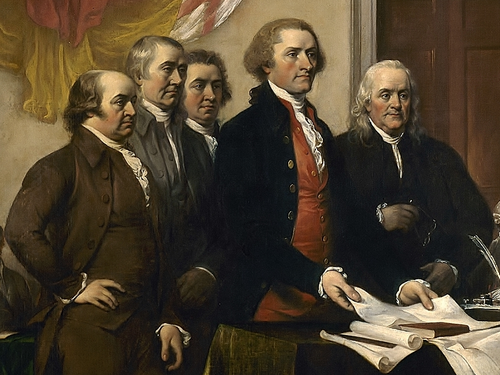
The governor and Council of Safety records from July 11, 1776, note simply: “The Declaration of Independence was received in a letter to Governour Trumbull from Col. Trumbull.” A July 12 minute reported that Congress required the text “to be duly published,” but a July 18 entry shows the matter was quietly “referred to the General Assembly, at their next session.”
The Connecticut Gazette printed the declaration as news on July 12 without comment, but the state government itself remained officially silent. Only in October did the General Assembly formally convene, approve the declaration, and resolve that civil government would continue under the colony’s 1662 royal charter.
This hesitation was structural, not ideological. Connecticut was fully committed to the patriot cause, reliably supplying troops, provisions, and political leadership — Sherman even served on the Committee of Five that drafted the declaration.
The delay reflected Connecticut’s unique governmental framework. The July 6 letter from Continental Congress President John Hancock arrived while the General Assembly, the colony’s ultimate governing authority, was in recess. Connecticut’s leaders believed that only the full legislature could act on so consequential a constitutional matter.
That deference reflected a political culture that prized stability and legal continuity. Unlike neighboring colonies that hastily dissolved their governments to adopt new constitutions, Connecticut’s leaders were determined to preserve their existing legal framework until the General Assembly constitutionally decided otherwise. The colony was not slow to embrace liberty — it was careful to do so through proper institutional channels.
MIKE PENCE KEPT HIS OATH. MANY IN MAGA NEVER FORGAVE HIM
As we commemorate the 250th anniversary of our founding, Connecticut’s quiet delay underscores a truth often lost in modern political discourse. The American Revolution was not merely a struggle for independence — it was a struggle to establish and maintain a constitutional order. Waiting for the General Assembly to reconvene was itself an expression of political fidelity.
At a moment when Americans across the political spectrum question whether institutions still matter, Connecticut’s example reminds us that liberty depends not only on the ends we pursue but on the means by which we pursue them. Fidelity to lawful process is its own form of patriotism.
Scott Douglas Gerber is a scholar at the University of Mississippi’s Declaration of Independence Center and a fellow at the National Association of Scholars. His most recent book is the award-winning novel The Trafficker.