
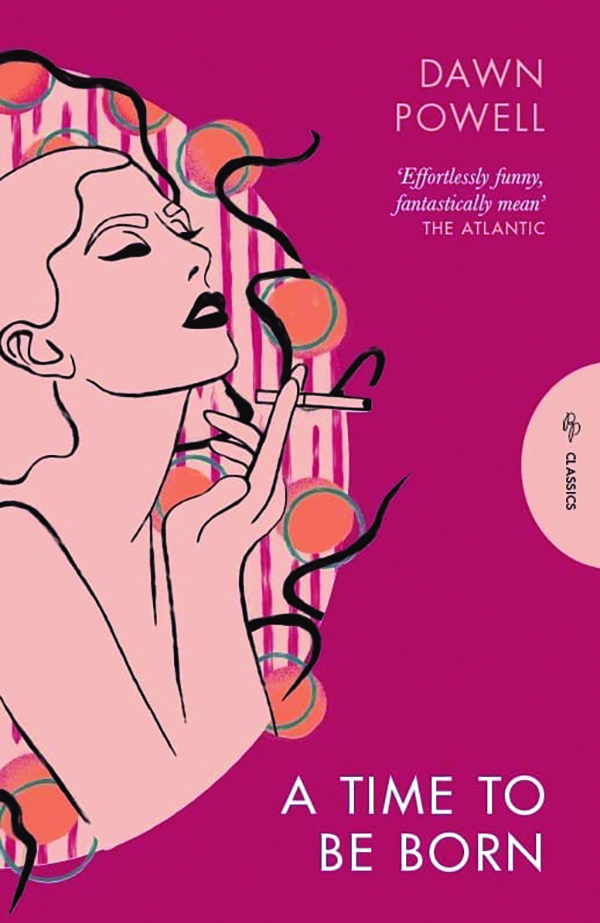
“The reputation of Dawn Powell may be doomed to a perpetual state of revival,” wrote John Updike in the New Yorker in 1995. The underappreciated and somewhat forgotten American novelist, playwright, and screenwriter, who was born in Ohio in 1896 and died in 1965, may not have found the fame she deserved during her lifetime. Reading A Time to Be Born, the 1942 novel that is being reissued this month by Pushkin Press Classics, it is impossible not to root for the 2026 revival to be the one that sticks. The book is such a masterclass in satirical fiction that after reading it, your first question is something like: Why have I never heard of her? Your second is sure to be: Where can I find more?
Upon further examination, you learn that Powell was a writer’s writer who earned the full admiration of her contemporaries and some of those who came after. In 1944, Ernest Hemingway named her his “favorite living writer,” according to an entry in Powell’s published diaries. In 1987, Gore Vidal spent a year reading her out-of-print and out-of-fashion works, and wrote the definitive essay of her career in the New York Review of Books, in which he concluded:
“Dawn Powell never became the popular writer that she ought to have been. In those days, with a bit of luck, a good writer eventually attracted voluntary readers, and became popular. Today, of course, ‘popular’ means bad writing that is widely read while good writing is that which is taught to involuntary readers. Powell failed on both counts.”
Powell’s characters are ghastly — every single one. But they are also relatable in ways that compel you to really look within. For example, consider the heroine, or villain, or queen bee, or awful shrew, in A Time to Be Born: Amanda Keeler Evans — whom, Vidal alleges, is based upon Clare Boothe Luce — is a character so utterly worthy of existing. She is from Lakeville, Ohio, and after a rough childhood, she climbs the ladder all the way to the top of Manhattan society, along the way capturing the heart of Julian Evans, a newspaper publisher who is key to her life goal of being a famous writer who doesn’t really write — that’s left to the help, her personal secretary Miss Bemel, who studiously eavesdrops on the Evans’ important guests and uses it as fodder for Amanda’s articles. An injustice, maybe, but one that Amanda believes is owed to her: “the tragedy of the attic poets, Keats, Shelley, Burns, was not that they died young but that they were obliged by poverty to do all their own writing.” Bemel hardly minds about this arrangement: “Miss Bemel was allowed to insult at least a dozen people a day, and to enjoy immeasurably the spectacle of her superiors fawning over her as representative of a great name.”
As much as rich, stuffy Manhattanites are an easy target for satire, Powell assures that there’s enough sour grapes to go around. Vidal, in his article on Powell, remarks that “class is the most difficult subject for American writers to deal with as it is the most difficult for the English to avoid.” Well then — Powell is positively English. The tasteless rich are presented as opportunistic bloodsuckers whose distaste for Adolf Hitler comes not from his evil, but from his “wrong-fork-using” and lack of manners: “How could anyone respect people who are willing to be led by such an upstart as Adolf Hitler? The Kaiser was at least a gentleman, an aristocrat, but imagine letting yourself be led by a common hoodlum.” The war is an opportunity, child refugees are the latest accessory that everyone needs to be seen with, and relationships are judged only by how much they propel you forward. It is worth mentioning here that Clare Boothe Luce — writer, politician, diplomat, and the spouse of Henry Luce, founder of Time and Life magazines — had a string of lovers that included Joseph P. Kennedy and Roald Dahl.
The poor and pitiful aren’t spared either. Vicky Haven, an old friend from Amanda’s past who ends up in New York only as cover for Amanda’s lurid affairs, is clumsy and honest and very clearly out of place. Her midwestern manners are poked fun at. She doesn’t know how to dress or act, and not in a cutesy way. Then there’s Ken Saunders, a kind of failed hack, a tortured genius, who is at Amanda’s beck and call throughout her marriage to Julian. He is thoughtfully pieced together, and clearly, in Powell’s mind, integral to showing that New York’s corrupting influence spares no one. What feels different here is that Powell, an Ohio transplant herself, refuses to sentimentalize her fellow country bumpkins. The midwestern arrivals are usually framed as the moral antidote to Manhattan’s rot — they are kinder, simpler, and harder working. But Powell spares them no snark. She understands that provincialism is its own kind of blindness, and she refuses to patronize her roots by defending them.
A Time To Be Born thus feels vital and contemporary in 2026, because Powell’s targets have never really gone away: the women famous for being famous, the public branding, the insecure newspaper publishers, and the underlings behind it all. And that brings us to the joy of the gossip session — a joy not unrelated to what it’s like to read Powell.
BOOK REVIEW: LOUISIANA VISIONS, THROUGH WROUGHT-IRON SCROLLWORK
Sometimes you’ll read something so juicy, so scathing and catty, that you can’t help but plunge yourself into it as if you were engaging in a gossip session with your cattiest friend in your local bar. I will admit that I am worse than most when it comes to this; I can gossip about people I barely know with such fervor you would think I were talking about a close family member or a longtime friend. Once, at a bachelorette party, a friend mentioned a friend of hers who suspected that her friend’s fiance may be gay. I think about this story all the time — and every time I see said friend, I am sure to ask, “Well, whatever happened with so-and-so?” I am so many degrees of separation from these people that I often have to remind her who and what I am even asking about.
The pleasures of this kind of gossipy vice and the pleasures of a book like A Time to Be Born are one and the same. We devour books like this for the same reason we dish dirt with our friends on people we don’t even know: because human behavior, especially the petty, striving, and status-obsessed, is endlessly fascinating. Powell knows that, and doesn’t lecture us from a moral high ground. Instead, she invites us into the bar, pours a stiff drink, and points a manicured finger at the ridiculous spectacle of it all.
Kara Kennedy is a contributing writer at the Free Press and writes for the Daily Telegraph.