
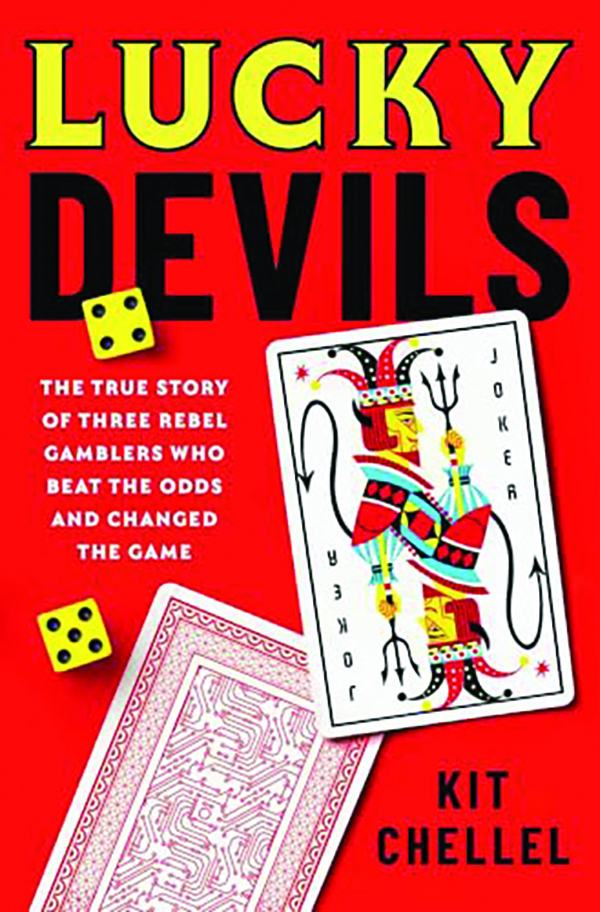
Pick up a copy of Kit Chellel’s recent book Lucky Devils, and you might think you’re getting “the true story of three rebel gamblers who beat the odds and changed the game.” That’s the subtitle, after all. But what you’re actually getting is a stranger, sadder, more fascinating book about obsession for obsession’s sake, a history of early computing, and the brutal optimization of gambling over the last 50 years.
Those rebels referred to on the cover are Bill Nelson, Bill Benter, and Rob Reitzen. All three men are young, intelligent, and determined to avoid the corporate rat race by any means necessary. They also share a peculiar outlook: Their interest in getting rich takes a distant second place to their interest in trying to solve an unsolvable problem — namely, how to find and exploit patterns in seemingly random games. Naturally, our protagonists find their way to Las Vegas. It’s the mid-1970s, and their passion is blackjack.
Computers make an entrance almost immediately. A major inspiration is Edward O. Thorp, author of Beat the Dealer: A Winning Strategy for the Game of Twenty-One, and the first man to use a computer to analyze probabilities in card games. That computer was an IBM 704, “a clunking behemoth powered by vacuum tubes, a magnetic drum, and punch cards” that took up “as much physical space as the average Buick.” One of the delights of Lucky Devils is watching technology evolve as the years go by. Before you know it, Bill Nelson is using a Hewlett-Packard programmable calculator to run regression analyses on a casino-grade roulette wheel crammed into his apartment. Incredibly, his months of grinding pay off: the Hewlett-Packard, with enough memory for a whopping 50 lines of code, helps Nelson gain a 24% advantage in the game Albert Einstein once called “unbeatable.” All he has to do is walk into a casino with a different computer strapped to his leg. This one, built and programmed by a friend, was “about the size of three paperback books taped together.” Thus, the entire scheme is made possible by the flamboyant fashion trends of the time: Nelson conceals his device under an outsize pair of bell-bottoms.
Details like that have Lucky Devils begging for the cinematic treatment. (Somebody get Aaron Sorkin on the phone.) As the book wends its way through the 1970s, ’80s, and ’90s, it’s almost comical how naturally the book follows the beats of your average rock-and-roll biopic. Do our heroes start out as scruffy but determined young men, short on money but full of dreams? Rob Reitzen’s story begins with a car crash, a bottle of painkillers, and too much time on his hands. Do their early successes and subsequent windfalls lead to an ever riskier, more debauched lifestyle? Bill Benter moves to Hong Kong to bet on horses with his partner Alan Woods, an Australian with a Rolls-Royce he never uses, a hot tub he only uses nude, and a fondness for entertaining; one partygoer recalls “arriving to see two naked women writhing on a glass table. ‘Are you decadent?’ Woods would ask his guests, which was his code word for sexually liberated polyamory.” And does the story end with everyone older and richer but nostalgic for the early days? Benter ends up winning $16 million on a single race — an 8,000% return on investment — yet still finds himself reminiscing “about his days as a card counter, cruising around in Reitzen’s rust bucket of a car.”
Ultimately, Lucky Devils is worth your time if only because there are more salacious, outrageous anecdotes than one book review can cover. I haven’t mentioned Mike Kent, an overweight, asthmatic, “fiercely competitive” computer engineer who used his company computer to rank “the strength of teams in the corporate softball league.” What was he supposed to be doing with the company computer? Nothing much. Just, you know, testing the safety of nuclear reactors. Nor have I mentioned the time Nelson won $2 million in a single, 16-hour roulette session or the time Benter lost $6 million on racing because he forgot to cash his winning tickets on time.
In gathering and arranging these facts into a coherent narrative, Chellel proves to be the right man for the job. It will come as no surprise to learn that he’s a journalist by trade. The book is meticulously researched, and he’s great with a turn of phrase. For example, as the 1980s roll in and our protagonists begin to make real money, he writes that “they saw themselves as Gordon Gekko and Robin Hood rolled into one, stealing from the rich to give to themselves.”
Chellel also makes the wise decision not to end the book with anyone’s final triumphant score. Instead, the narrative just … keeps on going, right up to the present day. This leads to the sadness I mentioned up front. Bill Nelson gets rich exploiting minuscule flaws in roulette machines, but the machines inevitably get fixed, and he eventually becomes disgusted with the Darwinian back-and-forth and leaves the life behind. Bill Benter gets ludicrously rich using computers to analyze horse racing, but by the present day, the algorithm seems to mostly run without him, and he dedicates his time to his wife and charitable giving. Rob Reitzen, who was always the odd man out, more beer-chugging bro than number-crunching nerd, creates an online poker empire whose eventual undoing occurs when the bots he trained make the game unplayable for any human participants.
As the book ends, one gets the sense that the world these men helped bring about — one where gambling is not about heedless risk-taking but mathematical optimization — is a world they never could have gotten started in. Everything is too well-understood now; there’s nothing left to exploit. But for all I know, another generation’s story could be currently taking place. Nobody thought blackjack, roulette, and horse racing could favor the little guy until a handful of brilliant young men proved otherwise.
Alexander Kaplan is a writer based in Richmond, Virginia.