
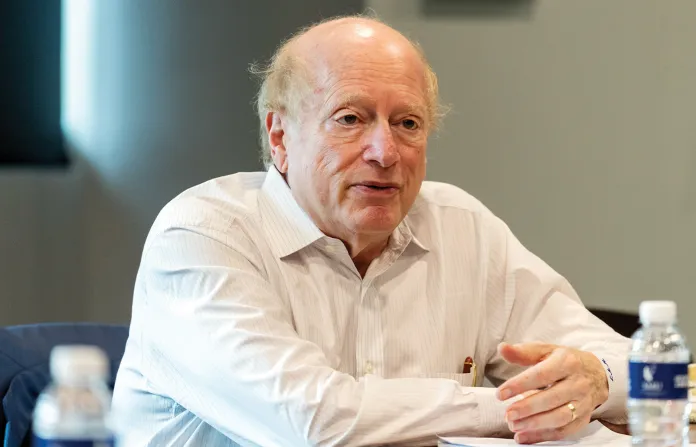
This has not gone the way Mark Tushnet thought.
Ten years ago, when Tushnet, then a professor at Harvard Law School, sketched out a vision of a resurgent left-wing jurisprudence in a post on the legal affairs blog Balkinization, he was imagining a much different future. A better, brighter one.
Hillary Clinton was on her way to the White House, and marching in the triumphal procession she’d lead to Washington was to be a phalanx of left-wing lawyers and academics. They were only awaiting their summons, a summons Tushnet prophesied would arrive in just a few months. After so long in exile, legal progressives were on the threshold of the promised land.
Canaan has never seemed further away. It was Donald Trump to whom voters granted the power to transform the judiciary, which he did by appointing three judges to the Supreme Court and hundreds more to the courts below it. The conservative legal movement’s decadeslong quest to push the courts to the right, which would have ended in ignominy and failure had Clinton won, culminated in triumph instead.
Whatever Tushnet foresaw a decade ago when he proclaimed the legal left’s deliverance at hand, what he and they got, to borrow his own words, was another forty years “wandering in the wilderness.” They knocked, but it was the legal right that was invited into paradise. Ever since, progressives have been divining ways to conquer Eden before their forty years are up, or, failing that, set it ablaze and burn it to the ground.
A delphic oracle
Tushnet’s immodest proposal carried the innocuous title “Abandoning Defensive Crouch Liberal Constitutionalism.” Yet there’s nothing anodyne about its contents. Suffused with an almost Nietzschean ressentiment, it reads like the testament of a man swearing revenge on his tormenters. There is a kind of malevolent glee to it, as though Tushnet were reveling in the images in his head of the punishments he would mete out to his persecutors as he put finger to keyboard.

Retribution can only be meted out by those willing to stand up for themselves. Tushnet sounds a clarion call for progressives to throw off the cautious, furtive posture to which they have long resigned themselves. His constitutionalism doesn’t cringe or cower. It is muscular, strident, and confident.
Both it and its adherents must, in a word, be “aggressively liberal” and proudly so. Only then can they, as their first order of business, compile “lists of cases to be overruled at the first opportunity” because “they were wrong the day they were decided.” Furthermore, liberals should unflinchingly exploit ambiguous precedents to advance their cause now that they no longer have to fear reversal by the Supreme Court.
Tushnet viewed the Left as victorious in the culture wars, and another principle of rampant constitutional liberalism is to treat its losers like a vanquished power. Having been defeated in “the battle over LGBT rights” and refusing to trade recognition of them in exchange for greater protections for “religious liberty” (the scare quotes are his), social conservatives, Tushnet elaborates, are in no position to demand quarter, let alone terms. So he will offer none, and instead “take a hard line” against them because “they lost, we won.” After all, such an approach worked just fine with Nazi Germany and Imperial Japan, whereas playing nice with the Confederacy didn’t.
At a more symbolic level, Tushnet urges the legal left to adopt role models more appropriate to its new, emancipated state. David Souter and John Marshall Harlan are out. In are liberal lions William Brennan and Thurgood Marshall. Last, the legal left should stop catering to Anthony Kennedy, the Supreme Court’s swing justice. With progressive constitutionalism ascendant, his vote isn’t “so crucial any more.” Thus, there’s no longer any need to succor him. Much liberal legal scholarship was geared towards trying to read his mind. “Stop it,” Tushnet urges. Or as he bluntly put it: “f*** Anthony Kennedy” (but without the asterisks).
To describe Tushnet’s diatribe as instantly infamous would be an understatement. It caused a sensation, especially on the right. Ryan Anderson of the Heritage Foundation charged him with “embodying a particularly vicious form of illiberal liberalism.” Rod Dreher categorized his approach as “Leninist.” Preventing Clinton from turning Tushnet’s fantasies real, Dreher wrote, was “the only good reason I can think of to vote Trump this fall.”
Millions of conservatives agreed. According to exit polls, voters who named the Supreme Court as their most important issue broke decisively for Donald Trump, who warned hesitant Republicans they had no choice but to vote for him because of it. Then-Solicitor General Donald Verrilli’s response to Justice Samuel Alito in the Obergefell gay marriage case oral argument that an institution that opposed gay marriage could lose its tax-exempt status encapsulated the looming threat that galvanized social and religious conservatives to back Trump, who was neither. Verrilli’s answer, averred David Bernstein of George Mason University, “cost his party the election.”
The judicial consequences of that loss, anyone on the Left will tell you, were dire. Conservatives’, not liberals’, lists of cases to toss out that were wrong when they were decided would be getting a hearing at One First St., NE. They would be exploiting precedents to their advantage. Tushnet had set the rules, and it was only fair for conservatives to play by them. Hence, asserted Georgetown law professor Randy Barnett in his own blog post, the time was nigh for “Abandoning Defensive Crouch Conservative Constitutionalism.”
Faced with the prospect of being stuck in their crouch for decades more, many on the Left decided that if they couldn’t control the Supreme Court, they’d crush it instead. Which is why progressives ever since have been trying to resurrect one of President Franklin Delano Roosevelt’s most unpopular ideas: court-packing. Repackaged in the inoffensive garb of “court reform,” drastically altering the court’s structure has become a popular virtue to signal to the Democratic Party’s base. But no matter what it’s called, the result would be the same: the end of the Supreme Court as we know it.
Packtacular
It seems unthinkable, had Democrats not felt themselves so cruelly denied control of the Supreme Court by a man so many of them loathe, that court-packing would have become a live issue for the first time since FDR’s benighted gambit. As it was, they latched onto it for the same reason he did: to obliterate the biggest obstacle in their way. Extreme as it is, this response isn’t illogical. The court’s rightward shift represents a grave threat to the left, and that shift shows no signs of abating. Neutralizing the threat by neutralizing the court, therefore, makes sense. Especially as today it is more conservative than it has been for nearly a century.
There’s no greater example of this change than the 2022 Dobbs decision, which reversed Roe v. Wade and overturned the constitutional right to abortion. Yet while that much-despised ruling gave it new urgency, the push for court-packing began in 2018 when Kennedy retired, letting Trump replace him with Brett Kavanaugh, solidifying Republicans’ grip on the court and incinerating whatever was left of Tushnet’s glorious vision.
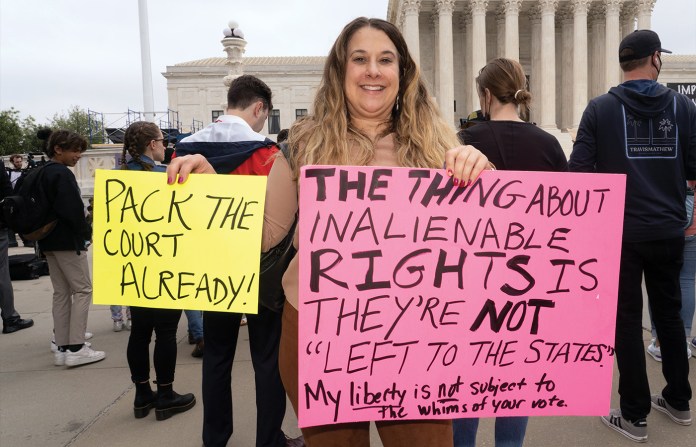
Left-wing outlets published justifications, defenses, and rationalizations of the idea with the speed of a newspaper rushing out an extra edition in a 1930s movie. Packing the court was necessary, swore a writer in Jacobin after Kennedy announced his retirement, because its conservative majority “poses a barrier to the agenda of even the most left-leaning president and Congress,” one which “must be confronted head on.” Shortly after Kavanaugh was confirmed, a political scientist organizing a group (of whose advisory board Tushnet was chairman) to lobby for court-packing told Slate that “Republicans stole the courts and Democrats must ‘un-steal’ them.” A fellow political scientist had written in the Washington Post just after Kavanaugh was nominated that Democrats would be magnanimous and not pack the courts if “the illegitimate Neil Gorsuch resigns” and Republicans agree to a constitutional amendment limiting justices to one 18-year term.
Court-packing was such a hot topic that it became part of the 2020 Democratic presidential race. Bernie Sanders and Pete Buttigieg unveiled plans for adding justices. Joe Biden, who had declined to take a position throughout the campaign, pledged a couple of weeks before the election that if he won, he’d establish a bipartisan commission to scrutinize the entire federal judiciary. The commission’s report, which refused to take a stand on court-packing, was released in December of 2021 and promptly stored next to the Ark of the Covenant.
The clamor for court-packing crescendoed after Dobbs was handed down a few months later. But even once it died down and the topic went out of sight for the rest of Biden’s term, it never went out of mind for the Left.
Hence in 2023, the Brennan Center for Justice, a liberal legal institute at New York University’s law school, published a report advocating one of the more popular models for restructuring the Supreme Court: single 18-year terms with the president appointing a justice every two years. A year later, Demos, another liberal think tank, reiterated the need for court reform in a white paper. It broached again such modifications as jurisdiction-stripping and requiring a supermajority to overturn laws, spoke favorably of term limits, all while insisting on the necessity of the biggest change of all: increasing the number of justices. Only if Congress fulfilled its “duty to address the Supreme Court’s blatant misuse of power” could there be an end to “the Roberts Court’s issuance of radical rulings that gut our democracy, roll back fundamental rights, and push a far-right agenda.”
Demonstrating an appetite for punishment transcending the gluttonous, in mid-2023, Tushnet co-authored an open letter to President Joe Biden urging him to tell the Supreme Court to pound sand. That was its gist, though its language was more diplomatic. Biden, Tushnet proffered, should adopt “popular constitutionalism,” a theory that holds that when the president disagrees with the Supreme Court’s interpretation of the Constitution, he can offer and follow his own. Embracing popular constitutionalism was no substitute for the permanent solution of expanding the court, but for the time being, it “could help contain the grave threat posed by MAGA justices.”
Biden himself finally came around on court-packing. A month after he bowed out of the 2024 presidential race, he called on Congress to pass legislation implementing eighteen-year terms. He also put his imprimatur on another idea beloved of progressives, a binding ethics code for the Supreme Court enacted by statute.
President Donald Trump’s reelection didn’t stop Democrats’ pursuit of court-packing for whenever they next control Congress and the presidency. Eric Holder, the former U.S. attorney general turned progressive factotum, stated on a podcast last fall that if Democrats regain power in 2028, they must consider reforming the Supreme Court because it is a “broken institution.” Graham Platner, the Nazi-tattoo-sporting, oyster-farming front-runner for the Democratic nomination to challenge Sen. Susan Collins (R-ME) in this year’s Maine Senate election, has expressed his preference for “stacking the Court” and impeaching Justices Clarence Thomas and Samuel Alito on multiple occasions.
So too has veteran Democratic strategist James Carville, who believes Democrats should couple court expansion with measures like making the District of Columbia and Puerto Rico states to lock in their power. Even one-time conservative luminary Bill Kristol, now a card-carrying member of the Resistance, has jumped on the bandwagon, endorsing a column favorably comparing court-packing to California and Virginia’s referenda redrawing their congressional maps to give Democrats more seats as “a proportionate response to Republican attempts to degrade liberal democracy and move America toward a post-liberal order.”
Within hours of the Supreme Court’s decision in Louisiana v. Callais in late April, significantly curtailing the Voting Rights Act, the familiar drumbeat was sounding again across the Democratic firmament. It only got louder after the justices let stand the Virginia Supreme Court’s decision striking down the effort to give Democrats ten of its eleven seats in the House of Representatives. Rep. Ro Khanna (D-CA) demanded the court be increased from nine to thirteen members “now,” apparently forgetting which party controls Congress and the White House at the moment. At an event sponsored by the Center for American Progress, a left-leaning think tank, Sen. Raphael Warnock (D-GA) remarked that “everything should be on the table,” including enlarging it, to reform the Supreme Court.
In the surest sign that court-packing will be part of the Democratic platform in the next presidential election, 2024 Democratic nominee and 2028 frontrunner, former Vice President Kamala Harris, included it as part of “an expanded playbook” of “no bad ideas” such as D.C. statehood and abolishing the Electoral College, she urged her party to adopt because “we gotta play to win.” But forget penny-ante stuff like adding two or even four justices. If Democrats ever do pack the court, they should “go big” and add “20, 30, or 50 seats,” former Biden-Harris official Hannah Garden-Monheit contended recently in the New Republic. And they should “do the same for the courts of appeals.” Amidst such a frenzy, the misgivings even of stalwart progressives like Vox’s Ian Millhiser that this path could lead to the extinction of the federal judiciary and armed conflict between red states and Washington seem destined to go unheeded, if they’re heard at all. Democrats haven’t given up on court-packing — they’re just waiting for their time to come again.
The most dangerous branch
They “snuff the approach of tyranny in every tainted breeze.”
Edmund Burke spoke these words about the American colonists in 1775, but there’s no better description of the paranoia that defines the left’s current attitude towards the Supreme Court. This paranoia is responsible for the mood of impending cataclysm pervading proposals for “court reform” and explains why every ruling inimical to progressive policies is greeted in catastrophic terms portending the demise of the Republic.
NYSRPA v. Bruen, a 2022 decision broadening gun rights, was one of the court’s “most dangerous” ever and arrived “at the worst possible time,” lamented a liberal legal scholar. The court wasn’t just imperiling the nation. A ruling from the same term rejecting an Obama administration regulation limiting greenhouse gas emissions from power plants made the court’s conservative majority “a threat to the world,” proclaimed CNN’s Stephen Collinson.
The Left’s collective hysteria over Dobbs is characteristic in this regard. Slate’s Mark Joseph Stern wailed it “will only lead to more suffering and death.” New York Times columnist Jamelle Bouie reviled the Supreme Court as “reckless, reactionary and power-hungry.” The Nation’s Elie Mystal railed against Justice Alito for creating a “dystopian hellscape” with his majority opinion. Millhiser indicted the justices for unleashing a “bacchanalia of reactionary indulgence” upon the nation. Dissatisfied with such partial solutions as term limits, impeachment, removing its ability to hear certain cases, and adding more justices, Ryan Cooper, editor of the American Prospect, proposed “to attack the problem at the root and abolish judicial review.” Only such a drastic remedy would bring a body “drunk on unchecked power for too long” to heel by destroying the source of its power.
Which would be tantamount to destroying it. But that’s just the fate progressives believe a Supreme Court they routinely accuse of reviving the spirit of Chief Justice Roger Taney deserves. For the Times’s Bouie, the 2024 Trump immunity decision was “one of the worst” ever handed down by the court and cemented Chief Justice John Roberts’s legacy as the reincarnation of his most abominated predecessor. The Roberts court, tweeted former Democratic National Chairman Jaime Harrison in the wake of Callais, “is the worst Supreme Court in American history. Yes, worse than the Taney Court. Full stop.” In a video posted to Twitter, California’s Khanna echoed the sentiment, declaring that “we must stand up to this modern-day Dred Scott court” by expanding and imposing term limits on it.
Perhaps unwilling to go quite so far, UCLA election law expert Richard Hasen dubbed it merely “the worst ruling in a century.” Given that Korematsu v. United States is a scant 82 years old, this conceit is an insult to the intelligence of anyone whose historical horizons extend beyond yesterday. Yet it is undoubtedly how progressives feel, and will continue to feel until the new worst decision in a century comes along the next time the court announces opinions.
Coursing through these exercises in apocalypticism, besides a profound sense of betrayal and outrage, is the conviction that the Supreme Court is no longer legitimate. “The court illegitimately dominates policymaking, undermining democracy,” maintained former Washington Post blogger (and current Substack crank) Jennifer Rubin several years ago, its right turn both a cause and an effect of its “disintegration as a legitimate judicial body.”
With Dobbs, the New York Times editorial board warned: “the court’s legitimacy has been squandered in the service of partisan victories.” That decision was “institutional suicide,” intoned liberal Harvard Law professor Noah Feldman. A forced suicide, if Democrats get their way. Callais was the fruit of an “illegitimate Supreme Court.” Therefore, threatened House Democratic leader Hakeem Jeffries, in the next Congress, “everything is on the table … to deal with this corrupt, MAGA majority.”
The Left’s main grievance against the Supreme Court, the true source of their frustration and animosity, and the primary cause of this supposed illegitimacy, is not that it is now ruling in conservatives’ favor, but that it is no longer ruling in theirs. How packing or “reforming” the court would restore its lost legitimacy when such blatantly partisan actions would only further delegitimize it by plunging it deeper into the political morass from which progressives pretend to want to rescue it, they never spell out. Because they can’t.
Vastly preferable, therefore, is the forthrightness of Ryan Doerfler and Samuel Moyn, law professors respectively at Harvard and Yale. In a Guardian op-ed from December, they don’t bother going through the motions of recommending various schemes to change, alter, rebalance, reform, or pack the Supreme Court. In their eyes, the court is “beyond redemption.” So they want to jettison it entirely. “It’s time to accept that the US supreme court is illegitimate and must be replaced.”
This, in a nutshell, is the Left’s attitude to the Supreme Court. It must be destroyed to save it from itself. Or to save democracy. Or to keep it out of the hands of their enemies. Most of all, the Supreme Court must be destroyed because if they can’t have it, no one can.
Tushnet’s boomerang
Like Augustus demanding Varus give him back his legions, Democrats have spent the last decade demanding Republicans give them back their stolen Supreme Court seats. With the conservative majority projected to persist at least into the 2050s, their grudge over the GOP’s “thefts” of first Merrick Garland’s seat and then Ruth Bader Ginsburg’s becomes understandable. After all, Tushnet promised they would soon go on a spree shattering precedents that were “wrong the day they were decided.” Instead, Alito added insult to injury when he denounced Roe v. Wade as “egregiously wrong from the start” as the conservative justices perpetrated their most unforgivable act of iconoclasm.
“Several generations of law students and their teachers grew up with federal courts dominated by conservatives.” Tushnet opened his notorious screed with this sentence. And that was before the major victories conservatives won over the subsequent decade on abortion, affirmative action, religious liberty, the Second Amendment, the administrative state, transgender rights (which were barely on the radar in 2016), never mind the Trump immunity and Fourteenth Amendment cases. What would he say now, after all that has happened, with the courts poised to deliver blows to the left for years to come and several more generations seemingly doomed to the same fate?
JEFFRIES THREATENS ‘MASSIVE’ JUDICIAL REFORM FOLLOWING SUPREME COURT’S VOTING RIGHTS DECISION
Tushnet wanted a radical transformation in constitutional law. Like so many who touch the monkey’s paw, he got exactly what he wanted. Just not in the way he wanted it. Perhaps he should’ve remembered the warning that when the gods wish to punish you, they answer your prayers.
In the spring of 2016, Mark Tushnet told his fellow legal progressives that they’d soon be able to stop “looking over their shoulders.” They never got the chance to say “f*** Anthony Kennedy.” But 10 years later, they haven’t stopped screaming “f*** the Supreme Court!” Tushnet’s boomerang is still flying.
Varad Mehta is a writer and historian. He lives in the Philadelphia area. Find him on X @varadmehta.