
“Emily — that free, wild, untameable spirit, never happy nor well but on the sweeping moors that gathered round her home.” So wrote Elizabeth Gaskell of Emily Bronte in her pioneering 1857 biography of the writer’s older sister, The Life of Charlotte Brontë. While Gaskell presented her subject and friend, Charlotte, as “a noble, true, and tender woman,” she presented Emily in a harsher light. She was a misfit and a misanthrope, a nonconformist and a law unto herself, a puzzle hard to solve and a person hard to warm to.
Deborah Lutz’s new biography of Emily Bronte — the first such work in over two decades — offers a considerably more nuanced portrait of this individual woman and idiosyncratic writer. Bronte is in good hands: Lutz, an English professor at Penn State University, excelled with her innovative 2015 book, The Brontë Cabinet: Three Lives in Nine Objects. Now, with This Dark Night: Emily Brontë, A Life, Lutz has sharpened her gaze and drawn on previously unavailable manuscripts and notebooks to produce what is arguably the most comprehensive study to date of the enigmatic author of Wuthering Heights.
Born in 1818, Bronte was the fifth of six siblings. She grew up in the parsonage in Haworth, West Yorkshire, where her father, Patrick, was curate. When she was three, her mother, the former Maria Branwell, died. Her Aunt Branwell moved in to help run the household and bring up the children. But in 1825, disaster struck the family again when Bronte’s two elder sisters died just weeks apart.
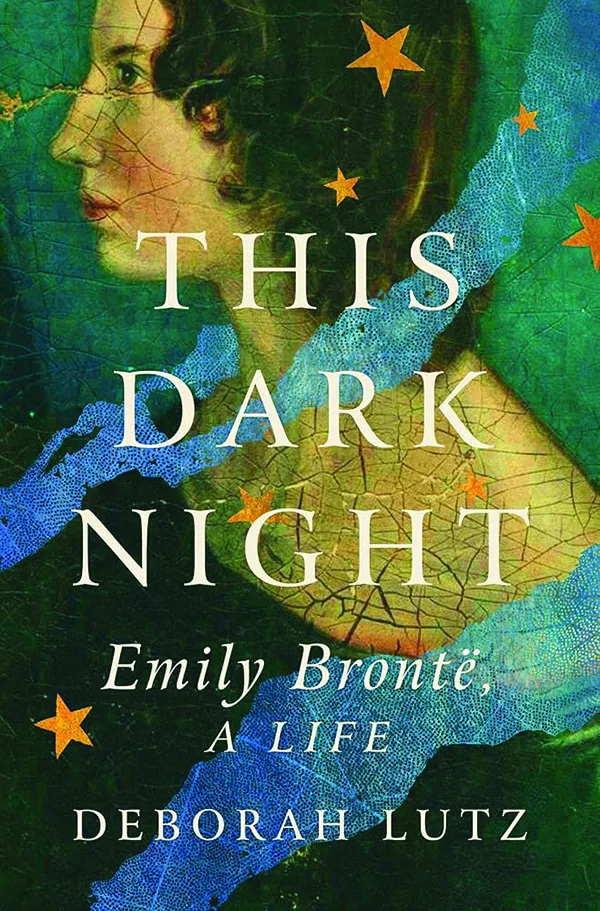
By Deborah Lutz;
Norton; 352 pp.; $33.99
One year later, Bronte, together with her brother Branwell and sisters Charlotte and Anne, began to write collaboratively. First, they produced stories based on plays they devised and acted out, often using a made-up language. Then, when Emily was 12 or 13, she and Anne dreamed up Gondal, a fantasy universe ruled predominantly by women. “The loss of the mother and sisters became internalized as a kind of empty space or wound that required filling with near-endless lands, people and tall tales,” writes Lutz. In 1834, Emily and Anne started to fill pieces of paper with quotidian updates. This more grounded form of writing may sound humdrum. However, the leaves measured only 2½-by-4 inches, and each of the girls’ microscripts was a vibrant and witty vignette comprising potted descriptions, regional dialect, and arbitrary spellings (“Ya pitter pottering there instead of / pilling a potate”). Lutz argues that this writing practice “feels distinctly modern, even avant-garde.”
Writing was only one aspect of Bronte’s days. She did her share of domestic tasks and tended the garden. She played the piano, read avidly, sewed, drew, and painted. But in many respects, she was markedly different from other young women. She took in stray injured animals and nursed them back to health. She needed long stretches of time alone. She was an insomniac who, in thrall to the moon and stars, wrote and walked at night. As Lutz puts it, “The nocturnal and crepuscular would become a sort of cottage industry for Emily.”
Bronte went to school at the older age of 17 but spent only three months there — she was, according to Lutz, “an exile against her will.” She ended up teaching herself. She lasted longer as an instructor at a school, but once again pined for home. It is therefore perhaps surprising that in 1842 she agreed to accompany Charlotte to Brussels to study at Madame Heger’s boarding school for girls, where, equally surprisingly, she also later taught. Bronte’s students disliked her. Madame Heger’s husband found her stubborn and selfish — but also brilliant and in possession of a commendably vivid imagination. During her time off, Bronte employed that imagination and wrote a long narrative poem about a man who kills himself because of a broken heart. It was a subject she was to develop to supreme effect some years later when she switched from poetry to prose and composed her trailblazing, spellbinding novel.
Some of Lutz’s standout chapters are on Wuthering Heights. We learn how the three sisters started writing novels in 1845, and that after nine months, Bronte had an almost-complete draft. The siblings came together most evenings for what Lutz calls “a peripatetic workshop,” which entailed reading manuscript passages aloud and giving feedback on characters and plots. Charlotte found Wuthering Heights too brutal, but Bronte pressed on regardless, following her instincts and realizing her vision.
The novel was rejected at least four times before it found a publisher. It finally appeared in print at the end of 1847 under the pen name Ellis Bell. The reviews were largely unfavorable. Some critics found Bronte’s gothic tale about the passionate and destructive love affair between Heathcliff and Cathy too bleak. Others were baffled by it. In contrast, Charlotte, writing as Currer Bell, enjoyed success with Jane Eyre. She went on to publish more novels. Her sister was not so fortunate. On Dec. 19, 1848, a year after the publication of Wuthering Heights, Bronte died of consumption at the age of 30. Who knows what she would have gone on to achieve? As one of the few enthusiastic critics of Wuthering Heights remarked, the “work of Currer Bell is a great performance; that of Ellis Bell is only a promise, but it is a colossal one.”
This Dark Night will appeal to all sorts, from the Bronte lay reader to the Bronte aficionado. It should be required reading for those who cast doubt on Bronte’s genius after having only experienced (or endured) Emerald Fennell’s recent overwrought and underwhelming film adaptation of Wuthering Heights, a textbook example of style over substance. Along with her analysis of Bronte’s “weird, witchy” masterpiece, Lutz provides insight into her mesmerizing poetry. At regular junctures, she reveals how Bronte’s life informed her art. The loss of her mother at a young age engendered a question that Bronte would grapple with throughout her career: “Where did life end and death begin?”
MORALITY AND MORTALITY IN JAMES MCINERNEY’S NEW NOVEL
Lutz makes clear at the outset that certain chapters of Bronte’s story remain a mystery. At the age of 16, she got into trouble. About this incident, Lutz speculates that she may have become romantically entangled with a young man, “or a young woman.” Most of Bronte’s papers were lost, possibly destroyed, after her death, which prompts Lutz to wonder if she had started a second novel and stashed this unfinished work behind a wall panel in the parsonage or even secreted it out on the moors.
Despite the gaps, Lutz utilizes a range of sources to convincingly flesh her subject out. We come away from this riveting biography with the awareness that a prodigious talent was snuffed out prematurely. We might wince as certain traits and themes are described as “Emilian,” but otherwise it is hard not to be captivated by the Bronte that emerges. She may have been that “untameable spirit”: We see instances where she doesn’t suffer fools — or, in one jaw-dropping case, disobedient animals. But she was also fiercely intelligent, independent, principled, and driven. Martha, the Brontes’ servant, conceded she was “self-willed … but devoted and kind.” As a woman, she was out of step with her own time, but as a novelist, she was way ahead of it.
Malcolm Forbes has written for the Economist, the Wall Street Journal, and the Washington Post. He lives in Edinburgh.