
Nearly two years after a Manhattan jury found President Donald Trump guilty on 34 felony counts in the New York hush money case, the legal battle to erase the president’s lone criminal conviction remains alive across multiple courts, even as the political moment that surrounded the historic verdict has largely faded into history.
When the verdict came down on May 30, 2024, former President Joe Biden was still seeking reelection, and Democrats openly hoped the conviction would cripple then-candidate Trump’s bid to return to the White House.
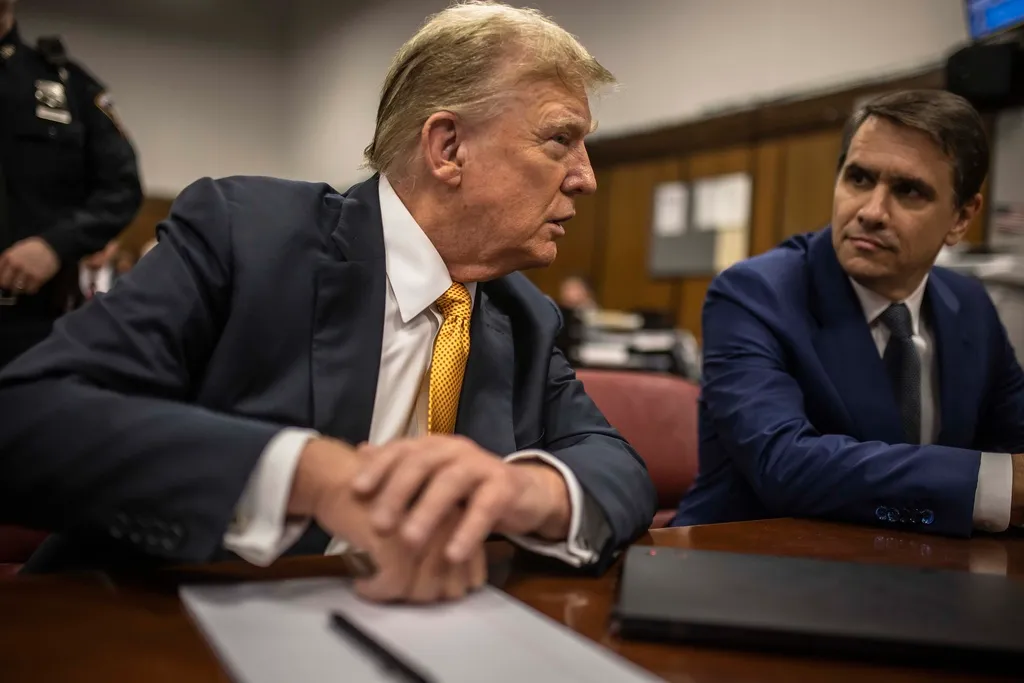
Instead, Biden’s disastrous debate performance less than a month later upended the race, and within weeks, he dropped out altogether. Then-Vice President Kamala Harris became the Democratic nominee, and Trump ultimately won the presidency despite becoming the first former president ever convicted of a crime.
Trump’s then-legal team included Todd Blanche and Emil Bove, who, in the second administration, were rewarded for their loyalty by being named acting attorney general and a judge on the U.S. Court of Appeals for the Third Circuit.
TRUMP SLAMS JUDGE FOR REVERSING KENNEDY CENTER NAME CHANGE AND BLOCKING CLOSURE
And yet, the conviction itself remains unresolved, and the record still stands that Trump is the first convicted felon to serve as president.
Trump’s new legal team is pursuing multiple avenues to overturn the verdict, including a pending appeal in New York state court and a separate effort to move the case into federal court on presidential immunity grounds. Both tracks remain active, and either track could ultimately wipe away the conviction that briefly appeared poised to reshape the 2024 election.
The ongoing appeals come as prominent constitutional and legal experts have said the case should never have resulted in a conviction.
The flaws in the hush money trial
“After 63 years of practicing criminal law, I have never seen a weaker case than this one,” Harvard Law professor emeritus Alan Dershowitz told the Washington Examiner. “This was the worst example of lawfare and targeting that I’ve ever seen. They just made up a crime.”
The Manhattan prosecution stemmed from allegations that Trump falsified business records related to reimbursements paid to former attorney Michael Cohen after a payment to adult film actress Stormy Daniels ahead of the 2016 election. Democratic Manhattan District Attorney Alvin Bragg ultimately secured convictions on all 34 counts.
The case quickly became a flashpoint in the broader debate over whether prosecutors were selectively targeting Trump, given the two federal criminal indictments he faced from the Biden administration and a separate racketeering case brought by Fulton County District Attorney Fani Willis, all of which were ultimately dismissed. Critics pointed to Bragg’s campaign rhetoric about pursuing Trump and to the role of Matthew Colangelo, a former senior DOJ official who left the Biden administration to join Bragg’s office and help lead the prosecution.
Trump’s supporters also attacked a series of decisions made by Justice Juan Merchan throughout the proceedings, including the gag order that restricted many of Trump’s public comments about witnesses and participants connected to the case. Further scrutiny was raised as to whether Merchan should have recused himself because of small-dollar political donations he made before the trial and because his daughter, Loren Merchan, worked as a Democratic political consultant whose firm had ties to prominent Democratic candidates and causes.
The state court appeal now underway revisits many of those issues, but it also focuses on several broader constitutional arguments that Trump’s lawyers believe could unravel the conviction.
Trump’s lawyers say federal law should have barred prosecution altogether
One of the most significant centers on whether Bragg improperly relied on an alleged federal campaign finance violation to transform what otherwise would have been misdemeanor business records charges into felony offenses.
Kellen Dwyer, a constitutional and criminal law attorney at Holtzman Vogel, said that issue appears prominently in Trump’s 96-page appellate briefing filed last October, and could prove consequential.
“This is actually his lead argument, the first one in his brief, which gives you a sense that his lawyers think this is their best argument, and they’re probably right about that,” Dwyer told the Washington Examiner.
According to Dwyer, federal law broadly preempts state officials from enforcing federal campaign finance laws, raising questions about whether a local district attorney can use an alleged federal election-law violation as the foundation for a state felony prosecution.
“The feds are supposed to enforce federal campaign finance laws,” Dwyer said. “You don’t want local elected officials trying to enforce federal campaign finance law because their incentives are very different.”
Trump’s immunity argument
Trump’s lawyers are also arguing that the conviction cannot stand on the basis that Bragg’s team introduced evidence that the Supreme Court later determined falls within the scope of presidential immunity.
Less than five weeks after Trump was convicted in Manhattan, the Supreme Court issued its landmark July 2024 presidential immunity ruling, a decision that immediately became central to his effort to overturn the verdict. The court held that presidents enjoy broad protection from criminal prosecution for official acts and that evidence related to those acts generally cannot be used in criminal proceedings.
Dwyer said that issue could present problems for the prosecution because jurors heard evidence involving Trump’s interactions with White House aides and conduct that occurred while he was serving as president.
“The prosecutor used a lot of evidence of what under Trump v. United States would be considered official presidential acts,” Dwyer said of the Supreme Court’s decision, which split 6-3. “Trump v. U.S. is pretty clear that evidence of official acts can’t be used as part of a criminal trial, so that’s definitely going to be a major issue in the appeal.”
Trump’s state court appeal additionally argues that Merchan should have recused himself from the case and challenges several of the judge’s rulings throughout the proceedings. The case has also been marred by criticism over its convoluted jury instructions, which allowed jurors to convict without unanimously agreeing on the same underlying unlawful means supporting the felony charges.
Separate from the state appeal, Trump is also pursuing a federal court strategy that could eventually place the conviction on a path toward Supreme Court review.
Last year, the Second U.S. Circuit Court of Appeals ordered U.S. District Judge Alvin Hellerstein, an appointee of former President Bill Clinton, to take another look at Trump’s effort to move the case from state court into federal court. The appellate panel concluded that Hellerstein failed to fully consider the implications of the Supreme Court’s immunity ruling when he previously rejected Trump’s request.
Hellerstein heard arguments over the matter again in February but has not yet issued a ruling.
Waiting game ensues
Dershowitz suggested the delays in outcomes from either court may reflect the unusual procedural posture of the criminal case against Trump.
“I think it’s possible that each court is waiting for the other, because a decision by one might moot the other,” he said, referring to the parallel proceedings in state and federal court.
Dershowitz argued that the most straightforward outcome would be for an appellate court to simply reverse the conviction altogether.
“The cleanest track is to say this is a made-up crime, and we reverse and dismiss with prejudice,” he said.
While acknowledging that no one outside the courts knows exactly what is happening behind the scenes, Dwyer said he could understand why judges might be reluctant to be the first to issue a ruling in a case involving a former president, unresolved immunity questions, and competing state and federal proceedings.
“I wouldn’t expect it to go that long,” he said when asked whether the litigation could extend beyond Trump’s presidency. “That would be pretty extraordinary for an appeal that’s been fully briefed for close to a year now.”
DEMOCRATS EYE BLANCHE AND PATEL SUBPOENAS AFTER BONDI DEFLECTS EPSTEIN QUESTIONS
Former federal prosecutor David Gelman said neither Hellerstein nor the state’s highest appeals court appears to be operating with any sense of urgency.
“Nobody’s rushing anything,” Gelman told the Washington Examiner. “The only reason they brought these charges was to stop him from becoming president of the United States. Well, that failed tremendously.”