
Rep. Elise Stefanik’s (R-NY) new book, Poisoned Ivies, opens with a premise that many American Jews have come to learn painfully: elite universities in the United States have become incubators for ideological extremism, moral confusion, and open antisemitism. But reading the book as merely a political critique of higher education misses what makes it so unsettling. For many readers, the crisis Stefanik documents is deeply personal. It forces a painful reassessment not just of institutions, but of friendships, communities, and people we once trusted.
Recently, one of my best friends from middle and high school posted a meme blaming the murders of everyone from JFK to Charlie Kirk to Princess Diana on Benjamin Netanyahu and “his people.” We have been friends for thirty years, and she’s always known I’m Jewish. We haven’t seen each other in years, but we’ve kept in touch via social media and bonded over how similar our lives have become despite the distance; we’re both homeschooling our children and still appreciate the same music we did as teenagers. When she posted that meme, I responded and asked, “Do you think I killed my friend Charlie?” She didn’t respond, and we haven’t communicated since.
That exchange crystallized something many Jews have quietly grappled with since Oct. 7, 2023. Writing recently for Commentary magazine, where he is senior editor, my husband, Seth Mandel, explained what it’s been like for millions of Jews around the world for the last two and a half years: “It’s just a strange feeling to know how many of the people you interact with would be unmoved if you were to go up in flames right in front of them. Essentially, October 7 became the kind of dividing line that made a lot of Jews understand history.”
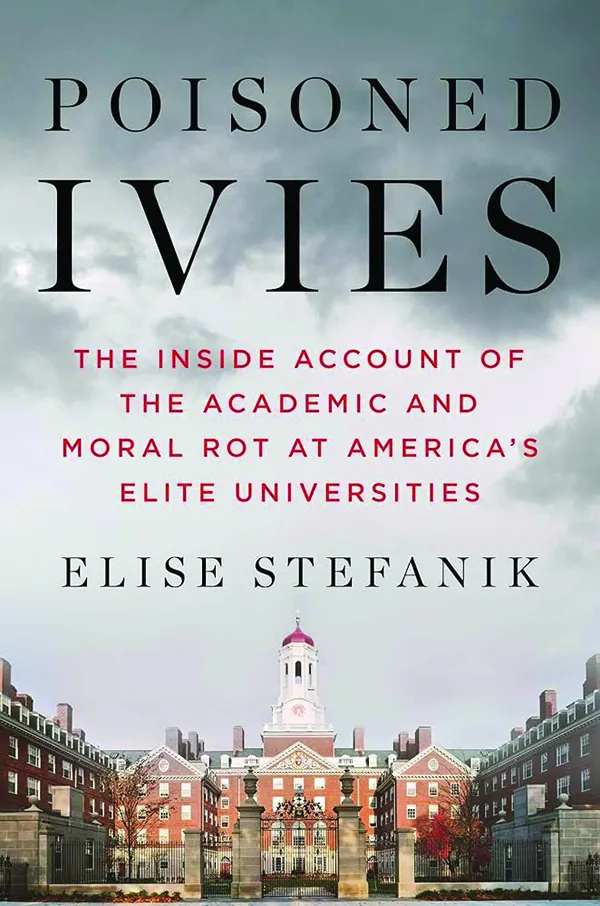
I had another one of those moments while reading Poisoned Ivies. I picked up the book intending to review Stefanik’s account of antisemitism on campus, but midway through, I encountered a far more personal shock: the name of someone else from my own past.
Stefanik recounted the case of Derron Borders, who, while working as a Cornell University diversity administrator, publicly celebrated the Oct. 7 attacks on social media, framing Hamas violence as resistance against “settler colonization, imperialism, capitalism, [and] white supremacy.”
Borders was not merely a passing acquaintance to me. When I was 16 years old and studying abroad in Belgium, he was one of my closest friends. He was one of the people who made me feel safe in a foreign country. Because he was gay, I trusted him implicitly in social situations where many teenage girls are vulnerable. He was physically imposing, kind, protective, and thoughtful.
One of the biggest topics of conversation during our exchange year was keeping safe from immigrants, who were mostly from Muslim countries and would go through Belgian cities in packs, endangering anyone unlucky enough to trigger them. On New Year’s Eve, one of our friends landed in the emergency room because one such gang discovered he was American. I was scared of them discovering I was a Jewish American; he would have been in similar danger as a gay American.
So it was jarring to discover, 25 years later, that he had become the sort of activist who reflexively excuses Islamist violence and frames Jewish victims as oppressors, defending a culture where gay men are routinely thrown off the roofs of tall buildings as punishment for their sexuality. But Stefanik’s book helped me understand how that transformation happens.
Borders’s story mirrors that of many of the figures Stefanik profiles. Like countless young people searching for a sense of belonging, he found it in academia — an environment that increasingly functions less as a place of learning and more as an ideological community demanding conformity. As Stefanik argues, DEI didn’t merely reshape universities; it became a pseudo-religious system in which dissent was punished and moral orthodoxy enforced. In short, my old friend joined a cult, and he bought in completely.

The post-Oct. 7 reactions on campuses revealed something impossible to ignore: the institutions most loudly obsessed with “harm,” “safety,” and “inclusive communities” suddenly discovered enormous moral flexibility when Jews were the victims. Universities that maintained sprawling bureaucracies devoted to policing microaggressions struggled to say plainly that calls for Jewish genocide violated basic standards of conduct.
Stefanik’s now-famous congressional hearing with the presidents of Harvard University, the University of Pennsylvania, and the Massachusetts Institute of Technology became a national flashpoint precisely because her question was so straightforward: whether calling for the genocide of Jews violated the university’s rules on bullying and harassment. The inability of elite university leaders to answer clearly exposed how deeply compromised these institutions had become.
Stefanik documents how similar patterns emerged across campuses nationwide, from Cornell to Columbia University and beyond. Across campus after campus, the pattern repeated itself: faculty members praised Hamas violence, student groups celebrated terrorism, administrators equivocated, and protest encampments became sites of open intimidation. And yet the institutions themselves often seemed paralyzed, unwilling to enforce even their own rules when doing so might conflict with prevailing ideological fashions.
Borders finally fit in, but he was an unlucky zealot: According to the Ithaca Journal, he was soon ousted from Cornell and found himself on administrative leave from his next gig at Kansas State after headlines emerged about his past comments.
Borders wasn’t even the most radical actor at Cornell; he was just unlucky enough not to have tenure. In the fall of 2024, Inside Higher Ed reported, “The Cornell University faculty member [Russell Rickford, an associate professor of history] who said, roughly a week after Oct. 7, that Hamas’s attack ‘exhilarated’ him is back teaching.”
Rickford is far from unique. Stefanik spends the entire first half of her book chronicling the immediate aftermath of Oct. 7 on college campuses across the country, from her alma mater, Harvard, to the University of Pennsylvania, to Columbia, and more.
Much of Poisoned Ivies grew out of Stefanik’s role in exposing these failures publicly, particularly during the now-infamous congressional hearings that forced university leaders to defend the indefensible.
THE QUIET RADICALIZATION OF THE AMERICAN LIBRARY
In an interview on my podcast The Mom Wars, Stefanik explained that she wrote the book partly because she feared the media would dismiss these incidents as isolated anomalies. They were not anomalies, she argued, but evidence of a systemic failure embedded within higher education itself. She told me, “To have it in one volume, it is jaw-dropping that this happened in the United States of America, let alone anywhere in the world, but in our own country at these very preeminent, previously prestigious schools. I think it’s important not only for today and this turning point of higher education, but for history’s sake, when we look back at this moment in time.”
For many Jews, the last two years have been clarifying in painful ways. Relationships that once felt solid suddenly appear fragile. Institutions once viewed as prestigious now seem hollow. Old friends reveal beliefs you never imagined they held. Poisoned Ivies succeeds because it captures that broader sense of betrayal. It documents not just a political crisis in higher education, but a cultural one — a moment when many Americans, Jewish and otherwise, began to realize that some of the country’s most influential institutions no longer possess the moral confidence to distinguish clearly between civilization and barbarism.
Bethany Mandel is a homeschooling mother of six and co-host of The Mom Wars podcast.