
In Focus delivers deeper coverage of the political, cultural, and ideological issues shaping America. Published daily by senior writers and experts, these in-depth pieces go beyond the headlines to give readers the full picture. You can find our full list of In Focus pieces here.
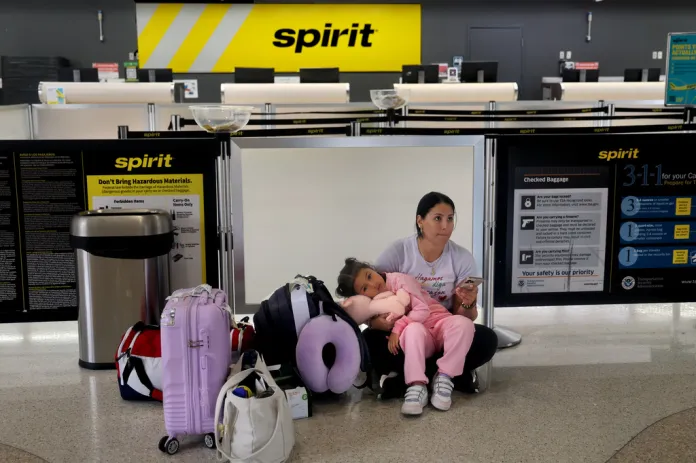
Like an executioner pantomiming grief at the funeral, Elizabeth Warren took to X to lament the demise of Spirit Airlines, blaming “spiking fuel prices from Trump’s war” in Iran and chastising Republicans “desperate to shift blame from higher costs hitting families.”
Of course, Spirit Airlines filed for Chapter 11 bankruptcy twice in the past two years, and both times were when inflation-adjusted gasoline prices were near their lowest point since the rock-bottom nadir of the pandemic. The real culprit wishing to deflect blame, rather, was the Massachusetts Democrat herself, who championed the Biden administration’s blockade of an attempted merger between Spirit and JetBlue.
HAVE AIRLINES BECOME MERE CREDIT CARD COMPANIES?
Back in 2024, the senator lauded her apprentices in the Justice Department’s Antitrust Division for fighting “runaway airline consolidation” and blocking the merger that “would have led to fewer flights and higher fares.”
Instead, because the Biden DOJ listened to Warren, we’re on the cusp of facing runaway airline consolidation. Thanks to the demise of Spirit, the worst is yet to come for commercial airline customers unless the government gets out of the way.
When Spirit, then the U.S.’s sixth-largest airline, tried to merge with JetBlue, then America’s seventh largest, the “Big Four” — United Airlines, American Airlines, Delta Air Lines, and Southwest Airlines — controlled a combined share of 60% of the domestic market. After the Biden administration blocked the merger, Spirit and JetBlue were forced to fend for themselves and cut flights across their respective networks. The Big Four’s domestic market concentration is now 80%.
We have good evidence that Spirit’s departure and JetBlue’s woes will continue to worsen the outlook for consumers. The Transportation Department found that the “Spirit effect” — when a budget airline enters a new route — jawboned down prices offered by the Big Four on those routes by 10%, while Spirit itself reported that routes that the airline stopped servicing between the second quarters of 2024 and 2025 saw average airfare increase by 23%.
But the irony is that airlines no longer make their profits through airlines. On the contrary, the Big Four are now credit card companies that also happen to fly planes. Though loyalty programs that steer customers to co-branded credit cards and airport lounges are nothing new, since the pandemic, they’ve taken up the lion’s share, if not the entirety, of the values of the Big Four.
On Point Loyalty, a consultancy that specializes in airline loyalty programs, values Delta’s SkyMiles program at an estimated $31 billion, two-thirds of its $47 billion market capitalization. OPL values AAdvantage at $26 billion, more than three times the $8 billion market cap of American Airlines, and MileagePlus at $25 billion, almost as much as United Airlines’ $30 billion market cap.
And it seems as though the inflection point was indeed the pandemic. Before 2020, all of the Big Four generated higher passenger revenue per available seat mile than operating costs per available seat mile. COVID then brought the aviation industry to a halt, and the federal government gave it $54 billion in taxpayer cash and forced the firms to keep airline workers nominally attached to their jobs and locked into high wage levels. When pent-up demand was finally realized upon the world reopening, airline labor took advantage of their state-bolstered position; all of the Big Four were cajoled into increasing pay by more than a third. For the first time in a decade, labor costs have actually outpaced fuel costs as the single largest line item in the industry’s budget.
For example, American Airlines saw its PRASM increase by 2% last year, but its CASM, excluding the cost of fuel, was up nearly 5%, largely due to a nearly 10% increase in the cost of salaries, wages, and benefits. By the first quarter of this year, American posted an operating cost per available seat mile of 19.38 cents and passenger revenue per ASM of 17.35 cents. That’s a loss of 2.03 cents per available seat mile.
In case that number sounds small, let’s put it into context. Take one of American’s flagship flights from Dallas to London just to illustrate how a 2-cent loss per ASM scales in a few hours. That 2-cent loss per ASM multiplied by 244 passengers flying 4,750 miles equals a $23,500 loss for the company on that single flight, or nearly a $100 loss per passenger onboard.
Thus, the Big Four are banking on their loss-leading flights to cultivate passengers into financial clients who, swayed with the prospect of points, upgrade privileges, and lounge access, will adopt their credit cards. Delta has done so to greater success than anyone, with a reported full percentage point of our GDP attributed to the company’s co-branded American Express cards.
The only possible recourse for consumers is to make the industry more competitive, not less. One obvious and easy way would be for Congress to raise the mandatory retirement age for pilots and modify the Railway Labor Act that artificially bolsters the bargaining strength of commercial airline crews.
But the real game changer would echo what President Donald Trump has done in the (temporary) waiver of the Jones Act. Just as the Jones Act constrains commercial shipping between U.S. ports to U.S. ships manned by U.S. crew, cabotage — the transport of passengers within the U.S. by a foreign carrier — is banned in commercial aviation by the Air Commerce Act of 1926.
TRUMP EXTENDS JONES ACT WAIVER
Although David Brat of Tea Party fame tried to repeal this Jones Act of the Sky with his 2018 Free to Fly Act, he never gained momentum. And that’s a damn shame, considering the cost savings to be had. The liberal Brookings Institution found that international open skies agreements that allow select airlines to provide cross-border service have generated $4 billion annually for consumers, leading to 15% lower fares, while hypothetically allowing even one foreign budget airline to enter underserved U.S. markets would net American flyers $1.6 billion annually.
Such as the Jones Act, federal cabotage law exists solely to protect airlines that are no longer willing or able to turn a profit operating airlines. Consumers deserve for the airlines to be put to the test. Either the government gets out of the way and zombie companies deservedly fall and make way for winners, or competition immediately craters costs across the board.
Absent action, Spirit won’t be the last airline to fall, and the Big Four will only grow in market share and depreciate in consumer experience.