
The next time you’re on an American freeway, take a serious look at the semitrucks all around you. Then do what’s necessary to get as far away from them as possible, because you’re at more risk from them now than ever before. From the 1970s through 2009, the number of serious truck-related accidents and fatalities generally decreased each year, much as the number of road fatalities unrelated to trucks did. In 2009, that changed: the rate of accidents started going up. In 2016, the number of truck-related fatalities began to soar after the Obama administration released a memo halting English-language proficiency testing for truckers.
In 2022, the federal government stopped releasing the crash and fatality data.
There is a safety crisis in professional trucking, and it has deadly consequences for the rest of us. Veteran tractor-trailer driver Gord Magill’s End of the Road: Inside the War on Truckers is at least partially an attempt to explain how we got here, what’s likely to happen in the future, and what must be done if America and Canada are to rectify the situation. The inclusion of our northern neighbor in that previous sentence is not a casual one. More than anything else, it is trucking that unites the two countries. Virtually all of the significant trade between them happens behind the cab of an 18-wheeler. Professional drivers of both nationalities move back and forth across the border on a weekly or even daily basis.
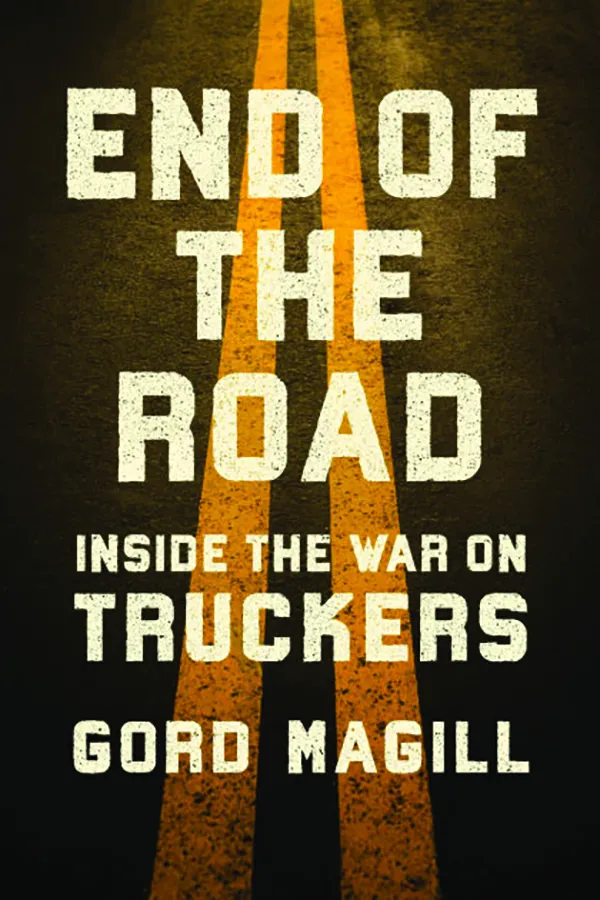
Magill is himself Canadian and a veteran of the famed Ice Road Truckers that captivated reality-TV viewers for years. He’s also driven the “road train” trucks that criss-cross Australia at high speed with as many as four trailers behind the cab. A third-generation trucker with a deep reverence for the profession, he has watched in dismay as wages have fallen, fatalities have risen, and the business operations have splintered into shell companies designed to limit liability, “chameleons” that perpetuate deadly practices through multiple revoked licenses, and shady Eastern European operations that force their drivers to stay awake for days at a time as their Ukrainian hackers “fix” the electronic driver loggers that are supposed to regulate the hours, and the on-road behavior, of every trucker operating in America.
Fortunately for Magill, but unfortunately for the American public, his book arrives just as some public attention is being paid to some truly horrifying incidents regarding untrained and English-illiterate immigrant truck drivers. Last October, Borko Stankovic, an illegal immigrant from Serbia who had taken $36,082 in COVID-19-era Paycheck Protection Program loans that were later forgiven, turned left in front of oncoming traffic and killed an Indiana driver. Just six days later, Jashanpreet Singh, an illegal immigrant from India, caused an eight-car collision in California that killed four people. Two months before that, the nation was horrified by a video in which Harjinder Singh, another illegal immigrant from India, blithely U-turned his tractor-trailer in traffic and killed three people.
The Trump administration, spurred by this and numerous other similarly egregious incidents, has begun a process by which the commercial driver’s licenses of up to 200,000 illegal immigrants, Deferred Action for Childhood Arrivals recipients, and other unhoused residents will be revoked. The Washington Post, echoing general party-line sentiment on this action, thundered that it “could mean higher prices for consumers.” That could be true, but the data suggest that more consumers will remain alive to pay those outrageous sums. As noted by Magill, a 2025 study suggests that truck drivers who don’t communicate well in English are involved in significantly more crashes than English-speaking drivers who are regularly caught speeding, or who have been involved in drug and alcohol violations.
End of the Road, like many books written by folks whose experience with the real world vastly exceeds their accumulated keyboard time, flits unsteadily between political polemic (he refers to COVID-19 regulations as “letters of marque”) uncertainty regarding matters outside the author’s expertise (he is much more convinced of a 100% autonomous-trucking future than is anyone designing said vehicles) and occasional, tentative grasps of sentimentality and/or lyricism (regarding modern aerodynamic tractors, he notes, “There is just something about those designs that is vexatious to the spirited”). Much of it deviates or just plain degrades into personal anecdote: the Quebecois-heavy truck stops of Magill’s youth, his hatred for the Australian authorities, or the NAPA Transportation reps who, after installing three consecutive defective NAPA-brand starters into their delivery truck, went to a junkyard and pulled out an original-equipment one. In particular, his pages on driving the “ice roads” in Canada can’t seem to decide whether they are a commentary on the reality-TV show, a story of the situation surrounding the show’s filming, or a matter-of-fact recounting of his own experiences in the area.
Yet this rough naivete and unfamiliarity with the rules of narrative or style also permit Magill to be fearless in calling out the three primary threats to a safe and stable North American trucking industry. He is particularly convincing about the first of those threats: a “trucking industry shortage” that does not exist and has never existed. A complex web of government-subsidized loans and programs, tracing their origins back as far as President Franklin Delano Roosevelt and as recently as President Joe Biden, puts approximately 450,000 new CDL holders on the road in America every year. There are as many as 10 million active CDL holders in the country at any given time. Yet there are fewer than 3 million long-haul truck-driver jobs in total. This has precisely the effect a freshman Economics 101 student would expect: real-world wages are as little as a quarter of what they were four decades ago.
The new drivers drive veterans out of the business because they are cheaper and often prepared to break or subvert the law in ways their predecessors were not. In Canada, a full 60% of truckers are Punjabi immigrants. Their numbers are climbing in America as well. Magill describes a “tower of Babel” experience at America’s truck stops, where public defecation and continual low-speed parking-lot accidents have become the new normal, as have poor fast-food labor rates. When Magill turns down a job for $14 an hour, the person who offered it to him says, to explain the lowball, “You’re just a truck driver.”
If a driver can find a job, he will then find himself subject to the tyranny of the Electronic Logging Device, which can coordinate with in-truck cameras to monitor everything from the driver’s eye movements to, one female trucker notes, her sleeping bunk. According to writer/researcher Karen Levy, whose work is quoted by Magill in his chapter on electronic driver monitoring, “The proprietary Omnitracs Driver Retention Model analyzes hours-of-service data … by looking for patterns and subtle changes in driver habits and work activities that serve as indicators of voluntary terminations.”
Up to 40% of potential safe operation hours are prevented by ELDs; Magill wryly notes that the entire “trucker shortage” isn’t as big as the wasted time caused by loggers that force drivers to sit idle by the roadside and in impromptu parking locations. For Eastern European and some Indian truckers, however, that’s not a problem; they rely on overseas hackers to reset the ELD and let them keep driving for days on end. When an audit reveals the ELD problem, the feds revoke the carrier’s DOT license, at which point the company switches to another Department of Transportation license and continues as before. These are known as “chameleon companies.”
At the same time, the trucks themselves are being regulated into unusable junk by California emissions laws. Magill relays a conversation with a fleet owner who has been completely stripping and rebuilding pre-2002 trucks for the past couple of decades, spending $100,000 or more per refurbishment. The alternative is to spend $300,000 or more on a truck that could lose an engine without warning or require months of dealer service time. Until 2021, thousands of new trucks were sold each year as “gliders” with no engines; the operator would install a pre-California-emissions drivetrain from a junked truck at eye-watering expense. The Biden administration put an end to that practice.
MAGAZINE: THE ONLY EV THAT EVER MATTERED
In places, End of the Road is heartbreaking. Magill interviews numerous career truckers who have left the industry due to low pay, alienation, or safety concerns. He draws sentimental yet fair comparisons between the way trucking once worked and the way it works now. And he makes the salient point that the famed Canadian trucker convoy wasn’t just the result of draconian COVID-19-era policy; the seeds for a working-class revolution had been sown long before that, with every step taken by governments and corporations to strip the dignity, safety, and living-wage compensation out of what was, once upon a time, a fairly well-respected profession.
Every motorcyclist with any significant time on the freeway knows that “Stay away from trucks” has long been the cardinal rule. Magill’s book and the safety data available to us both suggest that this should be a rule for every driver on four wheels, as well. It is well worth reading for anyone who wants a better understanding of the dangerous, yet necessary, 40-ton monsters all around us.
Jack Baruth was born in Brooklyn, New York, and lives in Ohio. He is a pro-am race car driver, a former columnist for Road & Track and Hagerty Magazine, and writer of the Avoidable Contact Forever newsletter.