
“Not he who has much is rich,” the mid-century German social psychologist Erich Fromm once supposedly said, “but he who gives much.”
Populists on both the Left and the Right have railed against the wealthy for centuries, and none more stridently than the likes of Sens. Bernie Sanders (I-VT) and Elizabeth Warren (D-MA) in recent decades. They claim that rich people in the United States — “millionaires and billionaires,” per Sanders — take and take and take from poor and middle-class Americans alike without contributing anything meaningful to society.
“Billionaires should not exist,” Sanders tweeted in 2019. “I don’t think we should have billionaires,” Zohran Mamdani, the socialist Bernie protégé and virulently anti-Israel mayor of New York, told NBC News last year.
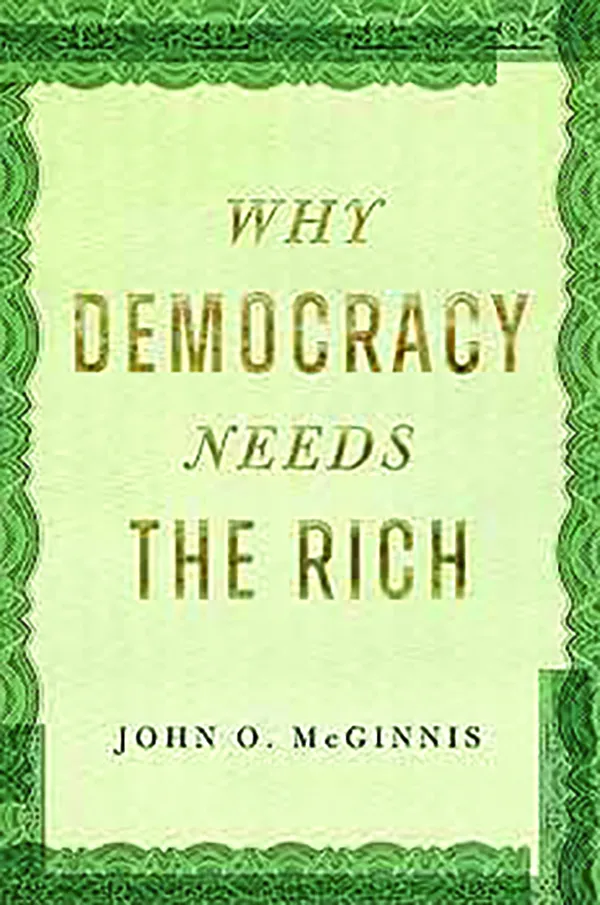
These shallow and self-evidently wrong assertions have been amply rebutted by economists, philosophers, and politicians alike, but in Why Democracy Needs the Rich, the Northwestern University law professor John O. McGinnis provides the definitive word on just how much the wealthy give back in material transfers and more inchoate contributions. In terms Fromm would appreciate, rich Americans, in particular, are wealthy indeed.
McGinnis begins by cataloging the parade of horribles that the populists trot out whenever debates over relative wealth erupt, which, of course, is rather often. These include, naturally, greed, sloth, avarice, ungratefulness, exploitation, and miserliness, among many others. But by far “the most prominent externality offered” by critics of the rich, he contends, “is the disproportionate influence they wield in the political process, allegedly harming democracy.” Buying elections, busting unions, securing exotic tax breaks, despoiling the natural environment, promoting regulatory capture — the list of the wealthy’s supposed crimes against liberal democracy is long and familiar.
Yet, many other political actors affect the American political system far more powerfully. For one thing, “the intelligentsia, or chattering class, including journalists, intellectuals, and entertainers, wields more significant power by shaping the short-term agenda through the media, affecting the long-term agenda through universities, and directing the cultural currents that flow into politics through books, television, movies, and music.”
For another, government bureaucrats, especially those entrenched in public-sector labor unions, “hold substantial sway over the day-to-day operation of government.” So, too, do trade associations, industry alliances, and organized labor as a whole.
All of these groups distort the institutions of governance in the U.S. and inexorably pull them to the left. But McGinnis shows how the wealthy — liberal and conservative, progressive and libertarian alike — in fact restore balance to a system unduly warped by these organizations. “The influence of the rich acts like a lever,” he contends, “amplifying the voice of the many against the concentrated power of the few. In serving as a counterweight to both the intelligentsia and special interests, the wealthy contribute to one of the virtues of democracy as a political system: its openness to contestation.”
As an initial matter, who are the rich? The notorious “one percent” includes individuals worth at least $12 million. But the top 0.1% have personal wealth of around $61 million. Actually, billionaires compose about 0.00034% of Americans. Yet, in our innovation-driven economy, the ranks of the wealthy are thoroughly fluid. McGinnis reckons that “the next wave of wealth will emerge from unforeseen innovations and entrepreneurial ventures, much like the last generation of wealthy entrepreneurs did.” In addition, the inventive spirit permeating successful creators benefits the hundreds of millions who make use of what they create.
And how exactly do these wealthy folks enhance American democracy? McGinnis points to four principal methods. First, he contends that “the representative nature of the U.S. political system means that influence is inherently unequal.” Journalists and academics, whose membership tilts left by at least a 10-to-1 ratio, exert enormous influence over American politics. Hollywood actors, popular musicians, and other creative types skew even more liberal and control the commanding heights of national culture. The wealthy, however, “tend to bring a pragmatic perspective on social affairs, one grounded in results rather than theories.” More broadly, he argues, “the shared interests of the wealthy, such as a commitment to a rule of law that facilitates transactions and to economic growth that increases the value of their capital, align more closely with the broader interests of society.”
Second, he observes that “the centrality of free speech in American democracy naturally results in unequal sway due to differences in resources, talent, and access to the media.” Precisely because the Constitution prizes the freedom of expression above many other competing values, those with greater entrée into the world of words impart immense impact. Both traditional and social media enjoy a pride of place in this ecosystem. But the rich can counterbalance these forces, and McGinnis notes that “the heterogeneity of paths to great wealth benefits democracy by generating varied perspectives.” After all, for every Charles Koch and Elon Musk, there’s a George Soros and a Bill Gates.
Third, McGinnis asserts that “organized interests often dominate democratic processes, leveraging coordination to achieve outsized influence.” Federal, state, and local bureaucrats, organized into public labor unions, effectively negotiate with themselves over government contracts. The same can be said for trade groups that spend tens of millions of dollars on lobbying efforts. Yet McGinnis demonstrates how wealthy Americans can, through foundations and think tanks, influence critical matters of public debate in ways that counteract special interests, whether in pressing for educational reform or protecting the natural environment. These approaches, he insists, “demonstrate that the wealthy’s efforts to counteract special interests through social initiatives are ideologically diverse, defying simple political categorization.”
And finally, McGinnis argues, “the American political order’s structural checks on legislative action, such as the difficulty of passing federal laws, create a unique need for private provision of public goods.” Civic movements and associations founded by the wealthy played key roles in ending slavery and Jim Crow, endowed institutions of higher learning, nurtured the careers of artists, and underwrote libraries, museums, theaters, and sports teams. “Private charity,” McGinnis shows, “can fill gaps that government programs, constrained by bureaucracy, cannot reach” by moving faster, nimbler, and more efficiently than public agencies.
As a center-right scholar, McGinnis defends charges against the wealthy emanating not simply from leftists such as Sanders and Mamdani but also from the New Right, which indicts them as decadent globalists seeking to mire hardworking, traditional Americans in a libertine techno-utopian society. Yet, he observes how even these Catholic integralists and other “common good conservative” organizations rely principally on support from rich backers and “have little hope of establishing a new regime without their support.”
At times, McGinnis’s prose runs long on rhetoric and short on evidence. And at others, he proves too much: If the wealthy are net contributors to society because they comprise both right- and left-wingers, how are their contributions any more valuable than everyday Americans who also range in their political views? Finally, a chapter on the rich and AI feels a bit bolted-on.
Still, this persuasive and engaging book firmly rebuts the many ill-considered attacks on those who’ve both earned and given a tremendous amount. The rich, in a Frommian sense, form an irreplaceable part of a liberal democratic capitalist society, and McGinnis eloquently explains how and why the U.S. is fortunate to have so many of them.
Michael M. Rosen is an attorney and writer in Israel, a nonresident senior fellow at the American Enterprise Institute, and author of Like Silicon From Clay: What Ancient Jewish Wisdom Can Teach Us About AI