
There is increasing evidence suggesting that the United States is preparing for ground combat action in the battle for the Strait of Hormuz energy chokepoint.
Iran has effectively shuttered that global energy transit artery by attacking international shipping in the area. Ayatollah Mojtaba Khamenei’s regime senses Hormuz is its key pressure point to push President Donald Trump to end this war on terms favorable to Tehran. Iran knows that its current action is more than enough to deter shipping companies from using the strait. Trump’s provision of insurance guarantees to these companies is an insufficient motive for them to risk making the crossing. As energy prices remain high and volatile, Iran gambles that Trump will give up in fear of Republican prospects in the midterm congressional elections.
Trump should seek off-ramps to what was always an ill-advised war. But neither Trump nor U.S. interests can afford to lose the Strait of Hormuz battle. Defeat, perceived or real, would greatly undermine America’s credibility with its allies while inspiring global adversaries to find their own pressure points toward defeating the U.S. in any future war. Defeat would also greatly empower the Chinese and Russian alternative Middle Eastern strategy of offering trade alongside promotion of regional neutrality.
But winning is far easier said than done.
Those arguing that the U.S. Navy should immediately begin escorting civilian vessels do not know what they are talking about, for example. The military realities here are significantly more complex. Until Iranian forces around the strait are degraded, naval escorts would lead only to U.S. warships being hit by Iranian fire. These Iranian forces currently include surface gunboats, underwater and aerial drones, minelaying vessels, and missiles hidden underground and loaded on concealed trucks. They are operating in concealed positions close to the strait, negating U.S. advantages in longer-range warfare and ranged air defense. To win this battle, the U.S. will have to both degrade Iranian forces engaged in the fight and simultaneously impose a new cost-benefit analysis on the Iranian leadership.
Trump is thus preparing to escalate to win the Hormuz battle.
The Wall Street Journal reported on Friday that the USS Tripoli and its embarked 31st Marine Expeditionary Unit are being redeployed to the Middle East from the Pacific. This deployment further underlines the predicted strain on China’s deterrence caused by this war. But as the Washington Examiner has previously outlined, MEUs constitute a potent if limited force. They include a ground combat element of three rifle companies and an additional weapons company armed with anti-tank and mortar equipment. This adds up to approximately 800 combat infantry personnel. The 31st MEU is also embarked with F-35B stealth fighter jets.
Still, other deployment activity the Washington Examiner is aware of suggests that additional elements of the far-larger 1st Marine Division-led 1st Marine Expeditionary Force may also be deployed to the Middle East. Taken together, these deployments indicate that the Pentagon is preparing for combat operations to seize Iran’s critical energy export terminal on Kharg Island. This would allow the Trump administration to deny Iran the resources it needs to maintain its economy. That economy was operating at crisis-levels before the war began.
In addition, if significant elements of the 1st Marine Expeditionary Force begin arriving in the Middle East, it may indicate U.S. preparations to also seize or establish strongholds on Iran’s Qeshm island. My annotated Google map below shows Qeshm’s location circled in red and the Strait of Hormuz circled in orange.
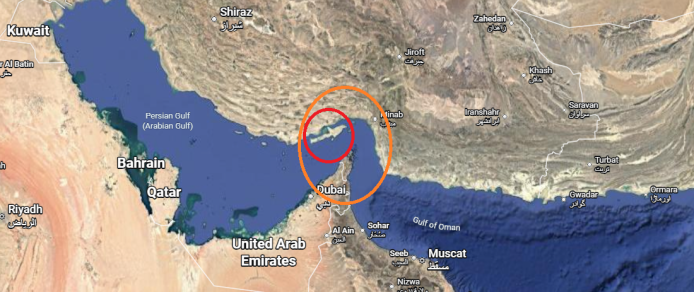
Sitting centrally in the Strait of Hormuz, U.S. control over Qeshm would reduce the most immediate missile and drone threats to passing maritime traffic, allowing for naval escorts (perhaps also including European warships). Ground combat operations on Qeshm would be bloody and difficult, however. The island is 68 miles across and heavily fortified with underground bunkers. And it would be a bloody irony were the 31st MEU tasked with leading an offensive here. After all, that unit just completed major combat exercises on Okinawa, the site of one of the Marine Corps toughest bunker-clearing battles during World War II.
AS STARMER STUMBLES, MACRON QUIETLY BOOSTS MILITARY TIES WITH US
The 31st MEU will take at least 10 days to reach the Persian Gulf.
Once it arrives, Trump will face a big decision. He cannot afford to allow Iran a victory over Hormuz. And if Khamenei and the Islamic Revolutionary Guard Corps lose Kharg Island, they may come to the concessions table. But if and when Marines land on Kharg or Qeshm, only the most pathetic fool could still claim this isn’t a war.