
Chris Kempczinski is one of the great male beneficiaries of the #MeToo heyday, winning the internal promotion to replace McDonald’s CEO and president Steve Easterbrook after the latter was accused of improper sexual relations with his subordinates. Kempczinski, a marathon runner who claims he stays fit while eating at the restaurant daily by ordering Filet-O-Fish sandwiches without tartar sauce and Egg McMuffins sans bacon, has presided over a 68% increase in the brand’s stock price since taking over in 2019, slightly beating the Dow Jones Industrial Average in the past five years and generating twice as much revenue per restaurant than its closest competitors.
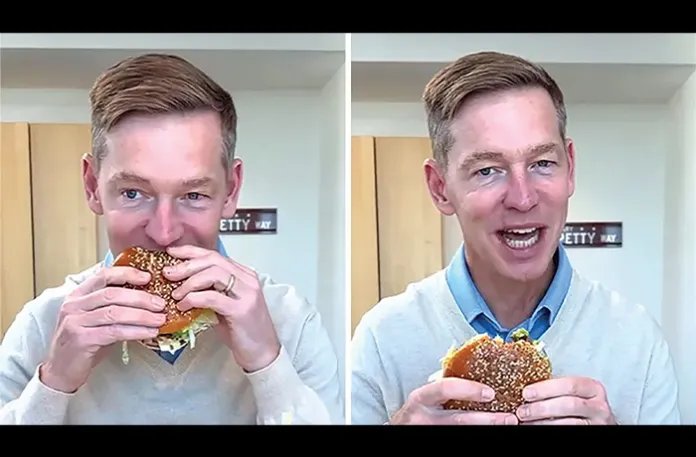
So when the ordinarily careful Kempczinski went viral for his video debuting the chain’s new “Big Arch” burger, the initial response was more amusement than alarm. In a clip that belies Kempczinski’s supposed passion for his own product, he struggles to take more than one bite of what the restaurant calls “the most McDonald’s McDonald’s burger yet.” But naturally, the burger itself — two quarter-pound beef patties, three slices of cheddar, topped with new special sauce on a poppy seed bun — intrigued me.
I’m about as easy a test subject for this burger as anyone: I’ve been racking up savings on the McDonald’s app for over half a decade, rely on a McDouble or two a month to fill an In-N-Out-sized hole in my California heart, and, conveniently, am almost seven months pregnant. So suffice it to say, I took it personally when the Big Arch turned out to be one of the worst burgers I’ve had in recent memory.
I had to wait out a deranged homeless man who was stalking and screaming across the drive-through before ordering, only to be told my burger wasn’t ready yet and that I had to park and wait in the front of the restaurant. Upon going home, I found a burger with zero, not three slices of cheese, a quarter-sized smattering of special sauce, and dry patties that had whatever flavor once infused it burned out of their cores.
Tiana’s terrible Big Arch experience doesn’t matter because a slightly unhinged pregnant woman shed a tear, but rather because Ray Kroc would have sobbed.
Kroc, the magnate who turned the local burger restaurant into the most successful fast-food corporation on the planet, imposed famously strict uniformity in quality control across the chain’s individual restaurants. From the limited number of McDonald’s suppliers cultivated with the restaurant for decades to the “Hamburger University” training that teaches franchisees the exact temperatures, sanitary standards, and number of pickles to place on each Big Mac, Kroc ensured that McDonald’s set the gold standard for, well, standards that are the same across the planet. Countries may allow some fun local menu options, but a Big Mac in Strasbourg is supposed to taste the same as a Big Mac in Singapore.
The problem with the Big Arch was exposed not by Kempczinski’s response to his burger, but by the burger itself: social media seems to agree that the succulent burger Kempczinski didn’t enjoy looked very different from the dry husk a lot of us wanted to enjoy but couldn’t. While the central corporation maintains ironclad supply chain standards, fixed costs, and franchise audits, McDonald’s execution at the individual store level has precipitously declined in the United States.
TIANA LOWE DOESCHER: AMERICA’S SWEETHEART VS. AMERICAN PSYCHO
It’s hard to quantify how much of the recent sales volatility in the brand is due to quality rather than the consequences of inflation and the GLP-1 craze, but a survey of 1,000 American customers by Attest found that at least a quarter complained about quality consistency. And it’s impossible to pinpoint one reason as to why quality has declined, but the labor market, far from being too soft, remains overly restrictive, forcing companies to shell out artificially inflated wages for fewer workers.
Workers may balk at automation, but try the Big Arch, and consumers may fear our robot overlords a little less. If humans can’t put together a Big Arch worth its price tag, there’s no point trying unless McDonald’s figures out how to implement technology to restore the quality control that made McDonald’s great under Kroc.