
PITTSBURGH — It is rare to find a film today that captures the essence of a region, its people, and the ties that bind them with a purity that excludes any outside influences. Yet that is exactly what NFL Films has done with The Football Town — a unique production that brings to life the storied history of western Pennsylvania’s tradition of football, faith, grit, and community.
It hits the mark beyond the story of football and manufacturing greatness and captures a region that celebrates its rootedness in community. And it shows how that community has humbly shaped the nation, thanks to its location, the hardiness of its people, and its love of a game that has both inspired them and held them together when everything around them was crumbling.
The film was made for the lead-up to the 2026 NFL Draft here in Pittsburgh, as part of a partnership with VisitPITTSBURGH, the Pittsburgh Steelers, and U.S. Steel. The picture opens with a sweeping shot of a river navigating the rolling Appalachian mountains containing it.
As the camera follows the curving flow of a river heading toward parts yet unknown, the rugged landscape serves as a symbolic element of the narration about to begin. You immediately understand that the river represents the flow of life, the bonds of community, and the possibilities the places ahead hold.
“There’s something in the water. That’s what people say about western Pennsylvania. It’s a metaphor, but it’s true here. The rivers are the source of life. They were here before, man. They brought man here and they will outlast man in his grand designs.”
From that moment, the viewer embarks on a journey. Narrator Pat McAfee, a Pittsburgh native, delivers the story pitch-perfect. His gravely voice retains the region’s Appalachian twang he grew up with, and he gives it the respect it deserves.
It isn’t dramatized. It’s real and authentic and sets in motion that this film is going to hit you in the gut.
“This isn’t just any football town,” the former NFL punter who played under the Friday night lights here as a kid, says. “It’s the football town.”
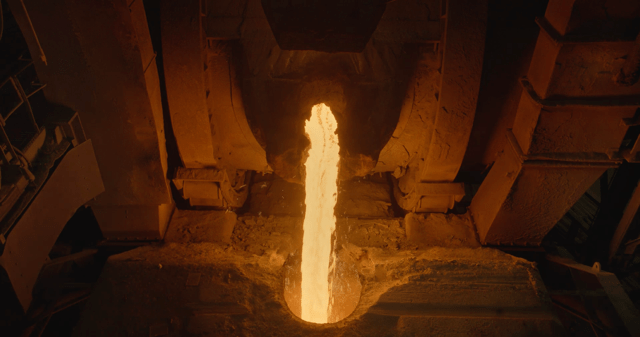
The film isn’t just about football, although that’s the main star. It isn’t just about steelmaking, although that serves as a riveting costar. Instead it is about place. It celebrates the rootedness that has shaped this region, and through that prism it captures the heart of the country.
‘THESE PEOPLE ARE CRAZY’ IS THE CAMPAIGN THAT DEMOCRATS SHOULD FEAR
McAfee’s narration makes the viewer want to be part of what he was part of — even if their team isn’t the Pittsburgh Steelers and even if no one in their family ever toiled in a steel mill. This right here is America at its finest.
He even gives a pretty good history lesson, reminding us how much a young George Washington shaped his nation as a surveyor and young military officer.
The U.S. Steel Tower in the center of the city, the tallest building in Appalachia, gets its due with an overhead shot. “This is the Steel City, the steel made here, built the world,” he says as a shot from the 86th floor of the Empire State Building is shown as the steel is laid while it is being built.
The film was shot last October over one weekend, capturing multiple Friday night high school football games. Each showcases both the coaches as well as the kids who aspire to one day be one of the nearly 700 other western Pennsylvania kids who have gone to the NFL draft, or better yet, one of the 20 NFL Hall of Famers to come from this region.
It’s a city with 90-plus neighborhoods, each fiercely proud of their local foot programs, and 43 school districts in Allegheny County. The shots of the Friday night games in places such as Seneca Valley, Aliquippa, and Westinghouse High School, capture the essence of the grit of the people here, particularly when you see a youth football team playing with the backdrop of the stacks of a steel mill in the background.
“Grit is what made football great here,” McAfee says while the camera takes the viewer deep inside the Edgar Thomson Works mill in Braddock.
The story begins with a reverence for the local history that shaped our country. It takes the viewer deep within the Appalachian Mountains that George Washington surveyed as a young man, to the forts that protected the assets of the French, then the British, in the frontier’s early days. And it reminds both locals and newcomers to the region that while the city has successfully diversified its economy, embracing premier technology, research, and robotics from Carnegie Mellon University and the University of Pittsburgh, none of that would have been possible without the blue-collar men and women who make things in this region.
RALSTON DELIVERS GOLD WITH HIS REID BIOGRAPHY
Without the men and women who get their hands dirty at the three U.S. Steel plants, there wouldn’t be any AI data centers being built here and across the country to power the future. All that is in the backdrop as communities draw together every Friday night to see their young people play at the local high school, or on Saturday mornings to watch Pop Warner ball, and, of course, on Sunday, to watch their beloved Pittsburgh Steelers play.
“There is no other place in the country that can do all of that with the skills and work ethic legacy,” Charlie Batch said after the film. Batch, who was part of a Steeler Super Bowl championship team, added that he was blown away by how well the filmmakers captured the essence of this region.
There are few places in this country that can claim that their hometown has had a significant hand in not only founding our Republic, but also in igniting an industrial revolution. After oil was discovered in Titusville in 1865, it was here where factories churned out the steel that would construct streets, build the bridges and buildings that built this country, and the airplanes and tanks that would secure it.
People have always been at the heart of it all. Descendants of resilient, gritty, hardworking, family-centric people who are fiercely loyal to this place. Their unique blend of individualism and parochialism has not diminished through the generations.
Wayne Wade Jr. was there to watch the film along with a couple of high school football players. And if ever there was a man who embodies the heart of this film, it is this Clairton High School football coach.
Wade, the son of a steelworker who also coached football, won a WPIAL championship as a player, WPIAL and PIAA titles as an assistant, and five WPIAL championships as a head coach.
Clairton, where he coaches, is the embodiment of a steel town. It is where the U.S. Steel Mon Valley Works coke plant sits, the largest coke manufacturing facility in the United States, operating nine batteries on 392 acres. Across from the plant is the practice field for youth football. Here, most of Wade Jr.’s players got their start playing Pop Warner youth football. On a crisp fall day, you can see the contrast between children scrambling in pads and helmets and the backdrop of steam billowing from the plant in the background.
Wade was on the coaching staff when the team won a whopping 66 games in a row, a historic streak that was the longest in Pennsylvania history, only ending against the team it began against, the Monessen Greyhounds — who are also from a steel town.
Last fall, Wade earned the one trophy that all high school football coaches revere. That was the state championship when the Clairton Bears defeated Bishop Guilfoyle 35-3 at Cumberland High School.
Wade, who is also the secondary dean of discipline at McKeesport School district, said the film is also a history lesson and should be required viewing for young people all over the country because of the way it captures what builds community and our country.
“The film exemplifies the dedication to hard work, how kids from places like Clairton can aspire for a better life in football or a good job at the mill; both are the fabrics of our lives and form our community,” he said, “Heck, that is the strength of our community.”
“This film isn’t just about football or steel, it is about how we are all bound together by our love for our place and that is what makes this region different,” he said. “We are just built different.”
This isn’t just a film to preview before the NFL draft comes to Pittsburgh in April. It is about why a region such as western Pennsylvania perseveres through whatever is thrown at it, all while never losing its rootedness — even if it is forced to move away.
Most NFL viewers, including rivals of the Steelers, will acknowledge that there is something about having a sea of gold “Terrible Towels” twirling in the air on their home field, leaving them wondering, “How does that happen?” Is it that the fans love their team so much that they travel to every game? Or is it that so many were forced to move during the crash of the steel industry in the 70s and took their love for their hometown and its team to other cities?

The answer is both. There is a reason why over 1,200 Steeler bars are located across the world, and it has to do with how many people were displaced during the fall of Steel. They never stopped loving their city or their football team, which was often the only glue holding people together in that time period.
TRUMP LIVES UP TO HIS PROMISE TO EAST PALESTINE
This sentiment and loyalty have been passed down by each generation. You are born a Steelers fan. All infants born in the region are swaddled in Terrible Towels. And who knows? Maybe one of those swaddled kids could at least grow up to make the NFL Draft one day. Over 750 have done just that, and more than 30 have gone on to be inducted in the Football Hall of Fame.
There is a reason the region is called the “Cradle of Quarterbacks.” Western Pennsylvania has produced 17% of all quarterbacks in the Hall of Fame, legends such as Joe Montana, Dan Marino, Joe Namath, Jim Kelly, George Bland, and Johnny Unitas.
The feature film will make its public debut Saturday, Feb. 28. It will exclusively play at the Kamin Science Center for two months leading up to the 2026 NFL Draft in Pittsburgh on April 23 through 25.
At 52 minutes, I expect it will eventually be resized to stream somewhere such as Netflix — it’s too good and too important not to. It captures U.S. exceptionalism in a way that you can relate to, no matter who you are rooting for on any given Sunday.