
HERMITAGE, Pennsylvania — In July 2025, Frank Evans attended the inaugural Energy and Innovation Summit in Pittsburgh. Both the certified public accountant and another local financial adviser, Frank Mindicino, emerged clearheaded about what had to happen in northwest Pennsylvania.
And that included not sitting around and waiting for prosperity and opportunity to come.
President Donald Trump had announced $92 billion in investments for the state in data centers and energy projects. Yet none of it was slated for the legendary Shenango Valley, where Sharon Steel once dominated the skyline and lined the pocketbooks of thousands of workers.
“None of that investment was planned for northwest Pennsylvania — none of it,” Evans said during a robust gathering of several hundred locals at Avalon Country Club. The meeting’s objective was to launch a coalition of community members, civil leaders, and local elected officials to form Power Northwest and get the region “shovel-ready” for new business.
Many reporters focus on the closing of the Youngstown, Ohio, steel mills beginning in September 1977 in the Mahoning Valley. And rightly so — thousands of jobs were lost. But thousands were also lost at Sharon Steel.
During the peak of American steel production and manufacturing, they both constituted what was known as the mighty Steel Valley. While the Mahoning Valley plants were more focused on finished steel, the Shenango Valley specialized in ore processing. At its peak, the No. 2 furnace could produce about 60,000 tons of iron ore in one month.
Sharon closed the mill in November 1992. One month later, it filed for Chapter 11 bankruptcy.
Both cities, just miles apart on different sides of the state lines, suffered the same economic fate. Churches closed. Local grocery stores, bowling alleys, movie theaters, and mom-and-pop clothing stores went out of business. Cultural touchstones and community gathering places disappeared.
Newer chain grocery stores came in, and, eventually, local manufacturing plants did open. But the job opportunities just weren’t the same. In time, a pattern set in, with people not learning trades. Young and college-educated people moved away, looking for opportunities.
MISSING THE STORY BETWEEN THE LINES
In February 2025, Russell Mills, the regional executive of the Pittsburgh branch of the Federal Reserve Bank of Cleveland, addressed the issue. Speaking at a Shenango Valley Chamber of Commerce breakfast, Mills said that while labor force participation had rebounded, it remained lagging in the Mahoning and Shenango valleys.
The labor crisis is tied to population loss. In the past 10 years, the counties that made up the Shenango Valley lost over 7,000 people. Trumbull and Mahoning counties also experienced steep declines.
Both Evans and Mindicino hope to end the cycles of population loss, disappearing opportunities, and skill gaps in the area, including the surrounding Erie, Butler, Beaver, Lawrence, Venango, Clarion, Warren, Forrest, and Crawford counties.
Sen. Dave McCormick (R-PA) spent the day in the region and gave an unabashedly aspirational speech telling civil leaders and community members that this coalition is precisely what is needed to make Pennsylvania a leader in one of the most remarkable economic transformations of our lifetime.
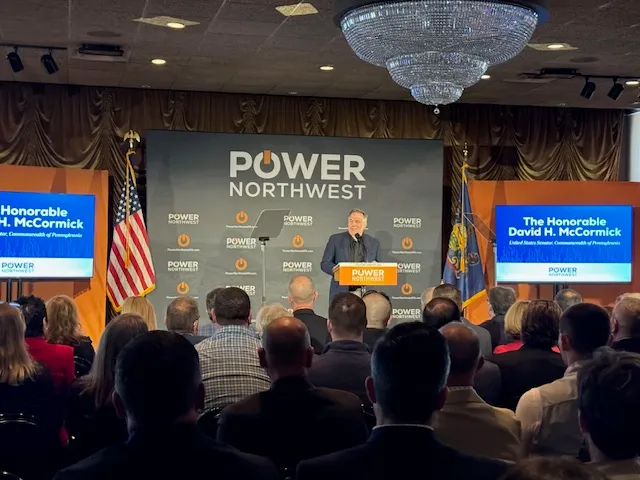
McCormick noted that the Drake Well, with its discovery of oil, had changed the world and made Pennsylvania the heartbeat of the first industrial revolution. But the past 50 years, an aging population, and limited growth, have created real headwinds.
“Still,” he noted, “the assets here are extraordinary.”
McCormick said he sees three major areas of opportunity in the northwest portion of the state: energy and artificial intelligence, national defense, and the life sciences and reshoring of advanced pharmaceuticals. The senator said he will hold another innovation summit later this year, focused on defense transformation.
McCormick pointed to Donjon Shipbuilding and Repair in Erie, Pennsylvania, as well as Hanwha Philly Shipyard in Philadelphia, as a “powerful example of maritime capability.” Last month, officials with the Erie-Western Pennsylvania Port Authority were briefed on a proposal to develop a new shipyard aimed at constructing vessels for the Navy, set to be located on a portion of the former Erie Coke plant along the Bayfront. This could drive economic development.
Erie, the largest city in Erie County, has been mired in a long-term population decline since the 1960s, when the population went from 138,000 to the 92,000 at which it stands today — its lowest level since 1920.
The senator noted that the United States is only responsible for 1% of the world’s shipbuilding, despite having the world’s largest economy. We let it happen, he observed.
“But we’re now on the cusp of rebuilding that because of the efforts to build our defense capability and rebuild domestic shipbuilding,” he noted.
He added that if Pennsylvania steps into the breach for shipbuilding, it will be huge.
“We should capitalize on our shipbuilding heritage and lean into the future,” he said.
The senator said he is backing the SHIPS for America Act, legislation that will jumpstart the industry. Thanks to a skilled workforce and access to the Great Lakes, Erie is a powerful example of the maritime capability that the region possesses, he noted.
“Erie has exceptional assets and the potential to really play a meaningful role in rebuilding American shipbuilding,” he said.
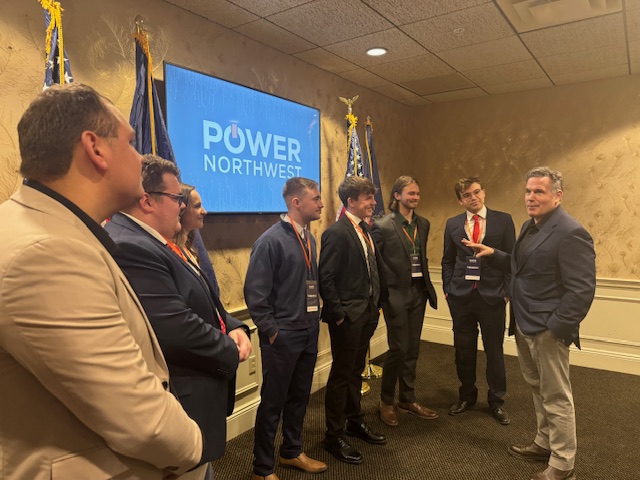
McCormick called on the region to move forward.
“We can’t die by incrementalism and the reasons we can’t do things,” he warned. “It’s really not for us. Mostly it’s for our kids and their kids.”
The senator implored listeners to reject what he called the four horsemen of decline: “Cynicism: ‘Can’t get it done.’ Incrementalism. ‘Let’s go small. We’re afraid we might fail.’ Pettiness. ‘That we don’t want to give somebody else credit.’ Divisiveness. ‘No, we won’t do it because somebody else is from a different party.’”
HOW FAITH AND COMMUNITY FORM AROUND PACZKI
McCormick is known to work well with his colleagues across the aisle, Sen. John Fetterman (D-PA) and Gov. Josh Shapiro (D-PA), on different policies that might bring opportunity to the region. McCormick stressed the importance of working together for the greater good of the area. He said this is a moment where people will look back and say what they did, or didn’t, do.
“Please work with anyone and everyone,” McCormick exhorted. “I promise that I will.”