
Here is a question that is nagging me. Why have the Epstein files had so much more impact in Britain than in the United States?
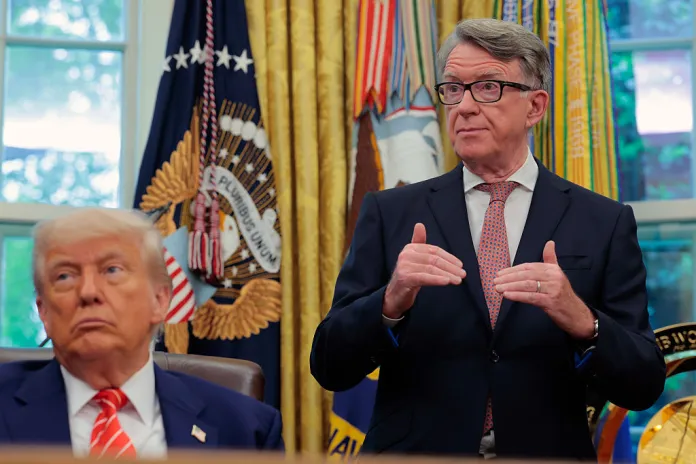
The former British ambassador to Washington was recalled for writing an obsequious greeting in the birthday collection, which contains a similar message from Donald Trump — though Trump denies that the note is his.
Peter Mandelson is gay and was presumably not abusing Epstein’s girls. But the revelation that he received favors from the debauched financier was enough to bar him from the House of Lords, and Britain’s Prime Minister, Keir Starmer, might yet have to resign for having sent him to Washington.
Andrew Mountbatten-Windsor, formerly the Duke of York, has been stripped of his titles and disgraced. In an earlier age, the king’s brother would have been discreetly drowned in a barrel of malmsey wine. In our softer era, I imagine exile in a hot and distant country is likelier.
So far, the only person jailed, other than Epstein himself, is another Brit, Ghislaine Maxwell, convicted of child sex trafficking in 2021. Now, obviously, drawing underage girls into a web of abuse is an abominable crime. Still, isn’t it slightly odd that the only person to have been locked up is a woman? I mean, what are the odds, given the nature of the crimes, that no men have been convicted?
Whatever else is wrong with Britain, at least its disgust reflex is working. It is quite possible that neither Andrew nor Mandelson committed crimes. But both have shown themselves to be men of bad character, dishonest and louche, and both have been hounded out of public life.
What of their American equivalents? No one has yet fallen over the Epstein affair. To be clear, there is nothing wrong with having known the man. Epstein made it his business to befriend public figures and, wherever possible, to have himself photographed with them. But those who went further, those who visited his island, those who romped with his girls, bound one to another, one assumes, by the logic of mutually assured destruction — what of them?
The U.S. appears to be responding in the worst possible way, namely by passing a general statute in response to a specific case. Congressional Democrats have announced that they will propose what they call “Virginia’s Law,” named after Virginia Giuffre, one of Epstein’s victims who brought legal cases against Epstein, Maxwell, and Andrew, and who committed suicide last April. It would remove the statute of limitations in cases of sexual abuse.

Now, here is a hard thing that needs saying. Laws named after people almost always have unintended consequences, precisely because they are passed in a spirit of high emotion and are designed to send a message rather than to deliver proportionate justice.
Megan’s Law, which required that the public be informed about former sex offenders in their localities, raised the rate of reoffending. A study by the University of Michigan Law School explained the increased recidivism on the grounds that “the more difficult, lonely, and unstable our laws make a registered sex offender’s life, the more likely he is to return to crime.”
Caylee’s Law, which required parents to report a missing child within 24 or 48 hours, led to a flood of time-wasting reports, as panicky parents called the police before searching themselves.
Britain inevitably picked up the habit of apostrophe laws from the U.S. and, equally inevitably, suffered worse unintended consequences as a result. Sarah’s Law, the British equivalent of Megan’s Law, led to outbreaks of vigilantism, sometimes triggered by misunderstandings — most notoriously when a pediatrician in South Wales was driven from her home by a mob which had misunderstood her job title.
Martyn’s Law, named after a victim of the Manchester Arena bombing, requires public venues to implement anti-terrorism measures. It has done nothing to reduce terrorism, but has forced a number of small events to close for want of resources.
There may be arguments for abolishing the statute of limitations — England, which has a similar legal system to the U.S., has no equivalent — but, if so, make them on their merits. Don’t try to ram them through as a kind of memorial to Epstein’s victims.
In any case, legal changes are beside the point. Even without criminal sanctions, Epstein’s associates should be shunned and disgraced. So let me ask again. Why is it not happening? Could it be that, like everything else, it has been drawn into America’s culture war? That people start from whether or not they think the revelations are harmful to politicians on their side? The mood surely can’t be that febrile. Can it?