
The Trump administration recently released its National Security Strategy (NSS), as mandated by the Goldwater-Nichols Act of 1986. The NSS theoretically serves as the grand strategy document for the United States, linking the ends of policy and the means available to achieve them in light of limited resources.
The reaction from the so-called “national security clerisy” has generally been negative. The New York Times calls it “misguided and dangerous.” The Atlantic calls it “incoherent babble.” Kori Shake of the American Enterprise Institute judges it “a moral and strategic disaster.”
There are three central criticisms of President Donald Trump‘s NSS: (1) Its apparent denigration of our European allies; (2) its seeming retreat from a policy of underwriting the “rules-based international order” that has been the basis of U.S. foreign policy since the end of World War II; and (3) its emphasis on the domestic “culture wars.” There is no question that the previous approach generally served the U.S. well in the past. But circumstances change, requiring concomitant change in strategy as well.
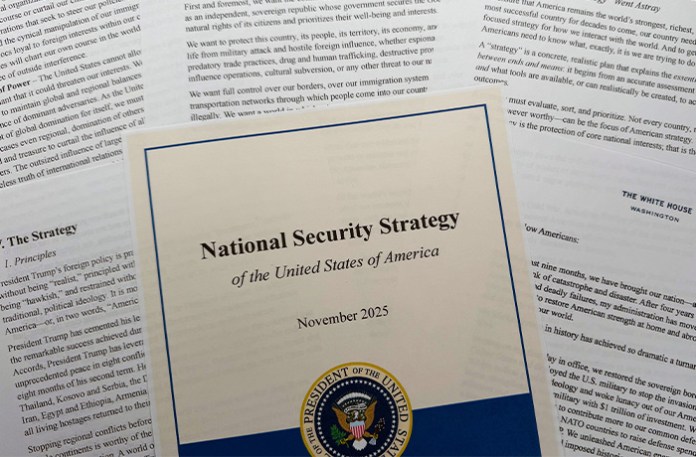
Responding to these changed circumstances is what the Trump NSS does. It corrects the shortcomings of previous NSSs. It is more than a list of aspirations. It lays out an actual approach for protecting U.S. interests. It rejects the idea that foreign policy is international altruism. It insists on reciprocity in foreign relations. It seeks compromise when possible but reserves the right to employ force when compromise doesn’t work. It chooses prudent realism over liberal internationalism, the preferred paradigm of the American foreign policy clerisy.
On Strategy
“Strategy” is ultimately best understood as the interaction of three factors, all within the context of risk assessment: Ends, the goals or objectives set by national policy that the strategic actor seeks to achieve; Means, the resources available to the strategic actor; and Ways, the strategic actor’s plan of action for utilizing the means available. In essence, a good strategy articulates a clear set of achievable goals, identifies concrete threats to those goals, and then, given available resources, recommends employing the necessary instruments to meet and overcome those threats while minimizing their consequences.
Typically, “strategy” now refers not only to the direct application of military force in wartime, but also to the use of all aspects of national power during peacetime to deter war and win the resulting conflict if deterrence fails. In its broadest sense, strategy is grand strategy.
As Edward Mead Earle wrote in his introduction to Makers of Modern Strategy: “Strategy is the art of controlling and utilizing the resources of a nation — or a coalition of nations including its armed forces, to the end that its vital interests shall be effectively promoted and secured against enemies, actual, potential, or merely presumed. The highest type of strategy — sometimes called grand strategy — is that which so integrates the policies and armaments of the nation that resort to war is either rendered unnecessary or is undertaken with the maximum chance of victory.”
Grand strategy is intimately linked to national policy, as it is designed to bring to bear all the elements of national power — military, economic, and diplomatic — to secure the interests and objectives, or ends, of U.S. national policy.
Although strategy can be described as the conceptual link between ends and means, it cannot be reduced to a mere mechanical exercise. Instead, it is a process, described by the late Colin Gray as “a constant adaptation to shifting conditions and circumstances in a world where chance, uncertainty, and ambiguity dominate.”
Strategy, properly understood, is a complex phenomenon comprising a number of elements, including geography, history, political and military institutions, and economic factors. Accordingly, strategy can be said to constitute a continual dialogue between policy, on one hand, and these various factors, on the other, in the context of the overall international security environment.
Real strategy must also take into account factors such as technology, the availability of resources, and geopolitical realities. The strategy of a state is not self-correcting. If conditions change, policymakers must be able to discern these changes and modify the nation’s strategy and strategic goals accordingly. The U.S. has faced substantial geopolitical changes of great magnitude since the end of the Cold War. Trump’s NSS adapts to these changing circumstances without apology. It does what strategy is supposed to do: Determine what is necessary for the security and prosperity of the nation, and then execute policies intended to secure those ends.
Back to the Future?
What most critics of the Trump NSS fail to grasp is that it represents a return to the American grand strategy that can be traced to the very founding of the American Republic, as articulated by George Washington in his Farewell Address and put into practice by the most remarkable statesman of the Early Republic, President John Quincy Adams.
The original problem for the American republic was how to maintain its freedom of action in a world dominated by two hostile powers, England and France. As Washington wrote in his Farewell Address: “It must be unwise in us to implicate ourselves … in the ordinary vicissitudes of [Europe’s] politics, or the ordinary combinations and collisions of her friendships and enmities.”
But, he continued: “If we remain one People, under an efficient government, the period is not far off, when we may defy material injury from external annoyance; when we may take such an attitude as will cause the neutrality we may at any time resolve upon to be scrupulously respected; when belligerent nations, under the impossibility of making acquisition upon us, will not lightly hazard giving us provocation; when we may choose peace or war, as our interest guided by justice shall Counsel.”
Usually invoked as a universal admonition against intervention, the Farewell Address instead represents a prudential combination of interest and principle, to be pursued unilaterally by the U.S.
To keep Europe at bay as the young republic expanded its territory across North America, Adams favored Hamiltonian policies designed to leverage economic and commercial power as the basis of American development. He was ever an opponent of sectionalism, whether it manifested itself among the Federalists of New England during the first two decades of the 19th century or subsequently among Southern slaveholders. For Adams, sectional loyalties contributed mightily to the centrifugal forces that threatened the American Union, but were necessary to protect American independence and the liberty and prosperity of the American people.
For Adams, American disunity was the primary threat to American survival as an independent state. The choice, he wrote in 1811, was between ‘‘an endless multitude of little insignificant clans and tribes at eternal war with one another for a rock, or a fish pond, the sport and fable of European oppressors’’ or ‘‘a nation, coextensive with the North American continent, destined by God and nature to be the most populous and most powerful people ever combined under one social compact.’’ To accomplish his goals, the grand strategy Adams pursued harnessed America’s geographic, military, economic, and moral resources.
The rise of the American republic was not preordained. It was instead something deliberately pursued, but a course that had to be adjusted from time to time. This is prudence. According to Aristotle, prudence is concerned with deliberating well about those things that can be other than they are — in this context, means. In political affairs, prudence requires the statesman to be able to adapt universal principles to particular circumstances in order to arrive at the means that are best given existing circumstances.
Aristotle calls prudence the virtue most characteristic of the statesman. Strategy is a species of prudence. Like the prudent man, the strategist never loses sight of the proper end, but he must be able to adapt his actions in pursuit of that end to particular conditions. As Monroe’s secretary of state, Adams was well placed to explicate and execute such a grand strategy.
In Surprise, Security, and the American Experience, John Lewis Gaddis argued that Adams’ grand strategy was based on three principles: Hegemony, unilateralism, and preemption. Hegemony was based on the idea that the republic’s safety precluded any sharing of power on the North American continent. North America constituted the U.S.’s sphere of influence. The U.S. would not accept a balance of power in the Western Hemisphere but sought to ensure a predominance of power. As Adams stated during a November 1819 cabinet meeting, if the U.S. wanted its territorial integrity to be respected, “the world shall [have] to be familiarized with the idea of considering our proper dominion to be the continent of North America.”
Adams shared the view of statesmen as disparate as Alexander Hamilton and Thomas Jefferson that the real danger to American security and independence was a weak U.S. unable to prevent European quarrels from being transplanted to the American continent. The farsighted American founders understood that the antidote to such a possibility was a strong and viable Union. Adams, like Washington in his Farewell Address, embraced Union as the “surest guardian of liberty” and rejected the possibility that the U.S. could coexist with any other great power in North America.
While unilateralism accepts the need for international cooperation in the form of treaties, it rejects alliances as an unnecessary limit on American action and has often been confused with isolationism. The French alliance of 1778 demonstrated to most Americans the dangers of committing to act in concert with other great powers against future contingencies no one could foresee. As noted above, misperceptions about Washington’s Farewell Address have contributed to the tendency to confuse unilateralism and isolationism.
Adams’ famous speech of July 4, 1821, is also usually invoked to suggest that the default American foreign policy is isolationism. The U.S., he remarked, “goes not abroad, in search of monsters to destroy. She is the well-wisher to the freedom and independence of all. She is the vindicator only of her own.” But like Washington’s Farewell Address, Adams’ speech is simply a prudential expression of a unilateralist policy designed to keep the U.S. from being embroiled in European affairs to the detriment of American interests.
The Monroe Doctrine represents an example of the unilateralist principle. When it became clear in the early 1820s that the newly independent Latin American republics might not be able to defend their sovereignty against Spain, possibly assisted by the reactionary monarchies of France, Austria, and Russia, Great Britain suggested a joint Anglo-American statement opposing future European colonization in the Western Hemisphere. While President James Monroe, along with former presidents Jefferson and James Madison, liked the proposal, Adams sought to transform it into a unilateral statement, in order ‘‘to avow our principles explicitly’’ rather than ‘‘to come in as a cock-boat in the wake of the British man-of-war.’’
Adams realized that the U.S. lacked the means to enforce the policy, but recognized that Great Britain, with its navy, did have such means, and that its own interests in this instance would complement those of the U.S. even in the absence of a formal commitment. Thus, the Monroe Doctrine permitted the U.S. to avoid the danger illustrated by the French alliance of 1778: The obligation to align American long-term interests with those of another state or provide assistance when those interests were threatened.
Preemption is a principle justifying early steps to prevent an adverse outcome in the future. U.S. actions in Florida after the War of 1812 constitute the clearest example of preemption during the early republic, during which time the U.S. faced many threats, including a continuing European presence in North America, from Great Britain in Canada, and Spain in Florida and Texas. It also faced down threats from what we would today call ‘‘non-state actors,” such as marauding Native Americans and pirates ready to raid lightly defended areas on the frontier.
These threats were exacerbated by the weakness of what Adams called ‘‘derelict’’ provinces — today we would call them ‘‘failed states’’ — which provided an excuse for further European intervention in the Americas and sanctuary for hostile non-state actors.
In 1818, Florida provided an occasion to address such threats. After Creeks, Seminoles, and escaped slaves launched a series of attacks on Americans from sanctuaries in Spanish Florida, General Andrew Jackson, acting on the basis of questionable authority, invaded Florida, not only attacking and burning Seminole villages but also capturing a Spanish fort at St. Marks. He also executed two British citizens whom he accused of aiding the marauders.
Most of Monroe’s Cabinet, especially Secretary of War John Calhoun, wanted Jackson’s head, but Adams came to Jackson’s defense. He contended that the U.S. should not apologize for Jackson’s preemptive expedition but insist that Spain either garrison Florida with enough forces to prevent marauders from entering the U.S. or ‘‘cede to the United States a province … which is in fact a derelict, open to the occupancy of every enemy, civilized or savage, of the United States, and serving no other earthly purpose than as a post of annoyance to them.’’ As Adams had written earlier, it was his opinion ‘‘that the marauding parties … ought to be broken up immediately.’’
The result was the Adams-Onis Treaty, in which Spain recognized America’s territorial claims to Oregon and the Pacific Northwest and transferred Florida to the U.S. In return, the U.S. relinquished its claim to Texas as part of the Louisiana Purchase. It seems clear that Trump’s NSS embraces these same principles: Hegemony, unilateralism, and preemption, placing him in good company.
Fundamentals of Trump’s Strategy
Today, it is common to make a distinction between foreign and domestic affairs, but for Adams, the two spheres were intimately connected. As secretary of state, president, and later as a congressman, Adams favored liberty over oppression and believed that the best way for America to support the former was to “perfect the American experiment.” This required security, economic growth and prosperity, and internal stability, the major threats to which were slavery and partisanship.
The connection between foreign and domestic affairs is likewise central to the Trump NSS. Just as disunity in the form of sectionalism threatened the security of the republic in Adams’ time, so does national disunity in the form of the ideological undermining of civic harmony threaten it today. This threat to national unity takes two main forms, and the first is immigration.
The debate over immigration can be traced to the very founding of the republic. Hamilton’s concerns about the need for lawfulness in a republic also help to explain his views on immigration. Although Hamilton was himself an immigrant, he was adamantly opposed to the open immigration policies that President Thomas Jefferson proposed in his first annual message to Congress in 1801. Jefferson had once opposed unlimited immigration, but came to see it as a way to secure the future political dominance of his own party over Hamilton’s Federalists.
Hamilton, like most Federalists, was concerned about French influence on American politics. Although the French Revolution had descended into terror and led to the rise of Napoleon, Jefferson and his Democratic-Republican Party persisted in their attachment to the French. Hamilton feared that Jefferson’s proposal for unlimited immigration would lead to the triumph of the radical principles of the French Revolution over those of the more moderate American Revolution.
Writing as “Lucius Crassus,” Hamilton argued: “The safety of a republic depends essentially on the energy of a common national sentiment; on a uniformity of principles and habits; on the exemption of the citizens from foreign bias, and prejudice; and on that love of country which will almost invariably be found to be closely connected with birth, education, and family.”
Invoking Jefferson’s own “Notes on Virginia,” Hamilton observed that “foreigners will generally be apt to bring with them attachments to the persons they have left behind; to the country of their nativity, and to its particular customs and manners.” He argued that “it is unlikely that they will bring with them that temperate love of liberty, so essential to real republicanism.”
He continued: “The influx of foreigners must, therefore, tend to produce a heterogeneous compound; to change and corrupt the national spirit; to complicate and confound public opinion; to introduce foreign propensities. In the composition of society, the harmony of the ingredients is all-important, and whatever tends to a discordant intermixture must have an injurious tendency.”
Hamilton concluded: “To admit foreigners indiscriminately to the rights of citizens, the moment they put foot in our country, as recommended in [Jefferson’s] message, would be nothing less than to admit the Grecian horse into the citadel of our liberty and sovereignty.” Hamilton’s fear was that a large number of immigrants attached to the principles of French Revolution rather than the American Revolution would undermine that “temperate love of liberty” essential to republican government.
Critical Theory
But in many respects, the most virulent source of today’s divisiveness is the overly intellectualized and emotionally juvenile approach to the world, the pernicious and reactionary philosophy of Critical Theory, which, by means of the “long march through the institutions,” has unleashed a swarm of demons onto the American psyche and helped to undermine American citizenship.
The toxic effects of critical theory are the topic of The Devil’s Pleasure Palace: The Cult of Critical Theory and the Subversion of the West by Michael Walsh, which traces the influence of the “Frankfurt School” — refugees from the Institute for Social Research in Nazi Germany — who sought refuge in America as the Nazis gained power. Like Antonio Gramsci, the father of “cultural Marxism,” these intellectuals recognized that Marx’s target, the Western working class, would never buy into the Leninist argument. Communism had always been imposed by force.
The key to undermining the principles of the American republic was to undermine their foundations. Cultural Marxism has succeeded beyond the most fervent hopes of Gramsci and the Frankfurt School, infecting not only the university culture but also the U.S. military, which has been weakened by such manifestations of critical theory as DEI. Ultimately, both unlimited immigration and critical theory undermine civic unity, without which a republic cannot survive.
Prudence and Overreach
The new NSS avoids the pitfalls of recent U.S. foreign policy. On one hand, some administrations, primarily Democratic, have placed an unwarranted faith in international institutions and acted as if the main use of U.S. power was to support these institutions. All too often, the goal of these administrations was to create a “global good,” a corporatist globalism divorced from patriotism or national greatness. At the same time, these Democratic administrations have consistently failed to make the distinction between friends and allies on the one hand, and enemies and competitors on the other. The result has been a loss of faith in the U.S. by our allies, while our enemies have been emboldened.
On the other hand, President George W. Bush’s administration quixotically embarked on a quest to reshape the world in a liberal image. That quest foundered on the shoals of tribalism and religion in Afghanistan and Iraq. This hubristic effort to reshape the international system ironically contributed to the rise of China in two ways: By expending limited resources on the post-9/11 wars and by acting on the false belief that China was willing to abide by the “norms” of liberal internationalism.
The Trump NSS rejects both overreach and the idea that the U.S. should cede sovereignty to international institutions to be embraced by the mythical “international community.” Although it is in the interest of the U.S. to cooperate with others within this international system, such cooperation depends on reciprocity. This has been especially important in the areas of trade and alliances.
In principle, free trade is good for countries in the international system, but the Trump NSS contends that for far too long, the U.S. has pursued trade agreements not in its best interests. Part of the problem here is that the U.S. has fetishized alliances, treating allies as possessing a kind of moral entitlement rather than as equal members of a strategic relationship. This is especially true of Europe.
Europe and the U.S. share historic and cultural bonds. But over the past few years, these bonds have frayed under the pressure of demographic change and Europe’s weakening commitment to liberal principles. The NSS simply attempts to restore symmetry and reciprocity.
Return of Geopolitics
When the Soviet Union fell in the 1990s, overoptimistic responses included the proclamation that the world had reached the “end of history” and that the U.S. had reached its “unipolar moment.” Technology and communications had rendered the “world flat.” Geography was no longer as important as it had been during the great power struggles of the past, and geopolitics was a fossil of a long-gone age of imperialism. Cooperation, not competition, was the promise of the future. But, as in the years before World War I, such optimism proved fleeting. As history proves, “bad times return.” History doesn’t end. And geography is ever-present.
Napoleon defined strategy as the art of using time and space. His focus was the operational level of war, but his definition also applies to the level of grand strategy. Geopolitics provides the link between geography and strategy. Geopolitics is based on the undeniable fact that all international politics, from peace to war, takes place in time and space, in particular geographical settings and environments. It then seeks to establish the links and causal relationships between geographical space and international political power to devise specific strategic prescriptions.
Geopolitics is not geographic determinism, but it is based on the assumption that geography defines limits and opportunities in international politics. States can realize their geopolitical opportunities or become the victims of their geopolitical situation. One purpose of grand strategy is to exploit one’s own geographical attributes and an adversary’s geographical vulnerabilities.
Geopolitics is dynamic, not static. It reflects international realities and the global constellation of power arising from the interaction of geography on one hand and technology and economic development on the other. Technology and the infusion of capital can modify, though not negate, the strategic importance of a particular geographic space.
Finally, geopolitics clarifies the range of strategic choices, providing a guide for achieving strategic efficiency. While it places particular stress on geographic space as a critically important strategic factor and source of power, it recognizes that geography is only a part of the totality of global phenomena.
The strategic importance of particular regions varies over time. As noted earlier, during the first century of America’s existence, the Caribbean and Gulf of Mexico were its most important regions. As the U.S. became a great naval power, the Pacific became central, leading to the purchase of Alaska from Russia and the annexation of Hawaii. During the Cold War, the U.S. pursued a policy of “containing” the Soviet Union, focusing on the “Rimlands” of Eurasia. In doing so, it followed the dictum of Nicholas Spykman: “Our constant concern in peace time must be to see that no nation or alliance of nations is allowed to emerge as a dominating power” within the Rimland.
The central geopolitical truth of the Trump NSS is that proximity shapes power. If the U.S. wants to compete with China economically, technologically, and militarily, it must simultaneously secure the space in which its own republic exists. This reality explains not only Trump’s actions in Latin America, the apprehension of Nicolas Maduro, interdiction of drug boats, seizures of oil tankers destined to Iran and China from Venezuela, and other forms of pressure on drug cartels and their state sponsors, but also his interest in Greenland.
Danish intelligence reports indicate that both Russia and China are making serious moves to secure footholds in Greenland. If Denmark and other European states are unable or unwilling to resist Russian or Chinese inroads into Greenland, the U.S. has the obligation to step in, as it did in Florida in 1818 and in securing Iceland against Nazi incursions in 1940. A great power cannot effectively project strength globally while hemorrhaging authority regionally. A state that cannot control its borders cannot control its destiny. A country that allows its hemisphere to be infiltrated by hostile powers cannot act with clarity abroad.
The Western Hemisphere is a strategic prerequisite for national survival. The NSS recognizes that the U.S. must secure its neighborhood if it intends to remain a sovereign power. Just as the Founders believed, just as the early republic believed, just as every serious strategist has believed, the Western Hemisphere matters most because geography is not an academic abstraction.
Trump vs. Biden: Less Kant, More Thucydides
The central difference between the NSSs of President Joe Biden and Trump is that the former was based on the assumption that the United States is the steward of a global system, framed in terms of maintaining a rules-based order. Threats are defined as forces that undermine those norms and structures. Thus, security is expansive, and instability anywhere becomes a threat to America everywhere. This explains why issues such as climate change, global health, gender equity, and the expansion of democratic norms have equal standing with traditional military threats.
On the contrary, the Trump NSS narrows the objects of security. Its goal of U.S. strategy is to secure the U.S. political community, its borders, its citizenry, its economic independence, and sovereignty. Immigration is not treated as an externality or humanitarian challenge, but as a strategic threat. Economic dependence is treated as a vulnerability. The Western Hemisphere returns to its central place in U.S. strategic geography.
Recent actions by the Trump administration put the principles of the NSS into practice, such as the regional focus on the Western Hemisphere, enforcing immigration laws, interdicting drug and human trafficking, removing Maduro from power, favoring friends (Israel) over enemies (Iran), seeking to deny hostile powers access to geopolitically important regions (Greenland), demanding that allies carry their own weight, and rooting out divisive ideologies such as DEI from American institutions, especially the U.S. military.
Some critics dismiss the Trump NSS as overly transactional or insufficiently moral. It is true that it does not seek to flatter the moral vanity of its critics. But it is moral precisely because it takes responsibility for the well-being of American citizens. It understands that before the U.S. can lead a coalition in Asia, shape outcomes in Europe, or broker peace in the Middle East, it must remain a functioning republic.
A country that is not confident in its sovereignty, secure in its borders, or rooted in its own civilizational inheritance is not a country capable of bearing the burdens of a great power. It is a strategic doctrine grounded in the belief that the American people deserve a government that protects them before it protects the world.
Dr. Mackubin Owens is a retired Marine and former Naval War College professor.