
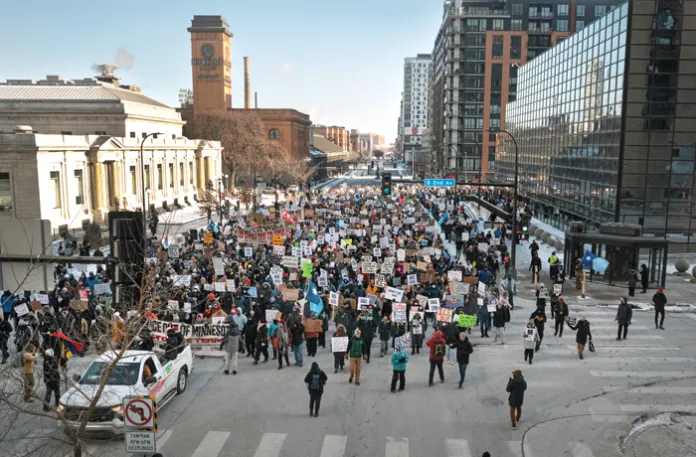
The protests against federal immigration enforcement rocking Minneapolis are frequently framed as a matter of tactics and prudence. Is what the Trump administration is doing strictly necessary to uphold the law? Are the personnel who have been deployed to the area enhancing or undermining public safety? Is this a good use of government resources? Are the new agents and officers being surged to Minnesota properly trained?
These are all important questions, especially after two American citizens have been fatally shot in confrontations with federal immigration authorities. But the showdown in Minneapolis also raises more fundamental questions about the legitimacy of immigration enforcement and whether the winners of the 2024 elections will be permitted to govern.
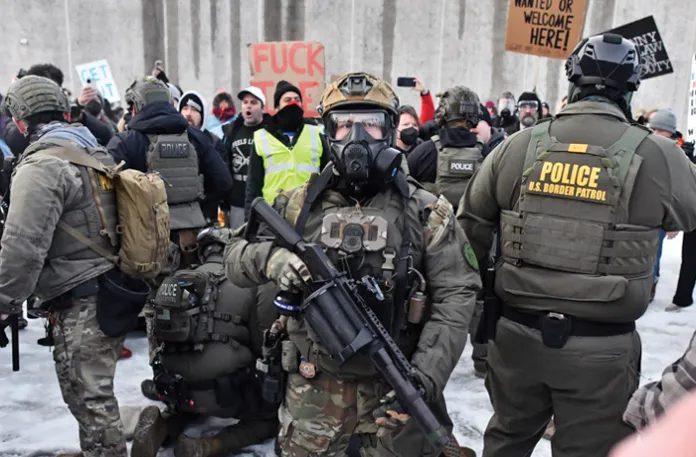
Many of those who have taken to the streets to protest the presence of Immigration and Customs Enforcement and the Border Patrol in their predominantly liberal state harbor deep convictions that these authorities are there to enforce racist and immoral laws. They believe they are unjust in a way that requires resistance and rebellion, not persuasion or legislative remedy. A significant number of mainstream Democrats are beginning to suspect that these activists are right, even if they may not be ready to go quite as far in their public rhetoric.
But a few of their elected officials are getting close. “Many of us grew up reading that story of Anne Frank,” Gov. Tim Walz (D-MN) told reporters at a press conference. “Somebody’s going to write that children’s story about Minnesota.” Walz was the Democratic nominee for vice president in 2024, not a fringe figure. The U.S. Holocaust Museum denounced his comments.
Some of this is inseparable from people’s feelings about President Donald Trump, compounded by anger over the shooting deaths of Renee Good and Alex Pretti. For a decade now, many Trump opponents have styled themselves as the Resistance, bringing suburban moms and college-educated retirees together in an unlikely common cause with antifa to thwart what they see as fascism stalking the land.
For his part, Walz could certainly argue that his comment about Minnesota children “hiding in their houses, afraid to go outside” was a reference to the shootings by agents of the federal government rather than the removal of illegal immigrants. But Minnesota’s sanctuary policies themselves, like those adopted by numerous other liberal jurisdictions, imply our immigration laws and their strict enforcement are illegitimate. And it is precisely those policies that have drawn the federal response at the center of this conflict.
“What we see all over the country, save a few sanctuary cities like Minneapolis, is we see cooperation and support,” Deputy Attorney General Todd Blanche said on Meet the Press on the same day Walz invoked Anne Frank. “We deport 10 times the number of illegal aliens out of Texas than we do out of Minneapolis. Why do we hear nothing out of Texas about any of the same problems that we have in Minneapolis? I’ll tell you why. Because in Texas, we have the cooperation and support of local law enforcement so that we can do these operations safely, keeping U.S. citizens and others protected and safe. That is not what we have in Minneapolis.”
The activists go further still. “The local protesters do not want the illegals deported, period,” journalist and commentator Mickey Kaus wrote. “Even if the ICE force was incredibly well trained, wore white gloves, and followed Waldorf-Astoria rules of etiquette, if they are effective, local dissenters will press forward with resistance until it produces confrontations and some violence. That’s the way it worked in the antiwar movement I was a part of.”
Some of these activists have developed elaborate networks devoted to surveilling and obstructing immigration enforcement operations in the Twin Cities. They follow what they suspect to be ICE vehicles, track their movements, and quickly mobilize protesters to places where they attempt to make arrests or even just get lunch. While that doesn’t justify the shootings that have occurred, it does create a hostile environment in which bad things are likely to happen. This is also why you see ICE officers wearing masks, which, in turn, reinforces the protesters’ beliefs that they are some kind of MAGA secret police.
Not everyone is as far gone as Malinda Cook, a nurse anesthetist who was fired for posting TikTok videos calling for the drugging of ICE officers. But these views are considerably less marginal in left-wing activist circles than they once were.
Democratic elected officials have threatened to block ICE officers from future government employment. Major liberal activist groups have resumed their calls for the agency’s abolition. At this writing, congressional Democrats are poised to shut down parts of the federal government over ICE. This includes Democratic senators who voted to reopen the government during last year’s funding impasse.
“They have also used their platforms to encourage left-wing agitators to stalk, record, confront, and obstruct federal officers who are just trying to lawfully perform their duties, which has created dangerous situations threatening both these officers and the general public and Minnesotans alike,” White House press secretary Karoline Leavitt said of top Minnesota Democrats at a daily news briefing. “This is precisely what unfolded in Minneapolis” on Jan. 24.
That doesn’t mean that the Trump administration has handled everything correctly. The White House has tacitly acknowledged its missteps by sidelining Homeland Security Secretary Kristi Noem and high-ranking Border Patrol official Greg Bovino while elevating border czar Tom Homan and dispatching him to Minnesota. The initial response to the shootings of Good and Pretti, which require thorough investigations, was botched. Worksite enforcement has taken a back seat to public raids.
Noem’s publicity-seeking and the White House social media team’s glee in promoting tough immigration enforcement are intended to encourage self-deportation. These tactics might also have a deterrent effect on future illegal immigrants. But the public approaches these questions with more ambivalence and less zeal than White House deputy chief of staff for policy Stephen Miller, another key player in Trump’s immigration policymaking, even if they generally want the laws to be respected and enforced. Cruelty, however, is not supposed to be the point.
This consistently shows up in the polling. A survey by Fox News found that Trump has a net approval rating of 5 points on border security and a net disapproval of 10 points on immigration. Interior enforcement needs to be done in a manner consistent with Americans’ basic liberties, both as a matter of law and to make the deportations campaign politically sustainable. Here, Trump may also be a victim of his success. Gallup last year found urgency over immigration had diminished since 2024, when the venerable pollster recorded the highest support for immigration reduction since 2001.
Nevertheless, it is important to remember how we got to this point. For much of his term, former President Joe Biden tolerated a level of chaos at the border that hardened public attitudes about immigration. At least 9 million illegal immigrants entered the country during the time period. They were mostly allowed to stay. By January 2025, an Ipsos-Axios poll found that 66% supported “deporting immigrants who are in the country illegally.” A New York Times-Siena poll in September found that 54% strongly or somewhat support “deporting immigrants living in the United States illegally back to their home countries.”
The border and inflation are the top two reasons Trump is in the White House right now rather than Biden or former Vice President Kamala Harris. Why did Biden and Harris allow the border crisis to fester? A considerable part of the answer is that they were responding to activists within their party who found immigration enforcement intolerable.
Most of the 2020 Democratic presidential field wanted to decriminalize illegal border crossings. They all, to varying degrees, supported amnesty for most illegal immigrants already in the country. Many of them wanted a moratorium on deportations, which Biden ultimately issued just two days after taking office.
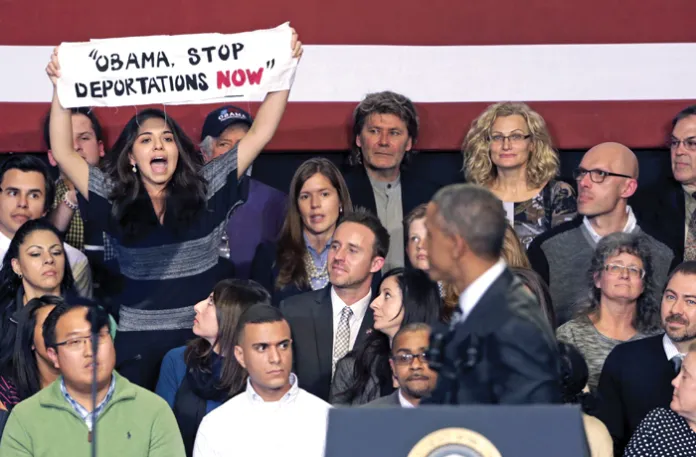
This is not how Democrats initially approached this issue the last time they held the White House. When Barack Obama was president, he sought to ramp up deportations. His goal was different from Trump’s — he wanted to build up enough credibility on immigration enforcement to pass “comprehensive immigration reform,” which would have given some form of legal status to most illegal immigrants. But he sought to break deportation records.
The Obama administration fudged the numbers at times to reach these goals. It focused quite a bit on border apprehensions compared to the Trump administration’s emphasis on the more politically risky interior enforcement. It did not put ICE officers in masks. It prioritized the removal of criminals and recent illegal border crossers.
But Obama still faced a progressive backlash. Activists who labeled him the “deporter-in-chief” did not mean it as a compliment. They often demanded that he grant amnesty to illegal immigrants by executive fiat. “The time has come to abandon the folly of enforcement-first and to focus on legalizing the 11 million aspiring Americans,” wrote Joanne Lin, senior counsel for the American Civil Liberties Union, in 2014. “No borders, no nations, no deportations,” read the placards carried by some protesters.
All this became an issue for Biden when he sought the Democratic presidential nomination. In 2019, there were protests at his campaign office, including family members of illegal immigrants deported under Obama. “Democrats have a choice to embrace the Obama legacy or choose to address the immigration issue in a humane way,” one of the organizers told Politico at the time. In February 2020, Biden, for the first time, said publicly that Obama’s deportations were a mistake. “We took far too long to get it right,” Biden said in an interview with Univision anchor Jorge Ramos, adding, “I think it was a big mistake. Took too long to get it right.” Biden was determined not to raise progressives’ ire on this issue.
This wasn’t always the way Democrats talked about immigration. When Bill Clinton was president, he appointed a liberal black Texas congresswoman named Barbara Jordan to chair his immigration reform commission. She had been a strong supporter of civil rights, but she did not champion an end to deportations.
“Credibility in immigration policy can be summed up in one sentence: Those who should get in get in, those who should be kept out are kept out, and those who should not be here will be required to leave,” Jordan said. “The top priorities for detention and removal, of course, are criminal aliens. But for the system to be credible, people actually have to be deported at the end of the process.” Jordan maintained that “it is both a right and a responsibility of a democratic society to manage immigration so that it serves the national interest.”
This right and responsibility are now politically contested questions in a way that would have been unthinkable during the Clinton years. Democrats have veered leftward on immigration, a journey that began before Trump ever became president.
But there comes a point where the sheer volume of illegal immigration becomes a public safety issue, even if many or most of the undocumented are sympathetic figures on an individual basis. It is also bad for the working-class “forgotten Americans” Trump campaigned to help.
HOW LOCAL BUSINESSES ARE HELPING ANTI-ICE ACTIVISTS OBSTRUCT IMMIGRATION ENFORCEMENT
“Illegal immigration is a tool for creating a second-class labor pool, one that uses the legal black zone of under-the-table labor, unprotected by labor law, to offset a high quality of life for a certain subset of people,” Michael Brendan Dougherty writes. “The arrangement condemns Americans in certain fields to compete with illegal wages and workers, or to vacate fields altogether.”
It is incumbent upon Trump to get his immigration policy right. There is no guarantee he will do so. But it now needs to be said that there is nothing inherently unjust about trying.
W. James Antle III (@jimantle) is executive editor of the Washington Examiner magazine.