
President Donald Trump dishonors the United States and Denmark, one of America’s most loyal allies, with his threats that the Danish territory of Greenland must be transferred to American ownership. Denmark deserves better.
So do Americans.
After all, Trump says that the U.S. needs Greenland to prevent the Russian and Chinese domination of, and military threats from, the Arctic. It is absolutely true that those threats are real. But the president is not being honest with the public. It is clear that he wants Greenland not for its security potential, but rather for its rich energy and rare earth mineral reserves. The proof of this is Svalbard.
More specifically, the Norwegian archipelago of Svalbard.
Located in Arctic bordering waters north of Russia, Svalbard would provide extraordinary strategic value to U.S. efforts to better secure the Arctic region. And while Norway does not currently allow for the basing of military forces on Svalbard’s islands, were Trump serious about his supposed Arctic security imperative, he would be pushing very hard either for ownership of Svalbard or for an agreement to allow U.S. forces to operate from the archipelago. That he is not doing so shows that his fixation on Greenland is about energy and mineral supplies and not security.
To be clear, Trump should not demand Svalbard from Norway for the same reason that he is wrong to demand Greenland from Denmark. Namely, that doing so would only undermine U.S. security by jeopardizing relations with a close ally and by threatening the common security architecture of NATO (of which Norway and Denmark are both members). NATO members are now exercising near Greenland in a uniquely rare show of concern over Trump’s demands. And it should again be emphasized that NATO manifestly serves American security and prosperity.
Consider NATO’s value even from a pure Trumpian economic quid-pro-quo perspective. NATO members imported approximately $1.1 trillion in goods and services from the U.S. in 2025. They also invested approximately $300 billion more in new foreign direct investments into the U.S. last year. In 2021, the year before the U.S. imposed significant sanctions on Russia over its invasion of Ukraine, Russian imports from the U.S. were worth approximately $17.3 billion. Russian foreign direct investments into the U.S. that year were estimated at $800 million. Combining these respective figures, NATO members provide the U.S. 77 times more economic value than even a relatively unsanctioned Russia. And although very belatedly and too unequally, NATO members are finally responding to Trump’s righteous call that they increase defense spending.
Back to Svalbard.
Were the U.S. to complement a bolstered military presence in Greenland (the U.S. military already operates a Space Force base on the territory and Denmark is open to much larger U.S. deployments) with a basing of forces on Svalbard, the U.S. would have the ability to dominate the Arctic security environment. Tempered to security and legitimate energy and mineral extraction policies alongside allies, the rising U.S. dominance would be a manifestly good thing. Russia and China are both pursuing aggressive policies to stake unilateral ownership over Arctic energy and mineral resources and new all-year shipping routes born out of shorter ice life cycles.
But if the U.S. military had access to Svalbard, Moscow and Beijing would have a big problem.
It’s geography, stupid. Just have a look at the maps below. With NATO territories circled in red and the Russian Northern Fleet bases circled in yellow, the maps show that U.S. military deployments on Svalbard, Greenland, and other NATO territories would allow Washington to exert great power both into the Arctic and against Russian forces transiting into the Atlantic.
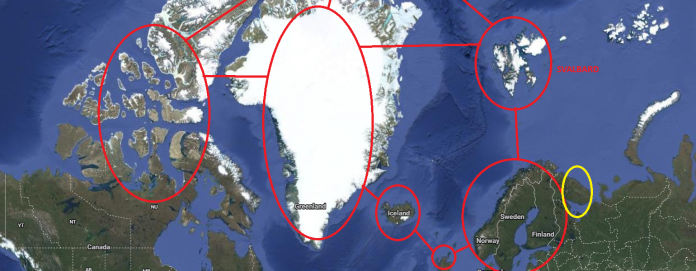
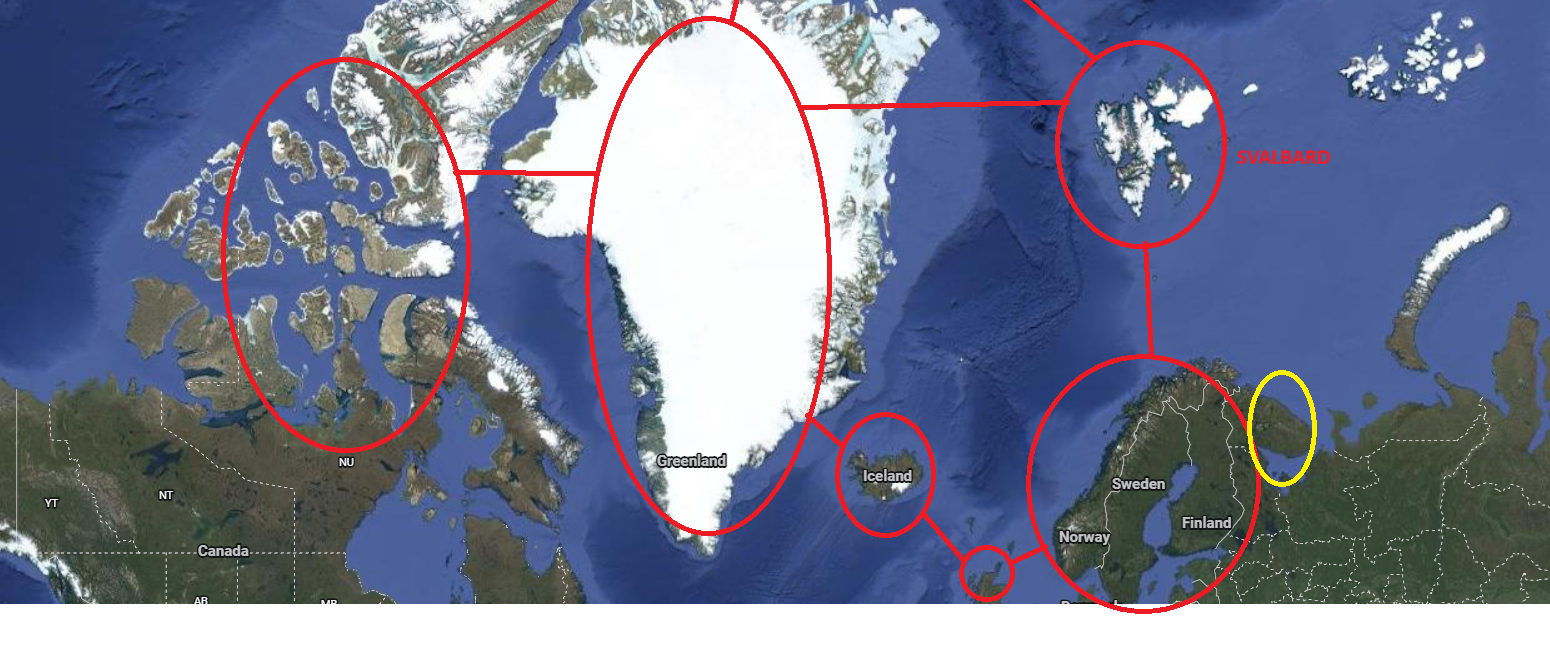
True, the 1920 Spitsbergen Treaty, of which the U.S. is a signatory, restricts military deployments on Svalbard’s islands. Still, in return for ending his threats over Greenland, the other treaty signatories; Norway, the United Kingdom, Denmark, France, Italy, Japan, and the Netherlands, would very likely be willing to amend the treaty to allow U.S. military deployments there. Svalbard already has the infrastructure to support military aircraft at its Longyearbyen airport, and new air and naval facilities could be developed with relative ease.
UK FACES A $38 BILLION TEST OF ITS DEFENSE BUDGET SERIOUSNESS
The tragic thing is that none of this is that complicated. The U.S. military, despising as their officer ranks understandably do in response to Trump’s threats to Denmark and Greenland, will surely have briefed the president on Svalbard’s security potential. Trump doesn’t even mention the territory, however.
He doesn’t, because he wants Greenland for its resources, not for American security.