
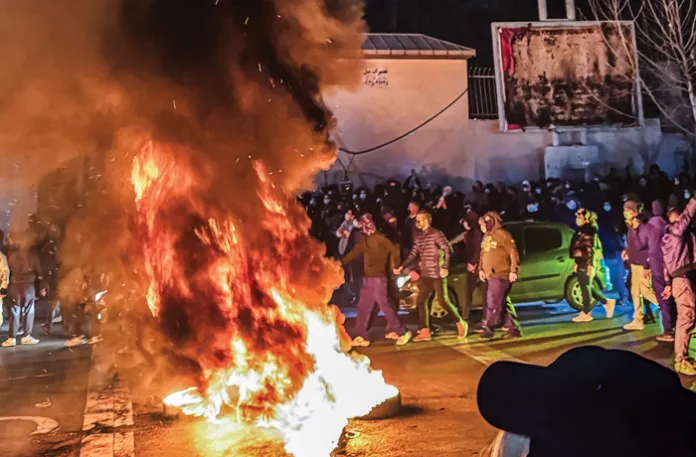
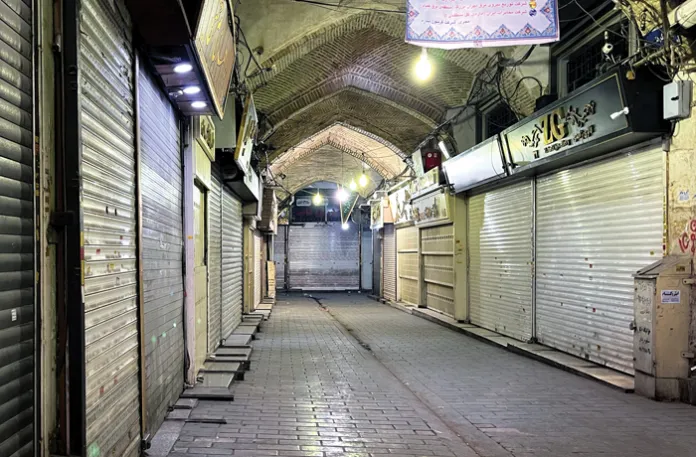
Protests have rocked the Islamic Republic of Iran with increasing frequency for the past quarter-century, but the closure of the Tehran bazaar on Dec. 28, 2025, was different. The market in central Tehran traditionally represents the financial lungs of the Iranian economy. It is not a tourist market as are the souks in Cairo, Jerusalem, or Istanbul, but rather a dense labyrinth of shops and stalls spread out over more than 6 miles of streets and alleys. Outside a few sanitized areas where foreign tourists visit, the dense area is characterized by tin roofs, crumbling brick, and gerrymandered wiring.
Its importance in Iranian history is outsize. In 1905, Iran’s Constitutional Revolution began with a strike at the Tehran bazaar. In 1952 and 1953, strikes in the Tehran bazaar marked the struggle for power between the shah and Prime Minister Mohammad Mosaddegh. In 1978, the Islamic Revolution began when the Tehran bazaar shuttered in protest of an article mocking Ayatollah Ruhollah Khomeini in the main state newspaper. While previous protests centered on Iranian elites — students, soccer fans, environmentalists, or women — the Tehran bazaaris are traditionally religious and conservative. They attend mosque. Their sons or brothers join the Islamic Revolutionary Guard Corps. They should be Supreme Leader Ali Khamenei’s most loyal base. But the regime’s mismanagement of the economy, the collapse of Iran’s currency, and rising inflation are too much for even loyalists to bear.
Regime has prepared for decades to crush rebellions
In many ways, it is a crisis for which Khamenei and the Guard have long prepared. Khomeini created the Guard because he did not trust the Iranian army. He had reason to be suspicious. As revolutionary protests grew in 1978 and 1979, the shah’s army sat on the fence, seeing which way the wind would blow. It only defected to the revolution once its outcome became certain.
While the army remained important for territorial defense, the founding statutes of the Guard define its mission as defense of the revolution, meaning enemies can be either external or internal. In 2007, Mohammad Ali Jafari assumed the Guard leadership and concluded that, with Iraqi President Saddam Hussein dead and the Taliban pushed back, the threats facing the Islamic Republic would primarily be internal. He reorganized the Guard to put one unit in every province, and two in Tehran.
By ensuring that members were not native to the provinces in which they served, Khamenei could remove the chance that they would face family members or school friends among protesters, which could lead them to stand down. Most of the Guard units operating in Kurdish areas, for example, are ethnic Azeris, the Iranian equivalent of putting Germans in Poland or Russians in Ukraine. In recent years, the Guard created a failsafe by importing foreign proxies — Lebanese Hezbollah, Iraqi hashd al shaabi, Afghan Liwa Fatemiyoun, and even, reportedly, Patriotic Union of Kurdistan peshmerga — to fire on crowds.
Even if security forces begin to defect, whether out of disgust with the violence perpetrated on fellow Iranians or because they believe the regime will fall, the structure of the Guard presents another problem.
Guard arms could fuel civil war
Every Guard unit has its own quartermaster-general and its own arms depots. If Iranian protesters overrun individual Guard facilities or if the broader Guard collapses, there could be a mad scramble for Guard arms. While many Iranians may hope for democracy to emerge immediately, Iranian history provides little reason for comfort. A far likelier scenario is that rival Guard units may defect or local power brokers will seek to assert regional power even as they lay claim to national authority. There is precedent here in the early 20th century, before Reza Khan, the leader of the Russian-trained Persian Cossack Brigade, declared himself shah after gaining popularity by subduing tribes and crushing regional autonomy movements.
The fall of dictatorships in Libya and Iraq is also instructive on this scenario. In October 2004, Massachusetts Sen. John Kerry, then the Democratic nominee for president, made allegations that President George W. Bush’s poor planning in Iraq sparked the insurgency by allowing an arms and explosives cache at Qaqa’a to fall into extremist hands. Seven years later, President Barack Obama’s unwillingness to commit ground troops to Libya enabled myriad weapons depots to fall into local hands, fueling conflict between armed gangs and ultimately a proliferation of weapons flows into neighboring states that contributed to terrorist campaigns and coups from Mali to the Central African Republic and from Niger to Nigeria.
The Venezuela model cannot work
The financial interests of the Guard also incentivize a continued fight. While the region knows the Guard as an army, if not a terrorist group, most Iranians know it as an economic conglomerate. Both are right. The Guard rose to prominence during the 1980-88 Iran-Iraq War. When the war ended, the elite forces feared a return to the barracks would mean the end to their power. To ensure their continued influence, they began to invest in the local economy. The Guard’s equivalent of the Army Corps of Engineers began competing for contracts, backed by their own military force if they did not receive them. Famously, when Imam Khomeini International Airport opened in 2004, a joint Austrian-Turkish company won the rights to conduct airport operations. This upset the Guard, which wanted to monopolize customs and the import of foreign goods. After the ribbon-cutting opened the airport, the Guard drove tanks and vehicles onto the runway and refused to leave the facility until authorities canceled the airport operations contract and awarded it to a Guard front instead.
A similar thing happened when a Romanian concern won a contract in an offshore Iranian oil field. After Guard gunboats shot up the Romanian workers, they voided the contract to allow the Guard to take over. Over the past 38 years, the depth of Guard penetration of the economy has grown exponentially. To understand the role of Khatam al Anbiya, the Guard’s economic wing, picture a merger between the Army Corps of Engineers, Bechtel, Halliburton, KBR, Boeing, Northrup-Grumman, Lockheed-Martin, Exxon, Chevron, Walmart, and Amazon. Today, many analysts estimate that the Guard controls up to 40% of the economy.
Many Iranians recognize the problem and blame the Guard. Climate change did not cause Tehran’s water shortage, for example. If it had, then Riyadh, Abu Dhabi, Doha, Kuwait City, and Tel Aviv would also be facing the same problem. Rather, the problem is Guard infiltration of the economy. The Guard demanded, and the government acceded to, numerous dam-building and water-diversion projects, not because they were necessary but rather because they funded Guard companies. Essentially, Guard engineering firms became the Iranian equivalent of the mafia using laundromats and casinos to launder money, with the primary difference being that the Iranian setup hurt ordinary people.
Nor is it only the drought for which the Iranian public blames the Guard and regime. Immediately before the protests began, the Iranian parliament received a draft budget for the new fiscal year, beginning on March 22. It reserved approximately one-third of Iran’s oil for the Guard, revenue from the sale of which would not only pump billions of dollars into Guard coffers but also deny tax revenue to the treasury because the Guard does not pay taxes. Such a setup also gives Guard-owned companies a competitive advantage over any Iranian businesses that must pay taxes. Such a system fuels public anger, but not only does the Guard not care, but it also creates a disincentive to stand down. After all, forfeiting power would also mean forfeiting a fortune.
This is why a Venezuela model would not work in Iran. While it may be tempting to some in the Trump administration to replace Khamenei with a strong general who would keep Iran from disintegrating, the analogy falls flat for two reasons. First, because the Guard is the institution responsible for the crisis that sparked the protests, empowering it would neither fix it nor win the confidence of the Iranian public. Second, it would be a mistake to downplay the Guard leadership’s genuine embrace of its theocratic ideology. Certainly, some Guard soldiers cynically join the service for its privileges, but others enter the bubble when they are as young as 8 because the organization runs after-school programs akin to evil Boy Scouts. They can then remain in the bubble by graduating to other Guard-adjacent organizations or the paramilitary Basij. Finally, they can finish their degrees in universities run entirely by the Guard. Accordingly, many members are true believers, indoctrinated from a young age. Perhaps Trump wants to strike a deal for Guard leaders to follow Khamenei into exile, but doing so would assume not only that they could forfeit their core religious beliefs but would also require a decision to look the other way on their decades of embezzlement and theft.
The promise and perils of Pahlavi
While the outbreak of protests had nothing to do with exiled Crown Prince Reza Pahlavi, its transformation into revolution may have. Whether by coincidence or design, Pahlavi’s subsequent calls to come out onto the street coincided with both the protest’s growth and the violence of the crackdown. Pahlavi has also laid to rest those who doubted his influence or the cachet of his name 47 years after he left Iran.
This should not have surprised anyone. During my first trip to Iran in 1996, I frequented the Isfahan bazaar to practice my Persian with the shopkeepers. A fruit vendor once passed by hawking small, moldy bananas. The carpet salesman with whom I was speaking explained, “My shah, my shah. Where is my shah? When I was young, the bananas were twice as big and one-third the price.” If such nostalgia existed when the revolution was still in its teens, it has only grown larger since. Fifteen years ago, I attended a wedding in Florida for which Pahlavi was the best man. Many guests came from Iran to attend but had no idea the crown prince would be in attendance. Most were from families that were traditionally antagonistic to the monarchy and proponents of Mosaddegh’s efforts to supplant it. When they saw the would-be shah, they got down on their knees and kissed his hand.
Nostalgia for the monarchy, however, does not necessarily mean Pahlavi’s return to Iran would be smooth. He faces many problems. First is his hands-off approach. He overcompensates for the error of his father’s autocracy by tilting toward the indecisive. Second is his disorganization. While he aspires to lead a country of more than 90 million people, he has not been able to run his own office efficiently. Different aides claim to speak for him, often staking out contradictory positions. While Pahlavi himself is modest and gentle, those who seek his adulation seek to prove their loyalty by castigating those around him. Chaos runs supreme. That Pahlavi has shed numerous aides and chiefs of staff over the years, few of whom remain on speaking terms with the would-be king, is a warning sign that cannot be ignored. Third is his fearfulness. While Pahlavi views Iran’s leadership as his right and while he could have a role to play, it is not clear that he has the spine to move from the theory of leadership to its actualization. In effect, Pahlavi and his immediate cohort are like the White Russians of a century ago, always plotting their return, but never wanting to leave the comforts of their life in exile. When the most recent round of protests erupted, Pahlavi was on vacation and remained so for several days until he recognized how serious they had become.
Pahlavi prefers Los Angeles, Washington, Paris, and London to those countries closer to Iran — the United Arab Emirates, India, Turkey, or even Iraq — where he might interact with a younger generation of Iranians. True, not all these countries might welcome him, and both Turkey and Iraq might be outright dangerous. But if Pahlavi plans to return to Iran, he must accept some danger. To try to wait for absolute security will lead to the opposite: A vacuum will develop that more reactive forces will fill. Even U.S. support is no guarantee of safety. The day after Baghdad fell to U.S. forces, Abdul-Majid al Khoei, a moderate Shi’ite cleric seeking reconciliation with the West who had returned to Iraq with U.S. facilitation, sought to take formal control of the Shrine of Imam Ali in Najaf. As he entered the shrine, a mob set upon him and hacked him to death. Even if the Islamic Republic collapses, many people will remain fully indoctrinated into Khomeini and Khamenei’s vision. If Pahlavi responds by isolating himself, however, he will fail in his mission to unify.
Still, he holds unique promise, especially as he seeks not to be his father, but instead a figure like King Juan Carlos I, who eased Spain’s transition back to normality and democracy after the fall of dictator Francisco Franco.
Aiming for democracy is worth it
There is no magic formula, but seeking democracy in Iran is worth it. Consider the alternative: In 1989, President George H.W. Bush sought to rush reconciliation with communist China just weeks after the Tiananmen Square massacre. Had he instead sided with the Chinese students, perhaps the United States and China would not be openly maneuvering for a future war. Two years later, Bush called for Iraqis to revolt against Saddam. They did, but Bush wobbled, and Saddam crushed the uprising. Not only did there follow a reign of terror, but the 12-year period between the liberation of Kuwait and Operation Iraqi Freedom only allowed the Guard to build its proxy and terrorist network inside Iraq. Hundreds of Americans died as a result. More recently, President Barack Obama turned his back on Iranian protesters, leading to their chant, “Obama, Obama, ya ba oona, ya ba ma”: Obama, Obama, you’re either with them or with us. What Obama saw as an opportunity for engagement, Khamenei saw as naivete to exploit.
Former President George W. Bush sought to bring democracy to the Middle East, but his efforts to transform Afghanistan and Iraq sullied the idea of exporting democracy. Today, both realists and regime apologists question the wisdom of seeking to bring democracy to Iran. They are wrong to dismiss it. Iran is neither Afghanistan nor Iraq. For Iranians, democracy is not a concept imposed by foreigners — rather, it is an indigenous experience to which they hope to return. During the 1905-1909 Constitutional Revolution, liberals and constitutionalists triumphed over an autocratic shah to force a parliament and constitutional limits on the monarchy. Iran’s subsequent democracy was real, but short-lived. Nevertheless, it creates a model that many Iranians can embrace.
While Pahlavi has the name recognition, he is not alone. There are many strains of opposition. Former reformists who have defected from the government, ethnic activists among the Kurds and Baluch, republicans, and labor activists. Here, the Constitutional Revolution provides hope. Not only did it give birth to Iran’s first true democracy, but it was also a movement without a single charismatic figure leading it.
What happens in Iran won’t stay in Iran
While a civil war is the most likely scenario in the short term, especially with neighboring states interfering to support their own proxies, Iranians strive for peace and moderation. Ultimately, they will achieve it. When they do, the region will transform for the better. Years of theocratic terrorism have immunized them to the empty promises at the heart of Islamism.
What is now underway in Iran is a historical event as momentous as Gamal Abdel Nasser’s 1952 overthrow of the Egyptian monarchy, the original 1979 Islamic Revolution, or the 2011 Arab Spring. Each event had ramifications across the region. When Nasser overthrew King Farouk, the kings of Libya, Iraq, and Yemen quickly followed. The 1979 Islamic Revolution transformed Lebanon, almost overthrew Bahrain, and today overshadows Yemen’s civil war. A fruit vendor’s suicide in Tunisia not only led to the fall of that country’s long-term dictator but also swept aside leaders in Egypt, Libya, and Yemen, and sparked a civil war in Syria that ended with Bashar Assad in exile in Moscow.
IRAN TURNS TO IRAQI MILITIAS TO SAVE ITS REVOLUTION
If Iran turns its back on Islamism and re-embraces a monarchy, the model could inspire similar movements in Afghanistan, where many Afghans exhausted by the Taliban romanticize the Barakzai dynasty and could welcome their exiled crown prince, Muhammad Zahir Khan. During my first visit to Iraq in 2000, a Kurdish academic quipped that Saddam was God’s curse since the communists killed the king in 1958. Arabs may reconsider their style of politics, especially if the Guard is no longer pumping money to their most reactionary, anti-American leaders. Moderation may prevail.
When Khomeini ousted the shah, Iran was on the verge of becoming one of the world’s most developed countries. That Iranians seemingly volunteered to return to a medieval order compounded the shock. Publishers commissioned professors to write books explaining the events — to a man and a woman, they described the Islamic Revolution as the natural apex of Iranian political evolution. A generation of diplomats and intelligence analysts, unable to visit Iran, have read these books and absorbed their theses. The problem is that the books were wrong. What happened in Iran was never natural, but rather an anomaly. It is time for the world to recognize that and help Iranians to achieve democracy and resume their place in the world.
Michael Rubin is director of policy analysis at the Middle East Forum and a senior fellow at the American Enterprise Institute.