
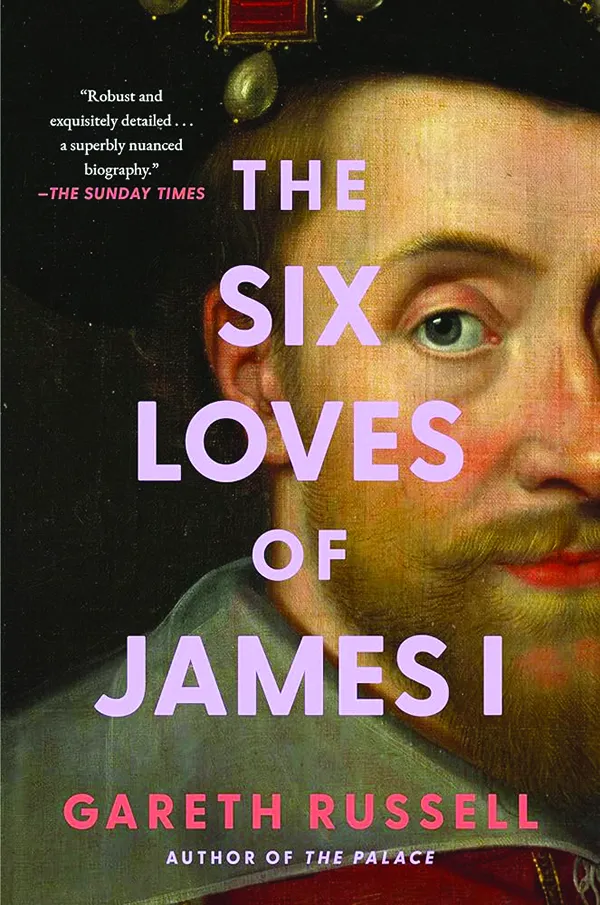
Though I occasionally find myself sucked into the high-gloss gossip of modern celebrities and political figures, the intrigues of our own era’s rich and powerful can’t hold a candle to the high drama of Tudor and Stewart England. In Gareth Russell’s The Six Loves of James I, we learn about a monarch who, if they had existed in his day, would have ruled the tabloids.
James may be best known to modern audiences for his male affair partners, thanks in large part to his recent depiction in the Starz series Mary and George, which plays fast and loose with Stewart history. Even scholars may be misled about the monarch, given the “caricature” which Russell says was assembled in the aftermath of his rule, when chroniclers cast him “as a Neoplatonic nightmare who slobbered on his male favorites, draped himself over them because he could neither walk nor function without them, and refused to wash.”
Russell’s depiction of James is far more expansive and generous. Despite its provocative title, The Six Loves of James I has far less to do with James’s infamous lovers than with taking an encompassing look at James’s life from conception through death, highlighting his work to unify Great Britain, his strong marriage to the formidable Queen Anna of Denmark, his patronage of the arts, his support for the colonization of the New World, and his sponsorship of the beloved King James Version of the Bible.
Russell sets the tone for the cutthroat power politics that would mark James’s life with his opening explanation that “the first of the many attempts to kill James Stewart came when he was in utero, and the plot involved his father.” In descriptive prose that is a hallmark of the biography, Russell brings a murder in Holyrood Castle to striking life. A horde of Scotsmen descended on the private chambers of James’s mother, Mary I, in order to kill her favored courtier, David Riccio. Russell describes how the attackers overturned tables and nearly set the room aflame as Riccio “cowered behind his employer, grabbing hold of her skirts and begging the men to show him mercy.” As attackers stabbed Riccio, one dagger flew so near Mary’s face that “she felt the coldness of the iron.” Only after another attacker “pointed a pistol at her belly” were the men able to drag Riccio from the room, leaving Mary and her ladies to “hear his sobs and screams, punctuated by stab after stab, until both sets of noise fell silent.”
Following Riccio’s murder, Mary attempted to spare her unborn child from a lifetime of “accusations of illegitimacy” by drawing closer to James’s father, Lord Darnley. Roughly 11 months later, Darnley would be strangled to death after escaping an explosion in the house where he was sleeping. Ongoing tumult forced Mary to seek asylum in England around a year later, at which point James inherited the Scottish throne and became James VI of Scotland. (He would take the name James I of England only later, when he became sovereign of that country as well.)
Russell demonstrates well the atmosphere of death threats and struggles for control that a young James faced. By necessity, James was raised apart from his mother and instructed by a tutor who consistently instructed his charge on Mary’s “moral failures as a wife and mother.” Regardless, Mary and James held a deep love for one another, though Russell reports that “their letters to one another, in French, did however end with both signing themselves as Scotland’s monarch.”
Two years after his mother was put to death in 1587 for complicity in a plot to murder Elizabeth I, James married Anna of Denmark. As Queen, Anna would “transform … herself into one of the most powerful political forces in Scotland.” Though Russell believes Anna knew of, and eventually exploited her knowledge of, James’s attraction to men, the two were a united front in running Scotland. They would also work in tandem to successfully rule England after Elizabeth I’s death in 1603 made James “the first king of England to be proclaimed at Edinburgh’s Mercat Cross.” Overnight, James gained control of myriad English properties and a larger tax stream, though it took more finagling for Anna to gain access to Elizabeth’s jewels.
James expressed an immediate hope to unify his countries and “establish peace, and religion, and wealth, betwixt” them. He “discussed proposals for creating a single currency, mutual laws, and free trade,” and put forward plans for a flag that would combine the blue and white Scottish cross of St. Andrew with the red and white English cross of St. George. Chosen in 1606, the new design would signify the new Jacobean era. The flag soon earned the nickname “Union Jack,” short for “Jacobus.”
The king of England and Scotland was a man of his era, of course. Under his reign, witch hunts claimed the lives of accused women who were certainly innocent of the charges against them. James also had weaknesses, including a dependency on alcohol in his later years and his poorly concealed array of affair partners. Incredibly hypocritical about those affairs, James wrote a book warning his son, Prince Henry, to “avoid ‘the filthy vice of adultery.’” Russell says that James also indicated that sodomy was “an equally unforgivable crime.”
TRUMP ADMINISTRATION STRIKES ANOTHER HAMMER BLOW AT AFGHAN ALLIES
Though some scholars believe that James had 15 lovers in his lifetime, Russell’s close attention to the texts — and subtexts — from the era indicates he had only six lovers. James’s partners were both men and women, and he often lavished them with titles and lands, giving them access to sometimes unprecedented power. If readers are hoping that The Six Loves of James I will contain lascivious details about James’s dalliances, they will be disappointed. Exceptions are few and far between, like a poem containing “overtly sexual imagery” that James likely wrote in honor of former mistress Anne Murray and a mildly erotic letter exchanged between James and last favorite George Villiers. In the case of some partners, the evidence of a relationship is incontrovertible, as in the case of Villiers and James, who began to refer to one another as husband and wife around the time of Queen Anna’s death.
An exciting and engrossing read, The Six Loves of James I would be a particularly excellent choice for book clubs catering to history lovers. The manifold unsolved mysteries — poisonings, attempted and actual murders, and the lingering question of whom James loved — between the covers would lend endless possibilities for debate and discussion. But far more enduring than the moments of intrigue is Russell’s dense, rich, and compelling account of a complicated king whose accomplishments left an indelible mark on the modern world.
Beth Bailey (@BWBailey85) is a freelance contributor to Fox News and the host of The Afghanistan Project.