
“The art of fiction is dead,” veteran New York sports reporter Red Smith wrote in 1951, after Bobby Thomson’s home run beat the Brooklyn Dodgers for the pennant. “Reality has strangled invention. Only the utterly implausible, the inexpressibly fantastic, can ever be plausible again.”
Smith covered baseball. Had he lived to witness Indiana’s 38-3 demolition of Alabama in the Rose Bowl on New Year’s Day and 56-22 destruction of Oregon a little over a week later in the Peach Bowl, he might have written those words again. When ESPN‘s Rece Davis asked Hoosiers head coach Curt Cignetti to describe his program’s transformation from college football‘s most reliable laughingstock to the nation’s consensus No. 1 team, Cignetti gave a two-second pause before delivering the only honest assessment: “It’d be a hell of a movie.”
It would. Indiana entered the 2023 season as the losingest program in Division I history, with more than 700 defeats accumulated across 130 years of trying and failing. The Hoosiers had won precisely three Big Ten games in the three seasons before Cignetti arrived. Their last conference championship came in 1967. Their previous Rose Bowl appearance preceded the moon landing.
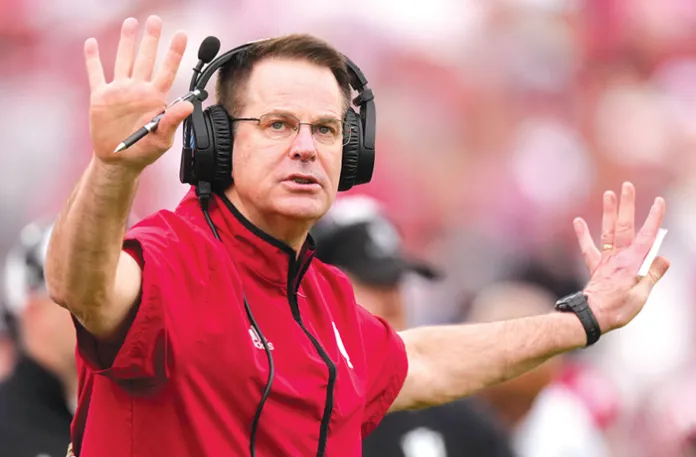
The athletic director who inherited this situation, Scott Dolson, wanted an experienced head coach with an offensive mind who could develop quarterbacks. He went off the board and found Cignetti at James Madison University, where the coach, then in his late 50s, had compiled a 52-9 record across five seasons while guiding the program through its transition from the Football Championship Subdivision to the Football Bowl Subdivision. Dolson made the call on a Wednesday. By Friday morning, Cignetti was in Bloomington.
He introduced himself at an Indiana basketball game on Dec. 1, 2023. New coaches typically offer platitudes at these things. Cignetti grabbed the microphone and announced, “Purdue sucks — but so does Michigan and Ohio State.” The crowd erupted. Three weeks later, reporters asked how Cignetti planned to recruit players to a program that couldn’t recruit players. His answer became the line that defined the season: “I win. Google me.”
Googling would have revealed a lifetime in football that started in the hills of southwestern Pennsylvania. Cignetti was born in Pittsburgh in 1961, the son of Frank Cignetti Sr., who was then coaching at Leechburg High School. His accent — the rounded vowels and dropped consonants of the Mon Valley, no different than any of my relatives — remains audible on every national broadcast. The Yinzer who grew up on college practice fields while his father climbed the coaching ranks now appears on 60 Minutes, CNN, Fox, ESPN, and anywhere else people want to learn about the best sports story in America.
From 1976 to 1979, Frank Cignetti Sr. was the head coach at West Virginia, where a young Nick Saban, not yet the GOAT coach he would become, was his defensive backs coach. He later returned to his alma mater, Indiana University of Pennsylvania, and coached the Crimson Hawks for 20 years, posting a 182-50-1 record with two Division II national championship game appearances. The College Football Hall of Fame inducted him in 2013. The playing field at IUP bears his name.
Son Curt played quarterback at West Virginia from 1979 to 1982, then spent the next 26 years as an assistant coach at Pittsburgh, Davidson, Rice, Temple, North Carolina State, and Alabama, where he won a national title under Saban in 2009 and recruited players including Julio Jones and Mark Ingram. Even though he learned everything there was to know about big-time football from Saban, the big-time head coaching job never materialized.
So Cignetti, then 49, took his first head coaching opportunity at IUP in 2011, succeeding his father’s own failed successor. He went 53-17 in six seasons with three NCAA Division II playoff appearances. He moved to Elon, turned around another program, then left for James Madison. At each stop, he won. At each stop, nobody from the power conferences called.
The “what” of Indiana’s rise is simple enough. The Hoosiers went 11-2 in Cignetti’s first season, then, as of this writing, 15-0 in his second, beating defending national champion Ohio State for the Big Ten championship and crushing Alabama and Oregon, for a second time in the same season, no less — three of the country’s best programs in quick succession. Fernando Mendoza, a two-star recruit from Miami who transferred to Indiana after three seasons at California, won the Heisman Trophy, the first in school history.
The “how” requires acknowledging that college football has changed. The transfer portal allowed Cignetti to bring 13 players with him from James Madison. Name, image, and likeness money allowed Indiana to compete financially with programs that have competed financially since the sport began. Cignetti spent $60 million on football in 2024, according to the Knight-Newhouse database, the first time Indiana exceeded the Big Ten median in total football spending in at least two decades.
Billionaire Indiana alumnus Mark Cuban cut a lot of those big checks. “I gave some to sports this year for the first time ever,” Cuban told CBS Sports in October 2025, explaining his decision to start funding Indiana athletics after decades of donating elsewhere to the university. Cuban, who graduated from IU in 1981 and was born in the same Pittsburgh-area hospital as Cignetti three years earlier, had never bothered with the athletic department. “After getting to talk to Cig and seeing what was going on, they kind of talked me into it.” Cuban obviously liked what he heard, and who could blame him? That accent is a thing of beauty.
None of this diminishes what Cignetti accomplished. Alabama and Ohio State had more money and better recruits, and Indiana beat them both. The Hoosiers’ point differential through 15 games, plus-473, ranks second in the AP Poll era behind only Florida State’s dominant 2013 national championship team.
When Cignetti missed his father’s Hall of Fame induction in 2013 because he had practice at IUP, he could not have imagined standing in the same building 12 years later as the coach of college football’s top-ranked team. He visited the kiosk displaying Frank’s accomplishments before his press conference in Atlanta ahead of the Peach Bowl semifinal against Oregon.
IS A KOREAN REALITY SHOW THE LAST HONEST SPORT?
Frank Cignetti Sr. died in September 2022. His son has since won 26 of his first 28 games at a program where winning has long been structurally impossible. The family legacy at IUP — the other IU, the one in Pennsylvania near the big nuclear power plant in Homer City — anticipated the dynasty Curt is building in Bloomington.
As of this writing, only the utterly implausible, the inexpressibly fantastic, remains for Cignetti to achieve. I think he’ll do it, but don’t take my word for it. Google him.
Oliver Bateman (@MoustacheClubUS) is a journalist, historian, and co-host of the What’s Left? podcast. Visit his website: www.oliverbateman.com.