
On a clear winter day in Dublin, a cold wind blows down the Liffey and flutters the Palestinian flags at the souvenir stall on O’Connell Bridge. Flocks of European tourists take selfies at the Gothic gate of Trinity College, oblivious to the statue of stately, plump Edmund Burke, then mill in and out of souvenir shops selling tweed caps and cartoons of leprechauns. The bars are full, the buskers are better than in London, and the Guinness is more perfectly aerated than anywhere else in the world. The tourists come for a taste of the old Ireland. But the Irish live in a new country.
In 2024, according to the Irish government, 15.5% of Ireland’s population were not Irish citizens. The European Union recorded that Ireland’s foreign-born population was 1.2 million out of a total 5.4 million, or 22.4%: a higher rate than in the United States or Britain. The only EU states with higher percentages of foreign-born passport holders were the tax havens of Liechtenstein, Luxembourg, and Switzerland and the ask-no-questions Malta and Cyprus. In the EU as a whole, foreign-born people were 9.9% of the population. In the eastern states such as Hungary, Poland, and Romania, foreign-born people were in the low single figures.
In 2023, the most recent year for which statistics are available, nearly 30% of Irish babies were born to foreign-born mothers. Legal or illegal, immigrants to Europe aim for the wealthy welfare states. Look at it that way, and Ireland’s numbers are a marker of success.
Ireland was once a poor nation whose most valuable export was its people. It is now a wealthy nation that imports people faster than any other member of the EU. But Ireland’s economic, social and political foundations are not as solid as they seem — and free speech, perhaps the most foundational value of all, is under threat too.
The new Irish
“Céad míle fáilte,” the Irish say: “A hundred thousand welcomes.” Make that 125,300 official welcomes in the year to April 2025, not forgetting 18,560 illegal immigrants and asylum-seekers, 30% of whose appeals to remain succeeded at the first attempt, plus somewhere near 30,000 undocumented adults whose numbers are roughly equivalent to the population of the county town of Kilkenny.
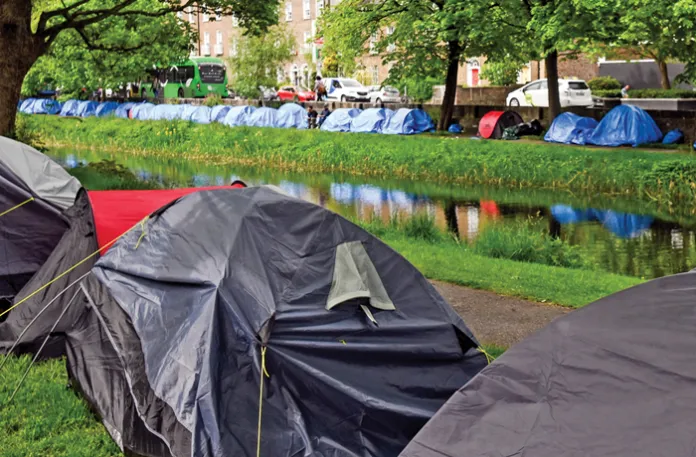
In April 2025, Ireland’s Central Statistics Office estimated the total population at almost 5.5 million people. In the 12 months before, 125,300 legal immigrants came to Ireland. This was lower than the 149,200 in the previous 12 months. The impact of these numbers is offset by emigration — 69,900 in the year to April 2024, 65,600 in the year to April 2025. Still, the influx of legal immigrants over the last two years alone exceeds the 250,000 or so residents of Cork, Ireland’s second-largest city.
Returning Irish citizens comprised about one-fourth, 31,500, of immigrants in the year to April 2025. Another quarter were citizens of the United Kingdom, 4,900, and the EU, 25,300. The Central Statistics Office did not report whether arrivals in these categories descend from Ireland’s indigenous population or from recent immigration into Ireland or other European states. The remaining half of Ireland’s immigrants, 63,600, were from other countries. The 2022 census found that the other countries with the fastest-growing presence were India, 15%, and Brazil, 8%. A refugee Ukrainian population appeared soon after the Russian invasion of Ukraine in February 2022. Similarly, Ireland’s Syrian population quadrupled after the Syrian civil war.
As in its late-1990s leap forward from economic backwater to “Celtic Tiger” prestige, Ireland’s recent immigration experience is an accelerated and more extreme version of that experienced by the other, larger states of Western Europe.
The old Ireland was highly homogenous: a kinship society that was almost entirely white and Catholic. The new Ireland is diversified in population, faith, color, and class, but, as elsewhere, the mixed blessings and their unequal distribution have created a gap between the needs of the state and the desires of the people. As elsewhere, the state and its institutional allies in the academy and the media have policed that gap by permitting discussion of some topics and stigmatizing other topics.
As elsewhere, this has backfired. The rise in population has caused a housing crisis. While overall price inflation rose by 22% from 2015 to 2024, house prices rose by 91% and rents rose by 78%.
On Nov. 4, a report from the Department of Finance warned that even if housing starts doubled from 30,300 in 2024 and the government built a quarter of them as social housing, pent-up demand is so high that the crisis would persist for at least 15 years. Housing is so expensive that skilled and educated young workers are priced out and pushed to emigrate. The taxes from their work will go to other governments. Ireland will be unable to meet its pension and welfare commitments. The government must choose between cutting those commitments and trying to boost the tax take through high immigration.
A November poll for Business Post found that 72% of Irish respondents supported the Department of Justice’s plans to “make it more difficult for immigrants to come/remain in Ireland.” But the Department of Finance’s report concluded that “Continued inward migration will be vital to maintain growth in the labour force.” Something has to give.
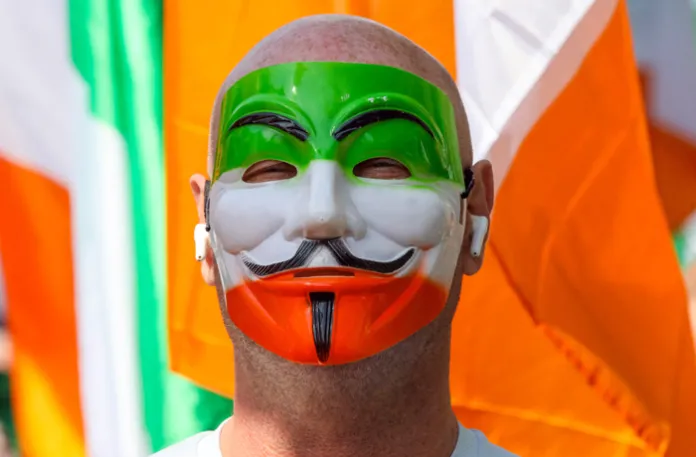
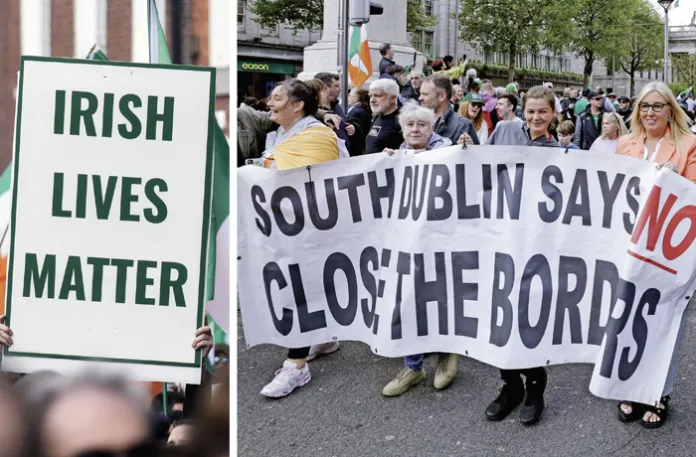
Between November 2018 and July 2024, there were arson attacks at 31 hotels, hostels, and other locations hosting, or believed to be connected with, asylum-seekers. Eighteen of the 31 incidents occurred in the eight months after November 2023. Fourteen of the fires were in Dublin. In July 2024, anti-immigrant protesters carrying “Irish Lives Matter” signs fought police and private security guards outside migrant accommodation at Coolock, near Dublin. In the same month, people with knives and pipes attacked 15 Somali and Palestinian asylum-seekers in a makeshift tent camp on City Quay in central Dublin.
The worst disorder occurred in November 2023, after Riad Bouchaker, an Algerian-born Irish citizen, stabbed three young children and their carer with a 14-inch knife at a preschool in central Dublin — “A threat to free speech comes to Ireland,” Dec. 8, 2023. The “Dublin riot” that followed was the most violent disorder in the city’s modern history. Hundreds of people gathered at the crime scene that night. They bombarded police with fireworks and bottles, looted shops, and set police vehicles and trams on fire. The police commissioner, Drew Harris, blamed the riot on the “lunatic, hooligan faction driven by a far-right ideology.”
British Prime Minister Keir Starmer took the same line when anti-Muslim rioting broke out across England in July 2024, following the massacre of young girls at a children’s dance party in Southport, northern England, by Axel Rudakubana, the son of Rwandan immigrants — “The Crown versus Elon Musk,” Aug. 16, 2024. Neither Harris nor Starmer has produced any evidence to confirm this allegation. Anti-immigrant violence in Britain and Ireland appears to be worse than organized and ideological. It is spontaneous and reflects endemic dissatisfaction.
Fiscal implosion
“We’ve pole vaulted from being one of the poorest members of the European Economic Community when we joined in 1973 to being one of the better off members of the European Union, essentially on the back of American multinational investment,” Cormac Lucey told me.
A wiry and lively man, Lucey is an economics columnist for the Sunday Times of Ireland and previously advised the Department of Justice. He compared the Trump administration’s efforts to “reshore” the taxes of the American corporations to a “slow puncture” for the Irish economy. Lucey doesn’t discount the possibility that “all four tires have slow punctures” eventually, but the structural weakness that most worries him is demographic — not the political effects of mass immigration, but the fiscal effects of “demographic implosion.”
“We’ve got a massive drop-off in fertility rates across Western Europe,” Lucey said. “That’s going to put social security systems under massive pressure, because they are essentially built on a Ponzi scheme where they have taken money in and haven’t invested it for future pensions. They’re paying today’s pensions out of today’s payments by tomorrow’s pensioners. That’s going to put pension systems under huge pressure on top of a sharp fall-off in innovation.”
European politics, Lucey said, neglects the basic questions — “How can we boost economic growth? How can we make our lives better? How can we make the lives of our children and our older people better?” — for “inward-looking, narcissistic self-absorption.” The older generations have dumped a demographic-fiscal burden on the younger generations, and this, he believes, has eroded governments’ legitimacy.
“The single biggest problem — and this is a trans-European problem, not an Irish problem — is that the social democratic state is economically and morally bankrupt,” Lucey said. “The system is bankrupt. It is known that the system is bankrupt. But we get little to no discussion of this in our politics. Some shock is needed to make people realize that they have been systematically lied to. The fact that the system is not suffering from payment problems today does not mean that it is has got enough assets to cover its liabilities into the future. There’s a distinction there, and that’s a key reason why things have been allowed to unfold as they have unfolded. The cash has been there, but it just means that when the problem does hit, it’s going to be all the bigger.”
Meanwhile, immigration exacerbates the “growing questioning of the legitimacy of democratic rulers.” Lucey, who lived and worked in Germany for several years, believes that attempts by established parties to “quarantine” the “so-called far Right” in Germany and France are “shooting themselves in the foot” and will boost anti-immigration parties in the medium term. “People are genuinely upset, and some are angered, by what has happened and been allowed to happen, and then being lectured and told, ‘You’re narrow-minded,’ and ‘This is good for us all, sit down and be quiet.’ Normally, we’re told that democratically elected public officials should listen to the voters. On this issue, it seems that voters must listen to elected officials.”
All changed, changed utterly
“The reasons why we adopted the current political consensus were largely an attempt, psychologically and politically, to bring the country more in line with European values, Western values, liberal values,” John McGuirk told me. “Now those values are shifting, there’s a palpable discomfort in the government about how to adapt.”
McGuirk is the affably determined editor of Gript, which, depending on who you ask, is Ireland’s only serious independent media outlet or an “alt-right” crypto-Zionist cell of Trumpists. Irish society, McGuirk said, is a “combustible mix.” The 2024 elections produced a coalition from the two-party duopoly of Fianna Fail and Fine Gael, but the signs of voter disenchantment are obvious. The radical left-nationalists of Sinn Fein did well in the 2024 elections and, McGuirk predicted, will do better next time around. “The political context in Ireland has changed radically, and for the first time, politicians are feeling it.”
The winner of October’s presidential elections, Catherine Connolly, is a left-wing independent whose anti-establishment appeal attracted endorsements from Sinn Fein and other left-wing parties, and support from younger voters in particular.
More than 1 in 8 voters preferred, however, to spoil their ballots — in Dublin West, it was 1 in 5. Their reasons varied — some objected to a poor range of choices, and others to the strategic absence of a Sinn Fein candidate — but most analysts agreed with McGuirk that the dissatisfaction stemmed from “concerns around immigration and a feeling of lack of representation.”
“That shook our politicians to the core, because it was a very significant act of protest,” McGuirk said. “There is a definite shift in the Irish psyche on these issues.” In a dynamic familiar from elsewhere in Europe, elected officials are obliged to follow the mood of an increasingly furious public. An open debate on immigration, McGuirk said, is only now becoming acceptable.
“One of the highest, highest Irish values is respectability, to be seen as a pillar of the community, to avoid controversy,” McGuirk said. “Ireland is a consensus society, and because of that, the consensus becomes respectable — and challenging the consensus is disrespectful. People have an unspoken fear that saying the wrong thing will impact their employability or their standing in the community.” This “unspoken censorship,” he believes, has impeded “honest debate” on immigration and other key issues, which is why “it’s so significant that you now see it shifting.”
“I tend to think that Ireland in many respects is ten years behind the U.K. politically,” McGuirk said. “I don’t mean morally or intellectually. I mean politically in terms of where we are in the political cycle. Ten years ago, the U.K. had the Brexit referendum, which, really, in retrospect, was a tremor in relation to immigration. You then had a couple of years of Boris Johnson pretending that it was about anything other than that. And now you’ve got the Reform surge. In Ireland, I think we are just about at the point where people are pretending it’s about anything other than immigration. I think this will be the major political issue for the next six or seven years now.”
Speak now
At a moment when Ireland needs to broaden the field of debate, its established media’s dependency on the government is deepening. “There is an ongoing state takeover of the media,” McGuirk said. Ireland’s old media, print especially, are “simply no longer cost-effective” and are “increasingly reliant” on “enormous subsidies” from the state. These sources include Coimisiun na Mean, the state’s media regulator. To justify that support, McGuirk said, the old media must claim to be “defenders against misinformation.”
This role, he said, fills the kind of “theological space” left by the contraction of the Catholic Church’s role in public life, with the media “presenting themselves almost officially as an arm of the state,” with the privileges that always accrue to the moral “guardians against misinformation and disinformation.” The “toxic relationship” of state-media financial fusion leads to a “two-way” exchange, with media drawing closer to the state and the state intervening to police speech, as in the Irish government’s proposed Counter Disinformation Strategy, to the discredit of both parties.
Ireland, Lucey told me, is “a society that is used to ideological monopolies.” Having been “a colonized country,” Ireland has also been “sympathetic to immigrants.” But the realities of “resource constraints” and increasing tensions with the Trump administration on economics and free speech are “causing that consensus on immigration to rupture and break.” An unelected speech regulator “saying what you may and may not say is just an outrage,” Lucey said. He believes it may breach Ireland’s constitutional protection of free speech.
“Trust in media is falling right across the board,” McGuirk said. “I think that is hugely connected to this push on misinformation and disinformation. People aren’t stupid. What we’re seeing here is institutions undermining themselves by becoming ideological. We’ve seen that in every Western country where this process has been undergone. We see major institutions being taken over by a liberal perspective, undermining public trust in them and leading to a new openness to populist, right-wing radicalism.”
Dominic Green is a Washington Examiner columnist and a fellow of the Royal Historical Society. Find him on X @drdominicgreen.