
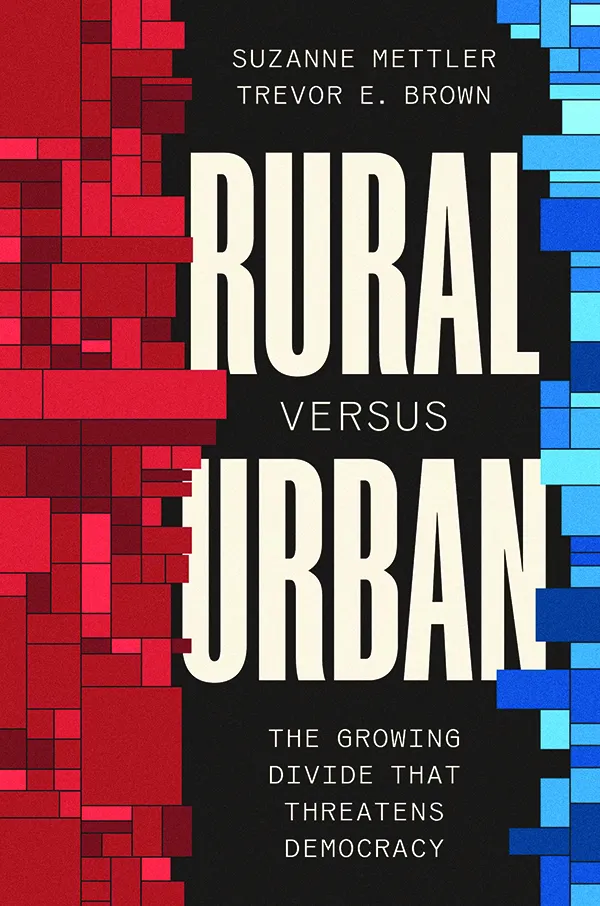
As a lifelong resident of rural America, I have grown accustomed to the media periodically sending journalists out to low-population areas to discover what is wrong with us, particularly after elections that Republicans win. In Rural Versus Urban: The Growing Divide That Threatens Democracy, political scientists Suzanne Mettler and Trevor E. Brown continue the tradition, climbing down from their increasingly shaky ivory tower to travel across America and learn why rural Americans don’t like them. This unabashedly biased book has no broader conception of “democracy” than bare majoritarianism, and its only concern is that the “divide” favors Republicans.
Following an introduction that primarily serves to show the authors’ devotion to every modern liberal academic piety and that they detest the “growing vitriol and extremism” of Republicans, the body of this text begins by giving the reader a history of modern politics in America. The core narrative is that because the New Deal was so great for rural Americans, many used to be loyal to the Democrats. But then, Republican deregulation destroyed the countryside, and this caused all of the hicks to support the Republicans. It is explained to readers that though the federal government, particularly the Senate, was always set up to favor rural areas, this was fine so long as rustics voted like urbanites, and thus it didn’t affect policy. Now that rustics are right-wing, it is dangerous.
Statisticians define rural in multiple ways, but the text’s preferred method classifies around 20% of Americans as rural. The book specifies that the rural-urban divide only applies to white people, while black people vote the same everywhere. It is presented as an enormous problem for democracy if white people who vote the same way are concentrated in some areas, but not if black people, who make up about 15% of the population and are concentrated in different areas, all vote the same way at even higher rates than rural white people. The reader is reminded that black people are “stereotyped” as urban, as if it is not a fact that they are more likely than white people to live in urban areas. This is a double standard that, along with tipping the hand about the actual underlying partisan motivations of the authors, operates as a framing device that deceives the reader. The problem with it is that it is a sort of spin that would make a credulous reader understand the world less clearly rather than more. Cities becoming more Democratic is never in focus. Instead, the entire book is about how rural areas becoming more Republican is destroying America. The authors go on at great length about the perceived legitimacy crisis caused by a president winning without the popular vote, or the Senate majority representing under half the population, but at no point do they suggest Republicans would be more legitimate if they got a couple more points from the cities.
One gets the impression that, despite having PhDs in political science, the authors have no familiarity with political theory but instead get their worldview from editorials in the Washington Post. For example, the authors seem to view it as extremism that a Republican county chair screened a documentary that presented Hillary Clinton as “corrupt and dangerous,” though these are garden-variety criticisms of a political opponent. What’s worse, the book contains egregious factual errors, such as saying Joe Manchin was a senator from Kentucky. But the problems with the book extend to a more fundamental level, one of grade-school American civics. Mettler and Brown tell us that rural voters have “imperiled basic procedures that uphold democratic norms,” empower “a party that takes extremist positions, pursuing policy goals that lack the support of a majority of Americans,” and that the current Supreme Court is “remarkable in its antimajoritarian status.” This ignores that political leaders in a Republic are supposed to take unpopular positions sometimes, and the court’s intended Constitutional role in preventing majoritarian tyranny.
I will give the authors credit for one short section, which was both accurate and illuminating. Discussing wind power projects, they say that across America, rural residents feel that these projects don’t benefit them and are sprung upon them with little input late in the process. In short, there isn’t an opposition to the concept, but to the fact that this is something being done to them by collusion of corporations, the government, and large landowners. This describes perfectly a current dispute over windmills in my community, where the process issues are bad enough that a local liberal environmental scientist, who advocates renewable energy, expressed dissatisfaction with the chosen location and frustration with poor communication and limited opportunities for public input. I had not given any thought to this being part of a pattern repeated across the country, only what I’ve witnessed firsthand.
In this sense, the authors do hit on the key problem for Democrats: Rural voters dislike them as distant elites. But frustratingly, they do so behind a miasma of self-complimentary euphemisms that preserve their sense that their own political in-group is blameless and their political out-group is monstrous. While they criticize Republicans for promoting policies their constituents support but that “the majority” doesn’t, Democrats who lost their seats voting for gun or abortion laws that were unpopular in their district are praised for their principles. Multiple examples are given of Democrats violating normal procedures, for example, to pass the ACA, and how this alienated rural Americans, even if, in the authors’ view, it ultimately helped the ingrates. The core message is no more complex than that: since Democrats are good, they can do what they need to in order to implement their agenda, but since Republicans are evil, they can’t.
THE FIGHT TO KEEP POLITICS OUT OF MEDICINE
The book concludes with some discussion of how the “problem” could be fixed, but the fixes recommended are primarily things that would require amending the Constitution, something Democrats do not and will not have the numbers to achieve. An idea they do not suggest is having more states choose electors by district, like Maine and Nebraska do, something that would require only state-level changes and which is also the most sensible way to de-escalate American politics and create a better regional balance. As it happens, doing this would currently favor Republicans, but only if strategies didn’t change to compete under the new rules.
The authors of this book fail for the same reason Democrats fail in rural areas: Politics is an art, not a science. Democrats need to free rural candidates and state parties from their national orthodoxies, the consultant class, and endless charts to make room for candidates who can shake a rural voter’s hand and show they care about his problems. If Democrats are unwilling to meet rural voters where they are, and if academics are unwilling to understand them honestly and without contempt, rural America will continue to be dominated by the Republican Party. That’s just called democracy.
Brad Pearce writes the Wayward Rabbler on Substack and is also a regular contributor to the American Conservative and the Libertarian Institute. He lives in eastern Washington with his wife and two children.