
One of the immeasurably disappointing moments in my life as a watcher of late-night television came in 2006, when John Madden was announced as a guest on David Letterman’s talk show on CBS. My disappointment did not stem from any ill will toward Madden. To the contrary, the former Oakland Raiders head coach — and, in my lifetime, the husky, amiable, freely ruminating color commentator on NFL broadcasts — was one of my favorite celebrities.
No, my disappointment was a result of what being the butt of a joke: Letterman introduced his next guest as Madden — as though Madden himself was about to make an appearance — but as soon as he said, “He recently was inducted into the Pro Football Hall of Fame …,” a celebrity impressionist named Frank Caliendo, sporting a white wig, ambled out. Perhaps I was the only person in America who naively expected the real thing rather than an ironic simulacrum, but I was genuinely crestfallen as I listened to Caliendo’s scattered (though not inaccurate) impression.
Fast-forward to the week before Thanksgiving 2026. Madden has been dead since 2021, and Letterman (blissfully) off-the-air since 2015. Yet the entertainment industry is still trying to offer substitute Maddens in lieu of the genuine article. If anything, my disappointment in the new movie Madden, now streaming on Amazon Prime Video, is even greater than what I felt after Letterman’s allegedly funny gag: While Frank Caliendo had the decency to present a plausible version of Madden, Nicolas Cage, starring as the coach turned broadcaster, puts in far less effort. He is content to attempt a version of Madden’s voice — far less ably than Caliendo — and adopt a digressive, distracted manner. That’s it.
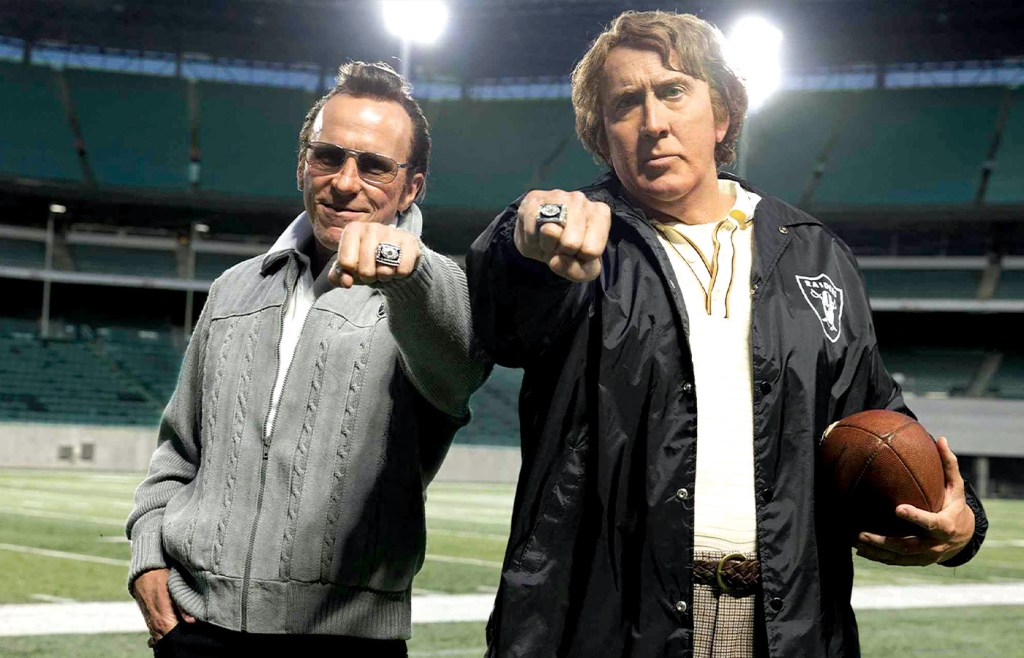
Instead of inhabiting his character, then, Cage relies on all manner of outward adornments, but none of them really evoke Madden himself. Cage has been given fattened arms that have the general proportions of Popeye the Sailor Man, a wig that suggests the locks of Bill Murray in Kingpin (1996), and a prosthetic-enhanced, weirdly immovable face that belongs in the House of Wax, not the Pro Football Hall of Fame. Cage certainly looks like somebody other than himself, but it isn’t the man who drew up X’s and O’s on America’s TV screens.
Perhaps this would not matter if the movie itself had anything substantive to say about its subject. Sadly, director and co-writer David O. Russell — whose best films, including I Heart Huckabees (2004) and American Hustle (2013), recede further into memory with each passing day — has an equally paper-thin conception of Madden. In the film’s telling, he was a man whose precocity for play-calling led to early greatness with the Raiders, and whose obsessive devotion to that passion led him, for his follow-up, to the one job that would allow him to further indulge it, NFL broadcasting. There is little turmoil or barely any conflict. Yes, Madden’s relationships — with his wife Virginia (Kathryn Hahn), with Raiders owner Al Davis (Christian Bale) — have moments of friction but, ultimately, are as solid and immovable as the big man himself. This is not the stuff of great drama.
The movie itself is unbelievably simplistic. At one point, Russell ineptly recreates an AFC Championship game between the Raiders and Steelers — announced, like most key events and people, with ugly on-screen typefaces — and as Steelers quarterback Terry Bradshaw is authoring a drive, the film cuts to Madden saying, “They’re drivin’.” Thanks for the helpful clarification. At another point, a play-action pass is explained as though the audience is likely to consist of kindergarteners who have never heard of a football game, let alone seen one. Inexplicably, despite such lame dialogue, Russell oversaw no fewer than three editors to assemble the movie in a rococo fashion that would not have been out of place in Oliver Stone’s JFK (1991), complete with first-person address to the camera, snippets of scenes taken out of context, TV commercials, and other bizarre techniques. This is a dumb movie that seeks to disguise its dumbness through hectic means.
The screenplay charts Madden’s exit from the Raiders, his efforts to incorporate his off-center style and odd techniques into the broadcast booth (e.g., his imaginative deployment of the Telestrator), and initial resistance to, and ultimate shepherding into stores of, the Madden video game. But because Russell declines to focus on any one of these strands — because the film is so overstuffed with incident — the movie never arrives at anything like a point beyond the fact that John Madden was an odd duck who loved football and was adulated by all. Maybe that makes Madden an odd duck (turducken?) of a movie.
FOX NEWS ANCHOR MARTHA MACCALLUM TALKS ABOUT HER NEW BOOK
Because Russell has talent, there are amusing moments, including a scene in which Davis attempts to prescribe crackers and peppermint Tums for what is ultimately revealed to be Madden’s bleeding ulcer. Another scene features Davis’s wife, Carol (Sienna Miller, a bright spot), urging Madden to read, of all things, Gail Sheehy’s Passages to get himself in the mindset to begin his broadcasting career.
These scenes, and a few others, induce smiles, but they are rare in a nearly two-hour movie. Thinking back on it now, I was wrong to be so disappointed in Frank Caliendo showing up on Letterman 20 years ago: after all, the segment was over in less than 10 minutes.
Peter Tonguette is the Life & Arts editor of the Washington Examiner magazine.