
Alaska’s Senate race remains uncalled more than a week after Election Day, with former Democratic Rep. Mary Peltola leading Sen. Dan Sullivan (R-AK) by 5,800 votes as election officials continue counting absentee ballots and prepare for a ranked choice tabulation.
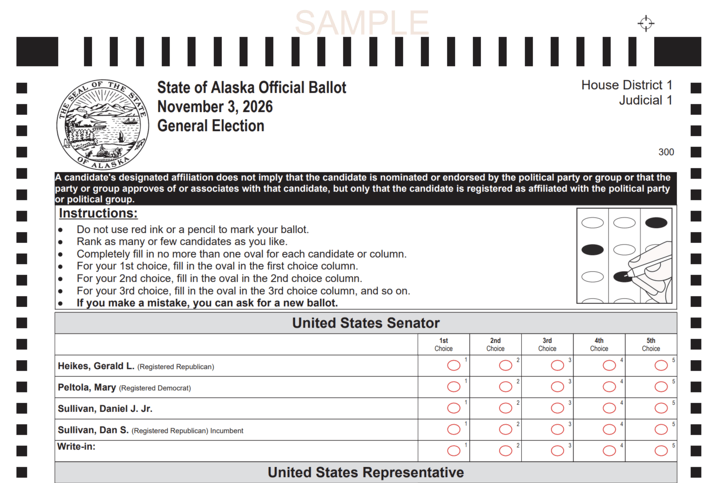
According to the Associated Press, 88% of the vote had been counted as of the latest reported tally. Peltola had 125,157 votes, or 49.2%, compared with Sullivan’s 119,357 votes, or 47%. Two other candidates, Republican Gerald Heikes and independent Daniel J. Sullivan Jr., had 5,490 and 4,199 votes, respectively.
The remaining ballots and the state’s ranked choice voting system will determine whether Peltola or Sen. Sullivan wins the seat. The election has also drawn national attention following a report that Democratic operatives helped recruit a second candidate named Dan Sullivan.
Here’s what to know about the still-undecided race:
When Alaska will finish counting votes
Alaska allows absentee ballots to arrive after Election Day, as long as they were sent before polls closed and meet other eligibility requirements. Domestic mail ballots have a shorter return window than ballots from overseas voters, which can arrive up to 15 days after the election. Friday is the deadline to receive domestic mail ballots.
The state’s final deadline for receiving overseas ballots is Nov. 18. Election officials must then complete their review before moving forward with the ranked choice tabulation, if necessary.
Peltola gained roughly 5,000 votes in the latest batch of ballots counted Thursday, extending her lead over the incumbent senator. Absentee ballots counted so far have also favored the Democrat.
The outcome will depend on how many additional ballots are accepted and whether any candidate crosses the 50% threshold needed to win outright. If no candidate receives a majority of first-choice votes, the state will proceed with ranked choice voting on Wednesday.
How ranked choice voting will decide the race
Alaska uses ranked choice voting, meaning voters rank candidates in order of preference rather than having to select only one. A candidate must receive more than 50% of first-choice votes to win outright. If no one reaches that threshold, election officials eliminate the lowest-performing candidates and redistribute those voters’ ballots according to their next available choices. The process continues until a candidate secures a majority.
As of Friday morning, Peltola has 49.2% of first-choice votes, leaving her short of the threshold. Dan S. Sullivan, the incumbent, has 47%, while Heikes and Dan J. Sullivan Jr. together account for about 4% of the vote.
Second Dan Sullivan sparks legal battle
The week before Election Day, the Senate race became a national controversy after the New York Times reported that Democratic operatives helped recruit Daniel J. Sullivan Jr., a retired teacher from Petersburg, Alaska, to run against the incumbent Republican.
Republicans alleged that the second candidate’s presence could confuse voters and siphon support from the incumbent. Subsequently, the Trump administration preemptively sued Alaska election officials in October, seeking to prevent certification of the Senate results if Sen. Sullivan lost by fewer votes than the number of ballots cast for his namesake. The Justice Department argued that the state could not certify a result potentially affected by voter confusion.
U.S. District Judge Sharon Gleason dismissed the lawsuit Nov. 1, finding that the Justice Department lacked legal standing to bring the case. The Trump administration has appealed the ruling, though the appeals process is not expected to conclude before Alaska certifies its results.
President Donald Trump has also publicly alleged that the election was rigged because of the second Sullivan’s candidacy.
Meanwhile, Gov. Mike Dunleavy (R-AK) has ordered a separate state investigation into the circumstances surrounding Sullivan Jr.’s candidacy. The Justice Department has also pursued a criminal investigation into whether the candidate was recruited as part of an effort to confuse voters. Peltola’s campaign has denied wrongdoing.
Judge rejects Peltola campaign’s request for ballot records
The legal disputes have not been limited to the second Sullivan’s candidacy. Peltola’s campaign sued Alaska election officials last Friday, seeking access to records identifying voters whose absentee ballots had been rejected and the reasons for those rejections.
The campaign argued that it needed the information to ensure that eligible voters were not improperly excluded from the count.
State attorneys opposed the request, arguing that the records contained confidential voter information and could not reasonably be produced while election officials were working to finish counting ballots.
Superior Court Judge Thomas Matthews sided with the state in a written ruling Wednesday. He acknowledged that the records might theoretically be redacted to protect private information but said the Division of Elections could not reasonably produce them at this stage of the counting process.
“The Division is actively in the middle of counting ballots. It has active deadlines it must meet,” Matthews wrote.
Matthews also pointed to the workload facing election officials, who are working to meet deadlines to complete the count and certify results.
“The timing of the Campaign’s request could simply not be worse,” Matthews added.
Why Alaska takes so long to count votes
Alaska is one of 14 states that allow eligible mail ballots postmarked by Election Day to arrive and be counted days or even weeks later. The Last Frontier State also has numerous rural precincts where ballots must be transported, sometimes by plane, and processed, contributing to the extended counting period.
SCOTT COLOM WINS MISSISSIPPI SENATE RACE IN HISTORIC UPSET
The delayed count is not unique to the Senate race. Alaska’s gubernatorial and House contests also remain subject to the state’s extended counting and ranked choice procedures.
Until then, the Senate race will remain the last uncalled contest for the 120th Congress’s upper chamber.