
White House counsel Will Scharf on Thursday singled out a landmark Supreme Court ruling expanding President Donald Trump’s authority over independent federal agencies as the judicial victory he is proudest of helping secure, calling it the correction of a “historic constitutional wrong.”
Speaking at the Federalist Society’s annual National Lawyers Convention in Washington on Thursday morning, Scharf identified the high court’s June decision in Trump v. Slaughter as a defining victory for the administration’s efforts to bring executive branch agencies under presidential control.
“Slaughter was an immensely important case that I think corrected very, very poor and quite ancient precedent,” Scharf said during a fireside chat with O.H. Skinner, a former Arizona solicitor general and longtime friend.
A ‘generational’ Supreme Court victory
The Supreme Court’s 6-3 decision on June 29 upheld Trump’s authority to fire Democratic Federal Trade Commission member Rebecca Slaughter, overturning the 1935 precedent Humphrey’s Executor v. United States, which had allowed Congress to shield FTC commissioners from removal except for cause.
The ruling marked a sweeping victory for proponents of the unitary executive theory, the constitutional view that the president must retain control over officials exercising executive authority on his behalf.
“The president who can’t control who’s exercising the executive power that is vested in him, that’s a cabined presidency,” said Scharf, who recently was promoted to lead the White House counsel’s office in September, succeeding David Warrington.
“The Supreme Court did a masterful job. Really got it right,” Scharf added, saying he was “very, very proud” to have played a role in the administration’s successful challenge.
Trump himself celebrated the ruling in June as a long-sought victory for presidential authority, while the court’s left-leaning justices warned that the decision threatened the independence of federal agencies.
Skinner later presented Scharf with a commemorative coin celebrating “generational wins at the Supreme Court,” describing Slaughter as precisely such a victory.
Scharf reveals early White House autopen research
Scharf also disclosed that during Trump’s first weeks back in office, White House officials researched the legal limits of presidential autopen use, an issue he said was particularly important to Trump.
“That was a huge political issue. It was one that was very important to the president,” Scharf said.
The research led officials through decades of Justice Department legal opinions authored by future Supreme Court Justices Antonin Scalia and William Rehnquist, along with an older attorney general opinion addressing mechanically reproduced Treasury signatures.
A 2005 DOJ legal opinion concluded that presidents may direct aides to affix their signatures to legislation using an autopen, provided the president personally approved the measure.
The issue later became central to Republican investigations into former President Joe Biden.
In October 2025, the House oversight committee released a report alleging that Biden’s senior aides concealed his declining condition while exercising presidential authority in his name without sufficient evidence of his approval.
Chairman James Comer (R-KY) referred the findings to the DOJ, then led by Attorney General Pam Bondi, requesting a review of Biden-era executive actions, particularly clemency decisions.
The referral has not resulted in criminal charges. Although reports in March suggested prosecutors had dropped the investigation, DOJ officials subsequently told the Washington Examiner that it remained active. Scharf did not suggest Thursday that the administration’s historical research established wrongdoing by Biden, who has separately maintained that all of his decisions as president were his and not those of staff beneath him.
Silent on looming Democratic investigations
Scharf’s appearance came just days after he warned incoming House oversight committee Chairman Robert Garcia (D-CA) that Democrats’ promised investigations of Trump officials could cross into “blatant criminality.”
In a letter sent to Garcia and House Democrats on Monday, Scharf argued that congressional subpoenas intended to intimidate administration officials rather than serve legitimate legislative purposes could be unlawful.
He also took aim at Garcia’s remarks about his own “pettiness,” which the California Democrat had jokingly attributed to being gay while vowing to hold Trump officials accountable.
Garcia rejected the warning, defending Congress’s constitutional oversight authority and accusing the administration of attempting to intimidate lawmakers.
Despite the escalating confrontation, Scharf did not address his letter or Democrats’ recent investigative threats during Thursday’s appearance, which concluded without audience questions.
WHITE HOUSE WARNS HOUSE DEMOCRATS NOT TO HARASS STAFF WITH OVERSIGHT INVESTIGATIONS
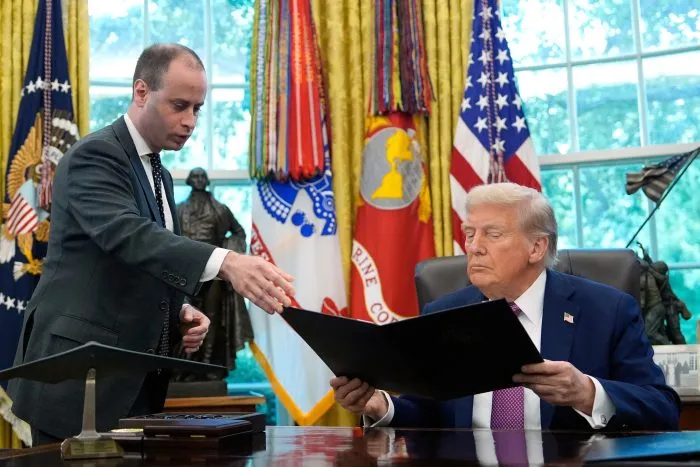
Prior to his promotion, his most prominent publicly visible role involved him handing the president executive orders to sign in the Oval Office, often announcing the purpose behind the orders the president signs. Scharf emphasized at the outset of the event on Thursday that he was speaking in his personal capacity.
The Federalist Society’s convention will stretch into Saturday, with the next notable administration official speaking at the event being Secretary of State Marco Rubio on Friday afternoon. Rubio is seen as a potential contender for the 2028 presidential race. He has not made any public announcements about a presidential candidacy, and the legal society takes no political positions or viewpoints.