
Sen.-elect Annie Andrews (D-SC) has a long track record of supporting gun control and treating firearms deaths, especially among minors, as a public health issue, a break from tradition in a state that has historically strongly backed Second Amendment rights.
Andrews, the Senate’s first female physician and first pediatrician, credits her stance on gun control to her experience treating children who have unintentionally shot themselves after finding an unsecured firearm.
Her views on gun control, including universal background checks and mandatory safe storage laws, are largely out of step with prior senators from South Carolina who have been staunch Second Amendment supporters representing a state that used to be a Republican stronghold.
Andrews defeated Sen. Darline Graham (R-SC) by 5 percentage points in an unexpected victory for a blue wave election favoring Democrats across the country.
Graham was appointed by Gov. Henry McMaster (R-SC) to replace her brother, the late Sen. Lindsey Graham, after his sudden death in August. President Donald Trump encouraged Graham to run for a full term in the Senate instead of only serving the remainder of her brother’s term through January 2027.
On the campaign trail, Graham targeted Andrews’s history of anti-gun violence advocacy, telling reporters in Columbia in October that Andrews is “hell-bent on gutting the Second Amendment and taking your guns.”
Andrews has rebutted the allegations from both Graham and Trump that she wants to take away guns and has instead focused on gun deaths as a public health issue for children.
“My platform to address the public health crisis of gun violence does not infringe on the Second Amendment,” Andrews said. “I support the Second Amendment, law-abiding citizens’ rights to own firearms, but I know we need to do something about this public health crisis.”
In addition to background checks and safe storage rules, Andrews says she supports “banning weapons of war from our streets,” including AR-style rifles.
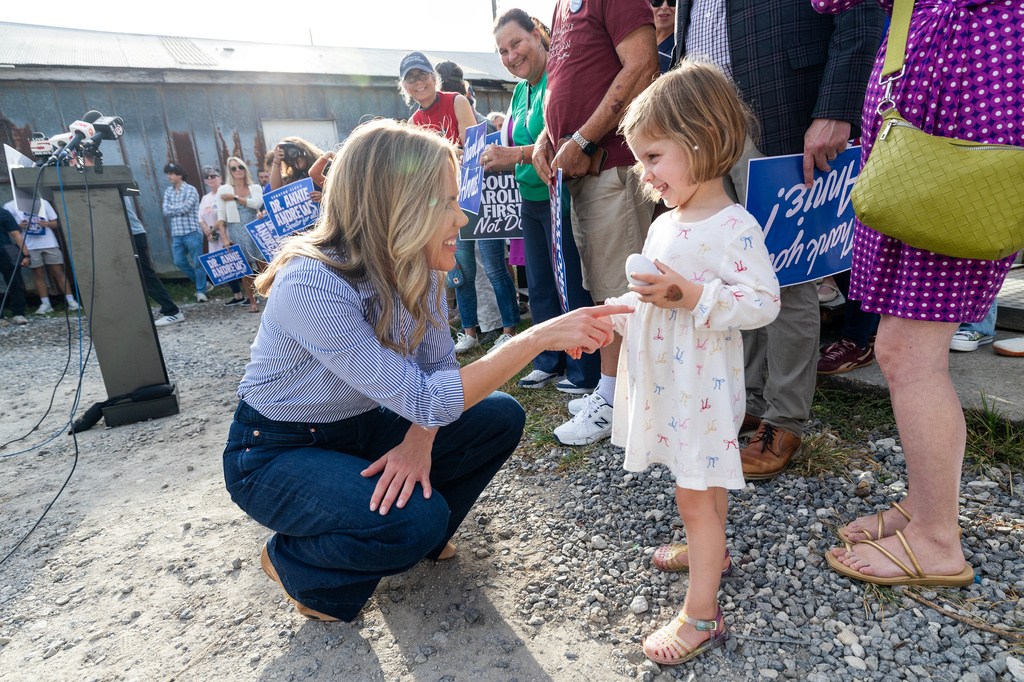
Longtime anti-gun violence advocate
Andrews joined the South Carolina chapter of the anti-gun violence group Moms Demand Action in 2018 shortly after the shooting at Marjory Stoneman Douglas High School in Parkland, Florida, that killed 17 and injured 17 others.
She later went through a political candidate training program from the anti-gun group Everytown for Gun Safety, and the political action committee for the organization donated $500,000 to her campaign in August.
Andrews also reported in her candidate financial disclosures receiving more than $130,000 from Everytown in 2024 and 2025. Part of her work for the organization involved producing “gun violence prevention in medical education and media appearances.”
In her work as a pediatrician, Andrews published multiple scientific papers related to youth gun violence, including the efficacy of gun safety measures and mental health outcomes for youth survivors of gunshot wounds.
Andrews’s victory on Nov. 3 is a political comeback story. She lost in a contentious House race in 2022 against Rep. Nancy Mace (R-SC).
In debates for the House race, Andrews accused Mace of putting her A rating with the National Rifle Association ahead of children’s safety following the shooting at Robb Elementary School in Uvalde, Texas. Andrews lost to Mace by 14 points for South Carolina’s 1st Congressional District.
John Feinblatt, president of Everytown for Gun Safety, said following Andrews’s victory that the senator-elect “has spent her entire career fighting to keep kids safe, and now she’ll take that fight to the U.S. Senate.”
“Winning a state Donald Trump carried by nearly 18 points is a wake-up call to every candidate who thinks gun safety only plays well in blue states, and Everytown is proud to have been with her from the start,” Feinblatt said.
Gun violence and public health
Andrews is poised to take up the long-fought debate over whether to use public health policy solutions for gun violence deaths, which for years have been one of the leading causes of death for children and adolescents.
Youth firearm deaths began to steadily rise in 2013 but dramatically increased in 2019, in part due to suicides during the COVID-19 pandemic. An estimated 4,063 children and teenagers died in 2022 from firearms, but that figure has likely decreased.
An analysis of data from the Centers for Disease Control and Prevention produced by the group Texas Gun Rights in October found there were 2,099 firearm-related deaths in 2025 for minors ages 1 through 17. That’s equivalent to the number of minors who died in motor vehicle accidents last year.
Approximately 85% of those gun deaths involved teenagers 13 and above. A total of 306 children under 12 died by firearms in 2025, according to CDC data.
In 2024, then-Surgeon General Vivek Murthy issued a sweeping advisory declaring gun violence a public health emergency that threatens “the health and well-being of our country.”
The advisory called on Congress to pass more restrictive legislation on guns as well boosting research funding on gun violence prevention. Shortly after Trump took office, the advisory was removed from the Department of Health and Human Services website.
The CDC began funding research on the correlation between firearms and domestic violence in the early 1990s. But in 1996, former Arkansas Republican Rep. Jay Dickey drafted a provision in 1996 to the CDC appropriations bill preventing the agency from researching gun violence “in whole or in part, to advocate or promote gun control.”
ANNIE ANDREWS COOL ON SCHUMER’S LEADERSHIP ROLE
The so-called Dickey Amendment was extended to appropriations for the National Institutes of Health in 2011.
Andrews has signaled that she supports increasing funding for community violence prevention and mental health services, but her platform does not directly address the issue of research funding for gun violence prevention.