
Roughly one-fifth of Minnesota is home to specially-created voter zones called “designated language-minority districts,” where residents struggle to speak English and require assistance with understanding how to vote, according to a Washington Examiner analysis of state electorate statistics.
Demographic data published by the Minnesota secretary of state’s office shows that the state has designated 290 such districts as “language-minority” and in need of special voting accommodations, such as on-site interpreters, because at least 3% of each district’s population “lack[s] sufficient skills in English to vote without assistance.”
These designated language-minority districts, situated mostly around the immigrant enclaves in Minneapolis and St. Paul, correspond with their U.S. Census Bureau tracts, which are apportioned subdivisions of a county that can span multiple polling precincts. Census tracts generally contain between 1,000 and 8,000 residents, with an optimum size of 4,000 people to help standardize population counts.
Out of the 1,505 total census tracts in Minnesota, as of the 2020 census, the 290 designated language-minority districts make up 19.27%, or almost a fifth, of the state.
Voting accommodations for foreign-language speakers include Election Day interpreters
In designated language-minority districts that meet the 3% minimum of limited English speakers, voting instructions and sample ballots must be translated into the foreign language primarily spoken there.
Poll workers are accordingly required by state law to display the translated election materials at every precinct located within that district.
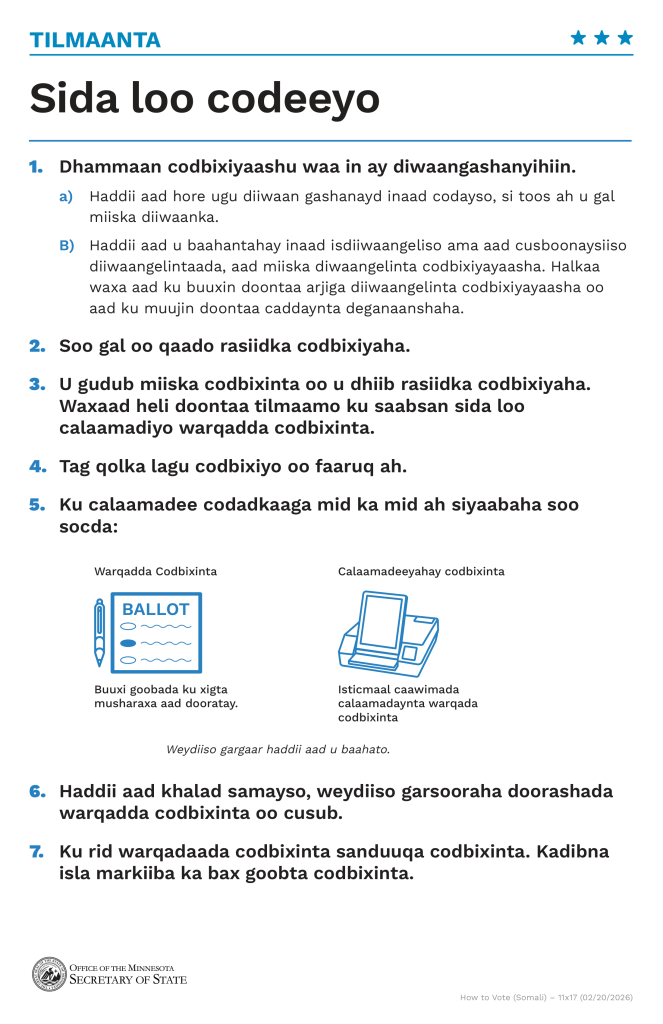
“How to Vote” posters containing voting instructions in Spanish, Hmong, and Somali — the three most commonly spoken non-English languages in the state — are already posted inside all Minnesota polling places as statutorily required.
In designated language-minority districts in which 20% or more of the population has limited English proficiency, foreign-language speakers may request an interpreter to provide in-person translation services on Election Day.
The Washington Examiner asked state election officials how many precincts, belonging to the 12 language-minority districts that have hit the 20% threshold, will be provided an interpreter on Tuesday.
“Our office has not received a notice from a county/municipality about a formal request for interpreter services,” a spokesperson for the Minnesota state secretary said.
However, the spokesperson said the city of Minneapolis and neighboring Ramsey County, which encompasses St. Paul, “regularly” staff polling locations with interpreters.
Asked to explain how the interpreters assist voters with limited English proficiency at the ballot box and whether their guidance involves answering any questions about the wording of ballot referendums, the spokesperson said, “Interpreters can translate materials and ballots for voters.”
“They cannot tell any voter how to vote,” the spokesperson told the Washington Examiner.
The state government’s website explaining “What’s on My Ballot?” and “Other Ways to Vote” currently features tabs translating election information in Spanish, Hmong, Somali, Vietnamese, Russian, Chinese, Lao, Afaan Oromoo, Khmer, Amharic, and Karen.
Assimilation and political literacy concerns
According to immigration policy experts, English proficiency among the immigrant voting class is an indicator of an informed and engaged electorate free from outside influence.
Ira Mehlman, the media director for the Federation for American Immigration Reform, warned that voters requiring so much help casting a ballot, yet who play an important role in deciding America’s elections, could be falling into groupthink within their communities.
“Voting is a right of citizenship. But it comes with the implicit responsibility of being an informed voter — which, in the United States, requires a command of the English language,” Mehlman told the Washington Examiner. “When large blocs of voters are not proficient in the common language of the country they are living in, they can be easily manipulated by self-serving leaders of their ethnic communities.”
“Nowhere has this been more evident than in Minnesota,” added Mehlman, “where community leaders have taken advantage of culturally and linguistically isolated immigrant groups to commit large-scale fraud.”
SOMALI COMMUNITY CARE PROVIDERS ARE VALUABLE SOURCE OF CAMPAIGN CASH FOR SOMALI POLITICIANS
Minnesota, which has the country’s largest Somali population, was the site of widespread public assistance fraud predominantly carried out by Somali immigrants, many of them congregated in Minneapolis.
Mehlman called the alarming lack of English language skills in Minnesota “a microcosm of the failure of Western societies to assimilate large numbers of immigrants into the social, cultural, economic, and linguistic mainstream.”
“We are seeing the consequences of these failures play out, not just in places in this country, like Minnesota, but in the growing civil unrest in Europe,” said Mehlman.

“For decades,” Mehlman said, “the United States and other Western nations have engaged in large-scale immigration, while neglecting the need to assimilate newcomers into the mainstream of society, including fluency in English. Both the Hesburgh Commission report in the early 1980s and the Jordan Commission report in the late 1990s emphasized the need for civic and social assimilation of immigrants. The situation in Minnesota and many other parts of the country indicates that those recommendations have not been adopted.”
While the U.S. citizenship test includes an English proficiency portion to pass, whether registered voters speak English proficiently is not a requirement for voting.
In fact, Section 203 of the Voting Rights Act mandates that certain jurisdictions provide language assistance to voters “unable to speak or understand English adequately enough to participate in the electoral process.”
According to the latest census counts, in 2021, the United States recorded more than 24 million voting-age citizens residing within 331 jurisdictions required to provide “minority-language assistance,” a notable 22.3% increase from 2016 in covered individuals guaranteed language accommodations, including verbal translation services.