
Federal finance authorities have identified the Southern Poverty Law Center’s “hate group” labels as the driving force behind the debanking of conservative individuals and organizations, particularly clients that were giving to Christian causes.
The explosive findings directly discredit a recent proclamation from the SPLC declaring, as part of its “Hatewatch” monitoring project, that anti-Christian debanking was a conspiracy theory spread by the “Christian supremacy movement.”
Though only a regulatory audit, fulfilling an executive order from President Donald Trump to ensure that banks were not discriminating against customers on the basis of their political or religious beliefs, the government’s findings add to the SPLC’s latest woes.
As an organization, the SPLC, in addition to its chief financial officer, is already facing criminal conspiracy charges for allegedly using donor funds to finance the activities of the very same extremist groups it was working to dismantle.
SPLC ‘hate group’ designations used as vetting tool in debanking decisions
According to an Oct. 14 report from the Office of the Comptroller of Currency, a federal bureau within the U.S. Treasury Department that regulates the nation’s banks, the SPLC’s bigot-flagging operations were politically influencing debanking decisions at major financial institutions across the country, including PNC Bank, JPMorgan Chase, Wells Fargo, and TD Bank.
The 47-page report said the SPLC played a key role in the debanking of, as well as the denial of financial services to, conservative clients wanting to support Christian groups or individuals financially.
But just last year, the SPLC published a “Hatewatch” memo claiming that institutional debanking of the religious Right was an imaginary threat existing only in the minds of Christian supremacists called “dominionists,” those who believe that Christians are “called by God to exercise dominion over every aspect of society” by taking control of all institutions.
SPLC KEPT PAYING ARYAN NATIONS OPERATIVES AFTER BRAGGING ABOUT BANKRUPTING THEM
In particular, the SPLC alleged that the “anti-LGBTQ+ hate group” Alliance Defending Freedom, a mainstream Christian conservative legal firm known for taking up religious rights cases, was pushing these “conspiratorial claims of Christian victimhood.”
This unfounded alarmism, the SPLC claimed, centered on a belief that banks were colluding with government regulators to deny or strip Christians of access to financial services.
It turns out, however, that many of the banks highlighted in the Treasury report were regularly basing their decisions to debank certain disfavored customers on the SPLC’s classification of “hate groups” operating in America.
A bulk of the organizations and individuals named in the SPLC’s “Extremist Files” are actually moderate conservative commentators, charities, and activists whose beliefs fit well within mainstream conservative positions.
Its work of “tracking hate” was called into further question earlier this year when the SPLC was criminally indicted in April on wire fraud and money laundering charges for allegedly defrauding donors out of millions of dollars. Prosecutors say the SPLC manufactured “hate” to boost its lucrative Nazi-busting business by paying operatives to embed themselves in neo-Nazi groups, some that were already dwindling in numbers and had been effectively bankrupted by the SPLC.
Banks regularly referenced the SPLC in ‘reputational risk’ evaluations
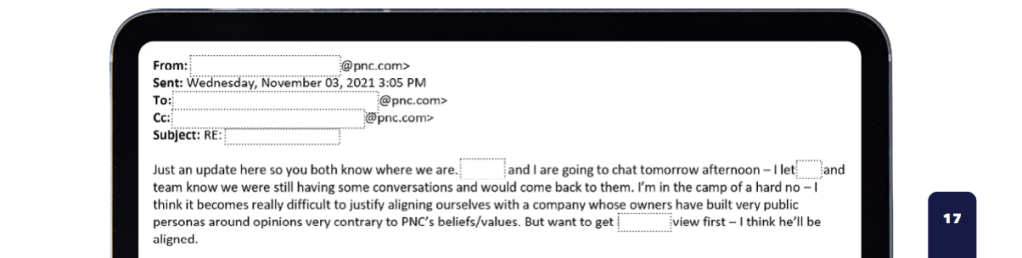
Treasury Department oversight officials say they discovered that PNC Bank declined to issue a line of credit to a media company in late 2021 due to “reputation[al] risk” concerns about its conservative owners.
The situation was brought before the bank’s environmental and social governance group, and employees at the bank allegedly noted that one owner’s foundation “has funded several Christian conservative groups, including several identified as hate groups by the Southern Poverty Law Center.”
“I’m in the camp of a hard no,” one PNC Bank employee stated, according to an email excerpt included in the Treasury report. “I think it becomes really difficult to justify aligning ourselves with a company whose owners have built very public personas around opinions very contrary to PNC’s beliefs/values.”
Federal investigators additionally discovered that WePay, a now-defunct subsidiary of JPMorgan Chase, terminated an account in July 2021 that was “used to raise funds to support a legal challenge by a ‘devout Christian’ of certain anti-discrimination laws.”
WePay, a payment processor, reportedly escalated the fundraising matter to the reputational risk officers at JPMorgan Chase before closing the crowdfunding account.
Auditors found that WePay, which often acted as an online payment platform for small businesses, had screened clients against a list of terms it developed that included “names of certain ‘hate groups’ identified by organizations like the Southern Poverty Law Center for their perceived non-mainstream social or religious views.”
According to the Treasury report, WePay was monitoring for violations of its terms of service using particular search terms and phrases, such as “MAGA,” “Make America Great,” and “America First,” to flag merchants who might be involved in “prohibited activities.”
WePay’s terms of service outlined specific categories of vendors for which WePay would not process payments if the businesses engaged in conduct perceived as hateful, racially bigoted, or violent.
For instance, in February 2021, WePay shuttered the account of a retailer that was selling merchandise supporting Trump and the Make America Great Again movement after the payment services provider allegedly determined that the products promoted “hate, violence, or racial intolerance.”
One employee said WePay closed the account for violating its terms of service, including that the type of wares the client sold appeared on the company’s blacklist.
“MAGA and Trump-related items are part of it,” the employee said.
In another alleged incident from June 2021, WePay closed the account of a customer characterized in the company’s internal screening system as a “right-wing religious conservative nonprofit with strong anti-LGBTQ rhetoric.”
Internal discussions about the customer allegedly mentioned the SPLC’s categorization of the organization as an “extremist hate group.”
JPMorgan Chase reputational risk officers accordingly advised WePay that “from a reputation risk perspective, we would recommend an exit from this account.” Two years later, a reputational risk officer at the bank allegedly removed all references in the internal tracking system that labeled the nonprofit organization “right-wing” and “religious.”
Instead, the employee described the organization as “a conservative education and research organization” whose mission is “promoting, protecting, and strengthening traditional family values, which include [being] pro-life, pro-marriage, and pro-family.”
In a statement responding to the Treasury report, JPMorgan Chase noted that it discontinued WePay after the payment services provider fell short of its standards.
“Our policies prohibit discrimination against customers based on political or religious views,” a spokesperson for JPMorgan Chase told the Washington Examiner. “A process used by WePay, a small technology company we acquired years ago and have since wound down, did not meet our expectations. We identified it, corrected it, and the business no longer operates.”
Regarding the federal government’s findings, the JPMorgan Chase spokesperson said, “We take this seriously, learned from it, and improved the way we do business.”
The spokesperson added that JPMorgan Chase agrees with the Trump administration that years of intense regulatory oversight contributed to “a culture of caution” throughout the banking industry.
“That system needs fixing,” the company representative said.
The Washington Examiner contacted the SPLC and PNC for comment.