
Republican Mike Rogers and Democrat Abdul el Sayed sparred over patriotism, the economy, healthcare, and Iran during their final debate Wednesday night, with each candidate spending much of the hour trying to tie the other to a political movement that some Michiganders may find unattractive.
The debate was still contentious, but it was notably more restrained than their first faceoff two weeks ago, when they repeatedly interrupted each other and traded personal attacks.
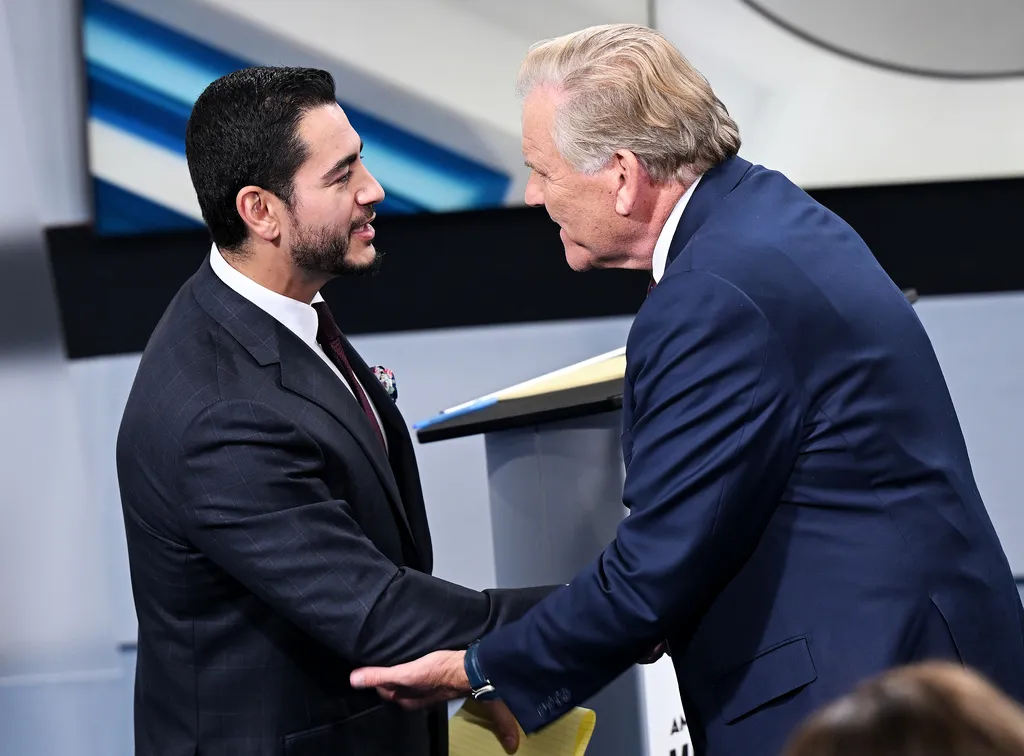
This time, Rogers sought to tie el Sayed to the Muslim Brotherhood and the Democratic Party’s left wing, while el Sayed portrayed Rogers as a MAGA Republican who lacked the backbone to stand up to President Donald Trump, even telling viewers from the jump to play “MAGA bingo” and take note when Rogers used a political “buzzword.”
The sharpest exchange came when Rogers questioned el Sayed’s patriotism and asked whether he supported America or foreign terror groups.
“Are you for America, or are you for these terrorist groups overseas?” Rogers asked, referencing the Muslim Brotherhood, an Islamist group designated a terrorist organization by several Middle Eastern countries. El Sayed has faced questions regarding his family’s connection to the Muslim Brotherhood and was repeatedly pressed about it during a viral town hall moment last weekend.
El Sayed, a former Wayne County health official who would become the nation’s first Muslim senator if elected, pushed back minutes later, calling the question “shameful.”
“To bring into question my commitment to the Constitution is really beneath you,” el Sayed said. “I am proud to be an American. I am proud of our Constitution.”
The exchange was the most tense moment of a debate that largely focused on policy, a stark contrast from the previous meeting in which little policy was discussed as the candidates lobbed personal insults at one another.
The candidates opened by agreeing that voters would hear two very different visions for Michigan. They quickly demonstrated that divide as they disagreed over the economy, healthcare, education, and foreign policy.
On healthcare, el Sayed highlighted his support for “Medicare for all” and criticized Rogers for voting against the Affordable Care Act.
Rogers countered that el Sayed’s single-payer proposal would cost trillions of dollars while limiting their choices and harming those with private insurance.
Rogers has tried to cast el Sayed’s agenda as too extreme for Michigan, while also creating enough daylight between he and the president’s policies, like tariffs. It will be a hard task as Trump is expected to headline a Michigan rally on Sunday.
El Sayed belabored Trump’s forthcoming Michigan visit, and his policies, throughout the 60-minute debate as he tried to inextricably link the president and Rogers.
Asked about affordability concerns, el Sayed blamed high fuel and grocery prices on the war in Iran and argued that Rogers would enable the president.
El Sayed said Rogers would “stand hip to hip with Donald Trump on all of his worst policies.”
Rogers countered that el Sayed’s progressive agenda would put additional financial pressure on Michigan families.
He dismissed el Sayed’s promises to put more money in Michigan residents’ pockets as a slogan without a substantive plan behind it.
“We cannot afford Abdul el Sayed’s policies, and we cannot risk his ideology,” Rogers said in his closing statement.
El Sayed, meanwhile, argued that Rogers was talking a “good game” about standing up to Trump but would ultimately fall in line.
The candidates also used the debate to appeal to voters concerned about the Democratic Party’s divisions over Israel and the war in Iran.
Rogers accused el Sayed of fracturing the Democratic base and made a direct appeal to Jewish Democrats, saying they were “afraid for their children.”
“We need to stand up now,” Rogers said.
El Sayed has said he is committed to Jewish safety while maintaining his forceful criticism of Israel.
The moderators continued their efforts to define the candidates with a series of rapid-fire questions near the end of the debate.
Asked whether he supported expanding the Supreme Court, Rogers said no. El Sayed said he would support expansion if it were done “fairly.”
On universal background checks for gun purchases, el Sayed said he supported them. Rogers declined to take a firm position.
“It all depends,” Rogers said. “In the middle.”
Their first debate, two weeks ago, was considerably more acrimonious. Rogers questioned el Sayed’s medical credentials, while el Sayed accused Rogers of being a Trump administration puppet. The candidates regularly interrupted each other and traded personal attacks.
PERSONAL ATTACKS, ISRAEL, AND TERRORISM DEFINE MICHIGAN’S CAUSTIC SENATE DEBATE
Wednesday’s debate largely avoided those confrontations, but the underlying battle over identity and political allegiance remained.
The stakes in the Michigan race are unusually high. Rogers is seeking to become the first Republican to win a Senate race in Michigan in more than three decades to help the GOP protect the Senate. Democrats need to flip four seats and hold on in races like Michigan to flip control of the chamber.