
Secretary of State Marco Rubio hit back at accusations that the United States was holding back Patriot interceptor shipments out of spite, instead saying the U.S. was balancing its own needs and those of other allies.
Speaking to reporters Tuesday during a trip to India, Rubio addressed the growing crisis in relations between Ukraine and the U.S. One of the most prominent issues in recent days was the lack of U.S. Patriot interceptor shipments to Ukraine, which Ukrainian President Volodymyr Zelensky and other Ukrainian officials publicly suggested was being done out of spite. Rubio clarified that this wasn’t the case and that the U.S. was instead managing a limited interceptor stockpile.
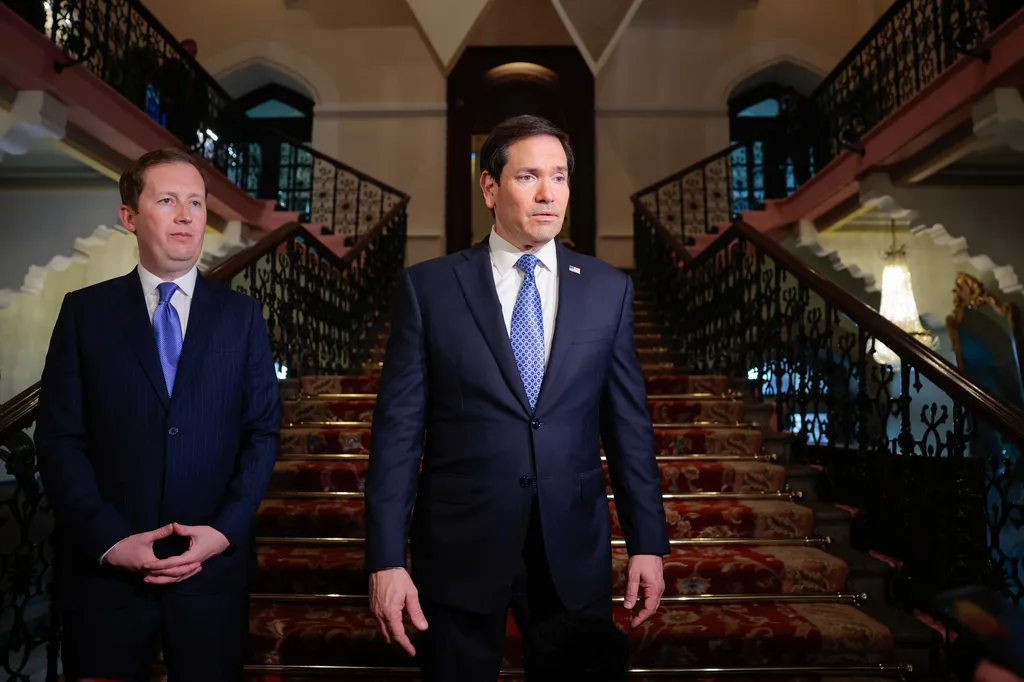
The Prioritized Ukraine Requirements List “is a program in which, when things are available for sale, they’re sold to the Europeans, who in turn transfer it to [Ukraine],” Rubio said.
“I know one of the things that President Zelensky has been talking about is that he’s been trying to buy interceptors, and I understand,” he continued. “So does every other country in the world. I also talked to Saudi Arabia today. They’d like interceptors. Israel would like interceptors. We would like interceptors. … It’s probably the most in-demand product right now in the defense field.
“So, when a country doesn’t get interceptors from the United States, it’s not because we’re denying. We have our own needs too. We have minimum standards that we have to meet internally in our base presence all over the world, that includes in our bases in Europe, as an example. There’s minimum standards that our … Department of War requires to protect these facilities, and obviously in the Middle East.”
The secretary of state warned against viewing the war in Ukraine through a “straw,” saying its defense requirements had to be balanced with those of the U.S.’s other partners, and its own needs.
His remarks were a sharp rebuke to Zelensky’s public claims, made to a bipartisan, bicameral group of legislators, earlier this week, when he suggested the U.S. was purposefully holding back interceptor shipments out of spite.
“Right now, a new missiles package is waiting for Mr. Hegseth’s signature,” Zelensky said in a video of the congressional meeting. “And our other partners, including those in Europe, are also waiting for American approval to transfer Patriot interceptors from their shelters, European shelters, to us. So the missiles are ready, and they could already be in Ukraine. And we are grateful to America and to our partners for their willingness to help, but unfortunately there is still no approval.
“All of this suggests that some political decision has been made to slow down support for us, and this is in sharp contrast to what we are achieving on the battlefield. We want to understand what is happening, why it’s happening, and where all of this is heading.”
The war with Iran has heavily drained U.S. Patriot interceptor stockpiles to a critical point, leaving little chance Washington could spare more for Ukraine. Just before Feb. 28, the Center for Strategic and International Studies estimated that the U.S. had 2,330 interceptors in its stockpiles. By July 27, this total fell to around one-third of that, sitting in the range of 759 to 827. Iranian attacks since have drained these stockpiles further, all while the U.S. prepares for another likely confrontation with Iran after the midterm elections.
The U.S.’s Middle Eastern allies also need to refill their own Patriot stockpiles after expending most of their arsenals against Iranian munitions. The U.S. has formal written partnerships with these countries, most of which house U.S. troops, ensuring they will take precedence over Ukraine.
Russia’s industrial production also provides a grim calculus. Moscow is producing hundreds of ballistic and cruise missiles per month, including over 100 ballistic and hypersonic missiles, which can only be intercepted by Patriot interceptors. Patriot batteries usually fire multiple missiles for each interception to increase their odds of contact, meaning any supply of Patriots to Ukraine is certain to be drained in a matter of days or weeks.
Rubio’s comments seem to confirm the reality the U.S. faces with its depleted stockpiles. He also angrily addressed Ukrainian officials’ direct blaming of the U.S. for civilian deaths in strikes on Oct. 13 and Sunday.
“I think the important takeaway for you is that there has not been some deliberate political directive to go out and harm Ukraine. This is just not accurate,” Rubio said.
“I saw somebody associated with the Ukrainian government say that people in Ukraine are dying because the U.S. is denying them information,” Rubio added. “That’s scandalous. That’s outrageous. That’s just simply not true. That’s not accurate.”
ZELENSKY SAYS HEGSETH BLOCKING MISSILES, STILL ‘NO EXPLANATION’ FOR STARSHIELD LIMITS
He spoke with Zelensky in a 45-minute phone call on Tuesday, which the Ukrainian president described on social media as a “substantive conversation — focused on the issues that matter.”
“I am grateful for his readiness to help and his clear position,” he said. “We agreed to get in touch again soon for an update. Thank you, Marco, for the constructive discussion! Thank you to everyone in America who supports fair approaches!”