
Rep. Haley Stevens (D-MI) has made scattered public appearances since her hairbreadth loss in the August Senate Democratic primary. In each one, Stevens has endorsed former rival Abdul el Sayed in his Nov. 3 race against Republican Mike Rogers for the Michigan seat held by retiring 12-year Sen. Gary Peters (D).
Some of Stevens’s comments came from impromptu Capitol Hill corridor interviews with reporters. She also joined freshman Rep. George Whitesides (D-CA) in an Oct. 6 interview on his YouTube series “Capitol Heat,” where politicians answer candid questions while eating increasingly spicy chicken wings. A couple of days later, Stevens crashed the Washington bureau of TMZ. On the celebrity news show, she laughed and joked with hosts Harvey Levin and Charles Latibeaudiere.
Stevens and el Sayed fought a bitter political battle, with an outsize focus on her support for the U.S.-Israel relationship and his opposition to it. Anti-Israel Democrats have since then made him an avatar of what was once unthinkable: They can win, and they can win against big money. About $5 million was spent supporting el Sayed, while Stevens was backed by $60 million, about half of it from pro-Israel political action committees.
Still, soon after her defeat, Stevens said, emphatically, that she was a team player.
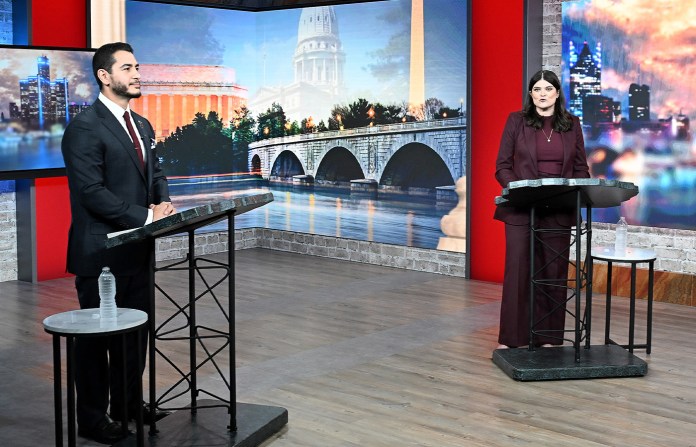
“I am not on the ticket; I’m happy to be on the team. Today I was with Abdul at the unity breakfast,” Stevens said on CNN on Aug. 7, three days after her defeat. “The big difference between the Democratic Party and the Republican Party is that we do have a big tent.”
Five weeks later, Stevens, 43, was leaving the Capitol when a pro-Palestinian activist started recording her with his smartphone, accusing her of abetting what he called Israel’s genocide in Gaza.
In the nearly two-minute exchange, which went viral on social media, Stevens at first tried to avoid the man pursuing her. But Stevens, who worked in President Barack Obama’s administration and won a suburban Detroit House seat in 2018, couldn’t resist shouting back, “Anti-Zionism is a hate movement!”
Even as her car drove off, Stevens, who is not Jewish, rolled down her window and shouted: “I’m a proud Zionist! I love Israel!”
So much for a big tent.
Stevens, who did not return a request for an interview, is emblematic of how what was once an influential pro-Israel bloc within the party is coping with being on the defensive — due to the rise of anti-Zionists such as el Sayed, the disfavor the country is enduring among Americans after three devastating years of war with Gaza, and the fraught relationship between Democrats and Israeli Prime Minister Benjamin Netanyahu.
Rep. Steve Cohen (D-TN), who is retiring after 20 years in the House because Republicans controlling Tennessee have redistricted him into oblivion in his longtime Memphis political base, said in an interview that anti-Israel sentiment was prevalent among young Democrats because of ignorance.
“Gen Z hasn’t a clue as to anything that happened more than three weeks ago,” Cohen said. “They have no conception of the Holocaust and why Israel was created in the first place.”
Democratic internecine fights over Israel
Pro-Israel Democrats are committing to solidarity ahead of next month’s midterm elections, seen as critical to stop what Democrats regard as the anti-democracy policies of President Donald Trump. But they’re not always able to resist furious outbursts, reminding anti-Israel voices in the party’s progressive wing that they may be down, but they’re not out.
“My condolences to @hasanthesun,” Rep. Jared Moskowitz (D-FL) said on Aug. 18 in his first tweet after he faced down an anti-Israel challenger who was backed by the virulently anti-Israel podcaster, Hasan Piker, whom Moskowitz had tagged. Moskowitz, a leading pro-Israel voice among Democrats, declined a request for an interview.
Such goading is rare among pro-Israel Democrats, as congressional leaders urge the sides to commit to uniting ahead of the midterms. Senate Minority Leader Chuck Schumer (D-NY), who hopes to become majority leader, has for decades been the most outspoken pro-Israel Democrat since winning his seat in 1998 and, for 18 years before that, representing a heavily Jewish Brooklyn-based House seat. Schumer, heading into the midterm elections, is wholly behind el Sayed.
Keeping a low pro-Israel profile is wise, said one operative in the party who worked on multiple campaigns for pro-Israel Democrats and asked for anonymity to speak candidly.
“In most Democratic districts, unless there’s a sizable Jewish population, it’s a liability,” the operative said of being pro-Israel. Moskowitz, the operative noted, was running in a South Florida district with a substantial Jewish population.
“I think the best thing a pro-Israel Democrat can hope for is that nobody talks about it, and it becomes a non-issue,” the operative said. The American Israel Public Affairs Committee, which does open battle on social media with progressives, is especially toxic, the operative said. “There’s nothing good to be achieved by being publicly tied to AIPAC. There’s just nothing good to come out of it.”
AIPAC did not return a request for comment. It has maintained throughout this cycle that it continues to enjoy the support of lawmakers from both parties.
Halie Soifer, CEO of the Jewish Democratic Council of America, which backs pro-Israel candidates in the party, said that long-term, the party was on the side of Israel.
“The majority of Democrats, certainly the leadership and the vast majority of Democratic candidates, are supportive of the U.S.-Israel relationship,” she said in an interview.
Soifer said that perhaps 10 Democrats were anti-Israel, and they won in deep blue districts — and were not representative of the Democrats running in competitive districts.
“They may have gotten a lot of attention this election cycle, but we are really talking about being a distinct minority among Democrats,” she said.
A swath of anti-Israel primary winners are practically shoo-ins for the general election running in deep-blue districts. Among the biggest headline-makers is a 29-year-old in Colorado, Melat Kiros, in a deep-blue Denver district. New York’s House delegation is set to feature a pair of DSA-aligned newcomers from New York City — Darializa Avila Chevalier and Claire Valdez. In Michigan, Donavan McKinney is set to join Congress after winning the August primary for a Detroit-area seat. Kiros, Chevalier, and McKinney defeated pro-Israel incumbents.
Hostility to Israel will also be put to a wider political test in a swing district. In Michigan’s 7th Congressional District, covering the Lansing area and northwestern Detroit exurbs, William Lawrence won the Democratic nomination by beating two relatively centrist Democrats. The one-time DSA member now faces freshman Rep. Tom Barrett (R-MI) in one of the nation’s most competitive House races. The district in its current configuration, and its Lansing-area predecessors, has had Democratic representatives in Washington for 28 years and Republican members for 24, making for one of the most evenly balanced political battlegrounds in the nation.
Brian Romick, the president of Democratic Majority for Israel, a group that fundraises for pro-Israel candidates, rattled off in an interview a number of pro-Israel Democrats who have fended off anti-Israel challengers but with less media coverage. Among them are Moskowitz in South Florida, Johnny Garcia of Texas in a San Antonio area district, Adrian Boafo in Maryland, Jeremy Moss, who is in line to succeed Stevens in her suburban Detroit district, and Marni von Wilpert of California, vying for an open San Diego-area seat.
Moskowitz, Garcia, Moss, and von Wilpert are playing in swing districts. Romick said anti-Israel candidates are not viable in general elections in swing seats — and primary voters understand that.
“In very, very liberal areas, some very, very liberal candidates won, but very, very liberal areas isn’t where the next majorities are going to be won,” Romick said.
A limited appetite for general election anti-Israel rhetoric
Joel Rubin, who was the Jewish outreach official for Sen. Bernie Sanders (I-VT) in the longtime lawmaker’s 2020 bid for the Democratic presidential nomination, said that the best avenue to a pro-Israel comeback is to remind the party that strident anti-Israel politics may play well in low-turnout primaries but are a loser in the general election.
“The old assumptions that were present maybe 15 years ago about electability being staunchly, clearly pro-Israel, within the party, within the primaries, that is no longer the case,” said Rubin, who recently wrote a widely read Free Press article about his alienation from the Sanders wing of the Democratic Party because of its hostility to Israel. “But what still is the case is that it matters related to general elections — and so candidate viability matters quite a bit.”
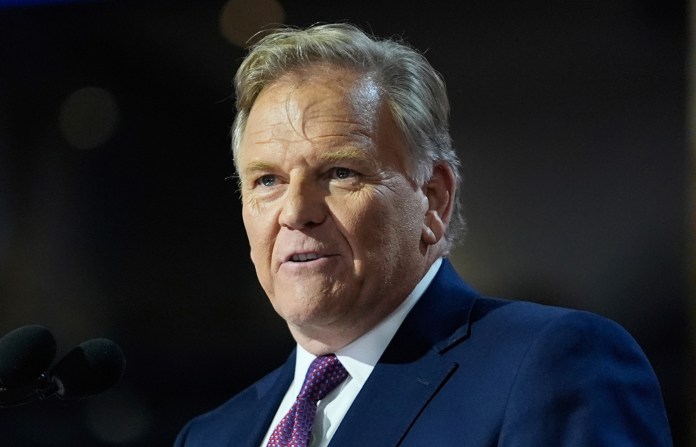
Rubin was referring to el Sayed’s neck-and-neck contest with Rogers, a Trump-adjacent Republican former House member and Intelligence Committee chairman, in a year when Democrats are substantially outpolling Republicans. Especially in swing states such as Michigan, where unhappiness with the Iran war and its effects on the economy is prevalent.
And anecdotally at least, el Sayed appears to be losing Michigan’s until-recently solidly Democratic Jewish community, numbering between 100,000 and 130,000.
Progressives acknowledge that el Sayed is a test case.
“If Abdul can win in Michigan, anybody can win anywhere. Anywhere,” Rep. Alexandria Ocasio-Cortez (D-NY), a strident Israel critic and a leader of the party’s Left flank, told a closed-door donors session on Oct. 5, the New York Times reported.
What does and does not constitute pro-Israel is not set in stone, and assessing which side — pro- and anti-Israel is emergent — is not always straightforward.
Brad Lander, who calls himself a Zionist, defeated the more conventional pro-Israel incumbent, Rep. Dan Goldman (D-NY), in a New York City district stretching from Lower Manhattan into Brooklyn by adopting some of the strident rhetoric of the anti-Israel Left, including accusing Israel of genocide in the Gaza war.
A similar scenario is playing out in San Francisco. In California’s 11th District, covering most of the city, state Sen. Scott Wiener faces San Francisco Supervisor Connie Chan in the general election to replace Rep. Nancy Pelosi (D-CA), the former two-time House speaker and minority leader who has held the seat for nearly 40 years.
Wiener, like Lander, is Jewish and describes himself as pro-Israel but has also accused Israel of genocide. Chan is to Wiener’s left on Israel, for instance, saying she would not allow the sale of defensive weapons to the country; Wiener opposes only offensive weapons. (In California’s system, the two top-vote getters in a “jungle primary” face off in the general election, even if they are from the same party. Weiner and Chan are both Democrats.)
Daniel Biss, the mayor of Evanston, Illinois, made AIPAC a political enemy in his successful bid for the nomination to succeed retiring Rep. Jan Schakowsky (D-IL) in a Chicago district with a substantial Jewish population. Using the same playbook as el Sayed, Biss wore as a badge of honor the fact that the lobby’s affiliated political action committees preferred one of his Democratic primary rivals, Laura Fine.
“I Was AIPAC’s Number 1 target – and I Beat Them,” is how he headlined an article in the progressive magazine, the Nation, after his March primary win.
Yet Biss, whose mother is Israeli and whose grandparents are Holocaust survivors, was also running against Palestinian American influencer Kat Abughazaleh. Biss distinguished himself from Abughazaleh, too, refusing to follow her in accusing Israel of genocide.
How to navigate support of Israel as a Jewish state while criticizing its policies was at the fore of Tom Malinowski’s defeat in February in a primary for a special election in New Jersey’s New York suburbs. Malinowski, a former congressman, was generally pro-Israel, but would not commit to backing all offensive weapons sales to the country. AIPAC spent millions to defeat Malinowski in a crowded race — and ended up installing a stridently anti-Israel candidate, Rep. Analilia Mejia (D-NJ), appalling even the lobby’s most steadfast backers.
Backing Israel, but not its current leaders
The way forward for pro-Israel Democrats may be to support Israel’s existence as a Jewish state, but to become robustly critical of its government’s policies, especially as long as Netanyahu, a figure revealed among Democrats for his full-throated identification with Republicans, remains prime minister, said Eric Alterman, who has written extensively on the U.S.-Israel relationship.
“As long as they begin by acknowledging both reality and the political reality,” he said. “If they say ‘Yes, Gaza is terrible, settler terrorism is terrible, Israel is on the wrong course, we all agree on that. But that doesn’t mean we should abandon them. They still have security challenges, and we still care about those and want to help them out as long as they understand that we’re no longer willing to write a blank check.’”
That’s the approach long advocated by J Street, a dovish rival to AIPAC. Last month, a welter of retired Jewish organization lay and professional leaders who once would never have imagined criticizing Israel — among them major donors to Democrats — aligned themselves with the group as the best means of sustaining pro-Israel support.
Rahm Emanuel, the former Chicago mayor mulling a presidential run who is the son of an Israeli, is also advocating tough love for Israel. That’s a means of maintaining Democratic support for the country, says Emanuel, also previously a senior counselor to President Bill Clinton, a congressman for six years, an Obama administration White House chief of staff, and U.S. ambassador to Japan for President Joe Biden.
“The prime minister and his government have led Israel into a dead-end,” Emanuel said in a July speech at Tel Aviv University. “For too long, American policy toward Israel operated under the assumption that the best thing Washington could do for Jerusalem was to blindly and silently stand behind your government, without conditions, without demands, and without consequences when we disagreed. That has been our mistake.”
Jason Steinbaum, long the chief of staff to Eliot Engel, the late New York Democratic House member who was perhaps Israel’s staunchest ally in Congress, said Emanuel’s approach is pointing the way to what “pro-Israel Democrat” might mean.
“If you were to have asked me six months ago about what’s coming, I would have suggested there was going to be a knock-down, drag-out fight among Democrats about Israel,” Steinbaum said. “I don’t think that anymore. I’m thinking that that debate is largely over, and that there is something approaching consensus over the question of how the party can deal with Israel and still be pro-Israel. And those will be things like supporting a strong ally, but stopping the assistance program or continuing to support defensive weaponry, whether it’s Iron Dome or it’s going to be even advanced fighters, but restricting certain other types of weapons.”
Rep. Brad Sherman (D-CA), who has for decades been involved in pro-Israel advocacy, said in an X thread last month that the Netanyahu government is ignoring counsel to change course at its peril. “Israel cannot survive with no friends in the world,” he said.
Some aren’t giving an inch
Jonathan Greenberg, a former AIPAC staffer who is politically conservative, said conceding anything to the anti-Israel crowd was a losing proposition. He admired the pro-Israel Democrats like Moskowitz who were giving no quarter.
“The only way that Democrats will purge themselves is to take these people out of their party, deny them positions of authority in the party, refuse to support them if they win primaries, refuse to seat them in the caucus, refuse to give them committee assignments,” he said.
Greenberg, who is the director for combating antisemitism at Defending Education, a group seeking to keep out of schools what it perceives as political ideology, named Democratic state Reps. Noah Arbit in Michigan and Esther Panitch in Georgia as his heroes for robustly speaking out against anti-Israel forces in the party, including the Democratic Socialists of America.
“We are not Jews with trembling knees,” Arbit, a strident critic of el Sayed, said last month on the state House floor, surrounded by supportive Democrats, quoting the late Israeli prime minister, Menachem Begin. “We will continue fighting to be heard above the din of hatred and conspiracy, no matter how excruciating and painful it continues to be.”
Arbit declined a request for an interview.
Panitch, the Georgia legislature’s only Jewish member, was determined never to stand down.
“If Jews go quiet and pro-Israel Democrats stop talking, then it’s a vacuum that will be filled by DSA, who’s more than ready to do it,” she said in an interview.
Ron Kampeas (@kampeas) is an Arlington, Virginia-based journalist. He was the Jewish Telegraphic Agency’s Washington bureau chief for more than 20 years, and previously reported for the Associated Press from the Jerusalem, New York, London, and Washington bureaus.