
It would be a stretch to say that the release of a Ben Affleck movie ever qualified as an event. Even in the late 1990s and the early 2000s — the post-Good Will Hunting window during which he was most plausibly anointed for stardom — Affleck tended to be recklessly productive in a way that diluted his brand. Was Forces of Nature (1999) an event? Was Changing Lanes (2002) a big deal? Was there a lot of press surrounding Paycheck (2003)? I am purposely omitting the flat-out bombs (Reindeer Games [2000], Gigli [2003], Jersey Girl [2004]) that Affleck has long seemed drawn to with alarming frequency.
Yet no two consecutive Affleck movies have ever been bigger nonevents than the two that saw the light of day this year, the laborious police procedural The Rip and the new alleged thriller Animals — both released on Netflix, both bearing annoyingly vague titles that offer no clue about their stories, both produced by the performer’s company with Good Will Hunting pal Matt Damon, Artists Equity, and most ominously of all, the latter directed and co-written by him. Affleck has become irrelevant not by ceasing to work but by continuing to lend his likeness to the modern cinematic equivalents of Muzak.
Notwithstanding his voluntary participation in Gigli, Affleck may be at least dimly aware of this, which might explain why he chose to play the lead character in Animals — independent Los Angeles mayoral candidate Mark Kimball — as the least inspiring, most perfunctory-sounding politician ever committed to the screen. By comparison, he makes Philip Baker Hall as a post-fall Richard Nixon in Robert Altman’s Secret Honor (1984) look positively Kennedyesque.
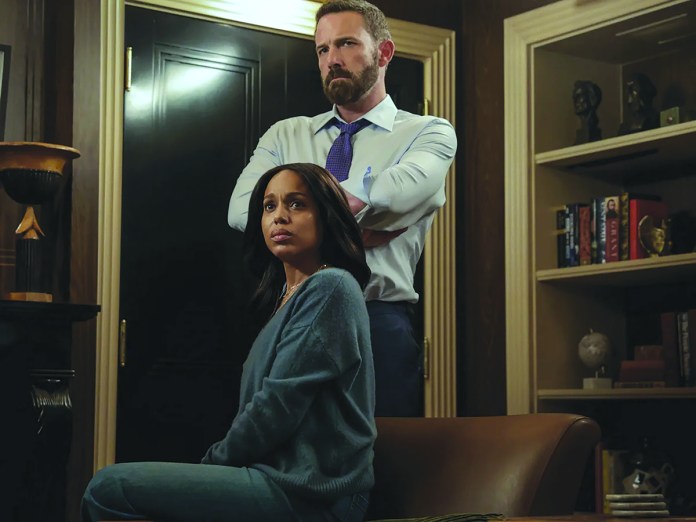
As the film opens, with Election Day imminent, Mark is struggling to find his footing against his Latina opponent, but honestly, based on his public appearances, one can see why. “The strength of this city is our bond and our common humanity,” Mark says, redundantly and in a bizarrely labored staccato fashion, at a campaign event that looks to be attended by perhaps a dozen reporters and aides. In a frequently under-realized production, this scene looks like it could have been shot in my backyard.
Mark reels off an improbable resume that includes work as a teacher, a lawyer in the offices of both the district attorney and public defender, a clean drinking water advocate, and, in an almost hilariously unlikely topper, a member of the armed forces during the Gulf War. The first one. To emphasize his virility, or simply to cut away from Mark talking, we also see Mark jogging.
Does Affleck mean for Mark to be inspiring because of his vague liberal values? Harried because he is in the process of exhausting his personal funds to win the race? Cynical because he keeps the extent of his spending from his wife, Abigail (Kerry Washington)? Who knows. We do know he is meant to be somewhat intelligent, because he has a copy of Robert A. Caro’s The Power Broker in his office — prominently displayed in multiple shots, as though mayoral candidates routinely dip into 1,000-plus-page nonfiction books when not on the trail. Equally odd-acting is Abigail, who, upon coming home to greet her husband, asks, “How are the internal numbers?” Abigail’s coldness might be explained by the fact that she is toying with the idea of leaving Mark, their little boy, Denny (Christopher Woodley), and their extremely beautiful house. Then again, it might just be bad writing.
Speaking of bad writing, in order for the plot to take off, the movie has Mark and Abigail’s housekeeper Cecilia (Adriana Paz), already tasked with taking Denny trick-or-treating, request that her new beau Ramon’s son Hector (Jacob Estrada) accompany them. (This gives Affleck-as-Mark the first of many opportunities to show off his Spanish-language skills.) But since Cecilia is the least attentive grown-up in recent movie memory, she permits the children to escape her view. One scene later, Mark is the recipient of one of those scary calls in which the speaker has disguised his voice and asserts that Denny has been kidnapped.
Inexplicably, Mark turns to his campaign manager, Sam (Steven Yeun), for help. “This is 5-to-1 a prank,” says Sam, who also knows that the demand for $7 million is unlikely to be met because of the precarious state of Mark’s finances amid the mayoral race. Give Affleck some credit: He shifts from a slumbering performance to something more frenetic, although his increase in energy is mainly reflected in lots of yelling and profane language. If only the voters could see Mark mad.
Enter Agent Dana Scully, er, Gillian Anderson, playing an unsmiling, well-funded operative on standby for politicos facing major emergencies. Anderson looks properly pensive as she sits in the back of a black SUV speeding past the Chateau Marmont, but, when she opens her mouth, she speaks with a high-toned whisper of an English accent that is no more credible than the immaculate white suit she is wearing in the middle of the night.
‘DIGGER’ IS UNPLEASANT, INCOMPETENT, AND UNFUNNY
But more quickly than you can say Highest 2 Lowest — Spike Lee’s far superior movie from last year about criminals who fumble a kidnapping — Denny waltzes in the front door. It turns out that Ramon’s son Hector has been absent-mindedly nabbed by the bad guys, although Mark remains on the hook for the money. In what is meant to be a stinging indictment of our political system, Sam suggests Mark look at the demand from a political perspective: “The truth is you need 2-to-3 points from the Latino vote.” Even the distraught Cecilia knows the stakes: “They can’t have a scandal like this for his voters.”
Yes, this movie is an unholy mixture of the Robert Redford movie The Candidate (1972) and the Mel Gibson thriller Ransom (1996). And, Highest 2 Lowest, too, of course. Except that it is not good, and as it wends its way to its climax, it stops being diverting even in a so-bad-it’s-good (or so-woke-it’s-good) kind of way. The kidnapping plot chugs along; Mark ugly-cries when he learns about Abigail’s affair; Hector is freed in a moment that defies known physics; various perpetrators are killed; and Mark, despite all evidence to the contrary, turns out to have inner reserves of political ruthlessness. To what end? Animals is, simply, forgettable — as forgettable as the last Ben Affleck movie and surely the next one, too.
Peter Tonguette is the Life & Arts editor of the Washington Examiner magazine.