
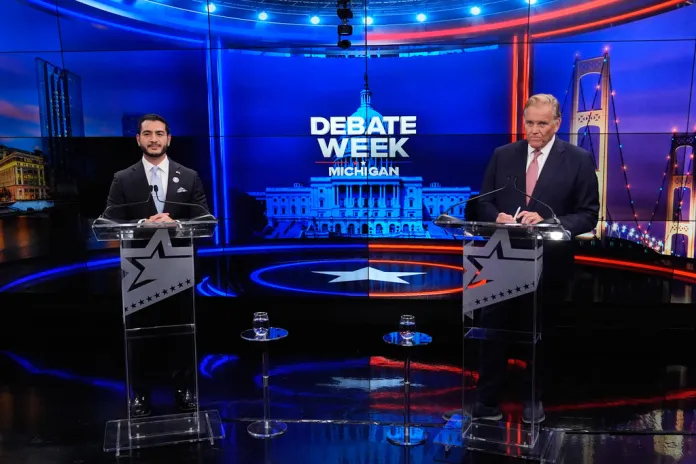
Neither candidate landed a decisive blow in Michigan’s first Senate debate, but the exchange exposed the political liabilities both must overcome in a race that could determine control of the chamber: Mike Rogers’s ties to President Donald Trump and Abdul el Sayed’s challenge in winning over voters beyond his progressive base.
Despite the personal attacks and sharp disagreements during Thursday’s debate in Grand Rapids, strategists from both parties said neither candidate delivered a moment likely to change the race, with both largely reinforcing voters’ existing impressions.
“I don’t think last night’s debate fundamentally changed the race, but it certainly highlighted the differences between these two candidates,” Jay Satterfield, a Democratic strategist and principal at North Shore Strategies, told the Washington Examiner.
Satterfield said those arguments are unlikely to reshape the contest on their own. The more consequential question is which candidate can convince voters that he understands their economic frustrations and has a credible plan to address them.
“These aren’t abstract political arguments for working families in Michigan who are trying to pay their bills, put food on the table, and get ahead,” Satterfield said. “Ultimately, I think this race will come down to which candidate can convince those families that their economic struggles are being heard and that Washington is prepared to do something meaningful about them.”
Jeff Burton, a Republican strategist and co-founding partner at Maven Advocacy, was even more dismissive of the debate’s impact.
“I doubt last night changed many minds,” Burton told the Washington Examiner. “Both candidates spent more time reminding voters why they shouldn’t vote for the other guy than giving them a reason to vote for themselves.”
Familiar attacks, few new answers
Much of the debate revolved around vulnerabilities that have already defined the campaign. Rogers faced pressure to explain where he differs from Trump, particularly on tariffs and the war in Iran. El Sayed faced questions about his foreign policy views and his ties to progressive streamer Hasan Piker.
Kaivan Shroff, a politics and culture commentator, said both candidates are trying to appeal to voters beyond their political bases without fully embracing the figures and positions associated with their respective movements.
“Each candidate is in a similar mode where they want to tap into a broader political base or movement without owning some of the main figures and ideas from those movements, el Sayed with the far left and Rogers with MAGA,” he told the Washington Examiner.
But Shroff argued that Rogers faces a particular challenge because Trump is the sitting president, leaving Rogers to defend his party’s record while trying to distance himself from policies that could hurt him with swing voters.
“That matters and that is becoming clearer and clearer as Rogers unsuccessfully tries to do this weird tap dance where he embraces Trump but distances himself from Trump’s harmful economic policies that are hurting Michigan,” Shroff said.
Political pundit Jamie E. Wright said Rogers’ breaks with Trump on tariffs against Canada and the war in Iran could appeal to suburban and nonpartisan voters. But those disagreements also gave el Sayed an opportunity to question Rogers’ consistency.
Wright said Rogers’ decision to invoke terrorism during the debate could also alienate voters who prefer a more measured approach.
“By bringing terrorism into the debate, Rogers may have been overreaching,” Wright told the Washington Examiner, comparing the tactic to a lawyer who loses a jury by trying too hard to sell an otherwise persuasive case.
Andrew Koneschusky, founder and CEO of Beltway Advisors, said Rogers appeared defensive at times, changing the subject and resorting to personal attacks. But he cautioned against assuming those exchanges would translate into meaningful movement among voters.
“The research on this is about as settled as political science gets,” Koneschusky told the Washington Examiner. “Across dozens of studies, debates rarely move the needle.”
The exceptions tend to involve extraordinary moments, he said, adding that nothing in Grand Rapids approached the significance of the June 2024 presidential debate between Trump and former President Joe Biden. That debate, held in Atlanta, upended the presidential election. Biden ended his reelection campaign, the Democratic Party tapped former Vice President Kamala Harris as its candidate, and Trump was reelected to the White House.
In the Michigan debate, “both candidates mostly appealed to their own supporters,” Koneschusky said.
“Swing voters tend to be turned off by a shouting match, so to the extent either candidate was trying to reach beyond his base, a debate like last night’s probably didn’t accomplish that,” he added.
Neither candidate can escape political baggage
The debate also offered little indication that either candidate had found a way to overcome the concerns that could limit his appeal.
For Rogers, that meant convincing independents that he can act independently of Trump without alienating Republicans. Burton said the former congressman needs to establish that he is his own man rather than simply an extension of the president.
El Sayed’s arguments on healthcare, affordability, and corporate power could resonate with voters, but his progressive foreign-policy positions could complicate his efforts to win over moderates.
“Rogers doesn’t need people to know everything that el Sayed stands for with Iran and Israel,” Wright said. “Just some nonpartisan voters who believe his opinion doesn’t align with what Michiganders want.”
Burton said el Sayed must show he isn’t too far left for Michigan while building support among Jewish and black voters.
Koneschusky said el Sayed would be better served by keeping the focus on affordability and other economic concerns that cut across party lines rather than getting drawn into polarizing disputes.
With no post-debate polling available, Koneschusky said he expects the overall numbers to remain largely unchanged. He noted that el Sayed had held a narrow lead in recent polls, though the race remains competitive.
“The best predictor of post-debate polling is pre-debate polling,” he said.
Shroff also said the debate produced no major gaffes or race-changing moments in a contest that has already attracted substantial national attention and spending.
“You can expect the next debate to be just as contentious, if not more,” he said. “But reality is this has been an incredibly expensive and scrutinized race nationally, so most people have already decided who they support. This debate didn’t produce any huge gaffes or race-changing moments.”
ARE THE POLLS OVERESTIMATING SENATE DEMOCRATS AGAIN?
The candidates are scheduled to meet again on Oct. 21. They will have one more chance on the big stage to make their cases, but strategists said changing the race’s trajectory will take more than another round of deeply personal attacks.
“In a race this close, the winner won’t be the candidate who throws the hardest punch,” Burton said. “It’ll be the one who gives undecided voters a reason to trust him.”