
STAFFORD COUNTY, Kansas — A zebra skin hangs over a beam and the spiral-horned head of a kudu, an African antelope, looks down from the wall, amid a gaggle of stuffed geese and ducks.
“I shot that zebra at 48 yards,” says Sen. Roger Marshall (R-KS), reminiscing about a bow hunting trip to Namibia as he strides into the sitting room of his cabin.
“It’s very modest,” he continues. “Three bedrooms. A cool den.”
The cabin is located on a dirt track on 320 acres of hunting land, and right at the center of his opponents’ favorite attack lines.
They say a trail of property records, tax filings, and even fishing licenses point to a second life in Florida after he became a senator and sold his family home, just up the road in Great Bend, in 2021. The result is a string of questions about his commitment to Kansas, as they portray him as an absent senator who relied on a P.O. Box to receive ballot papers.
On Saturday, Marshall invited Secrets to join him for a tour of rural Kansas, around Wichita, to see the homes where he grew up, the hospital he built, his favorite fishing ponds, and the cabin he now calls home.
He said the allegations of absenteeism were wide of the mark. He spends between 160 and 200 days each year in Washington, D.C., and then up to 150 days in Kansas, with a couple of weeks of travel.
“I mean, we went back and counted,” he said. “But the social media mafia finds out you got a home in Florida, of course, and they go wild.”
The house in Sarasota was bought in 2019 as a base for his wife Laina to visit their two grandchildren and her mother in Florida, whose husband was dying from cancer.
“So she says, look, if we’re going to stay married we need to buy a home in Florida where I can stay at when I’m down taking care of family,” said Marshall.
Meanwhile, there was no need to keep their six-bedroom family home in Great Bend, 20 minutes up the road from the cabin. Since then, his main residence has been the 1,120-square-foot cabin, with its taxidermy, fishpond, and firepit.
And on Friday, Mrs. Marshall signed the closing documents to sell the house in Florida, he says.
But the paperwork, bedroom count, and calendar are not the main point of our tour. The real message drips out over the course of our road trip, from the moment the senator pulls up in a Ford F-250 truck at my hotel in downtown Wichita (“Hi, I’m Roger!”), to the moment he tumbles out of the pickup 10 hours later clutching a fresh shirt for a Kansans for Life dinner.
“So my home home, where I grew up, is about 35 minutes from here, and we’ll go by it,” he says, throwing the truck into drive and heading east on Highway 54.
To our left are the hangars and warehouses of the city’s aviation industry. More than a third of the world’s aircraft are built here, the “aviation capital of the world.”
“My grandma would have been a Rosie the Riveter in World War II,” he says pointing out the area where she would once have worked.
READ MORE: HOW KANSAS BECAME COLLATERAL DAMAGE IN TRUMP’S WAR WITH CANADA
Then it is the Robert Dole VA Medical Center. “As a medical student, I spent about a year working in that hospital.”
The words tumble from his mouth as he points out landmarks, his connection to them, and then plans for the rest of the day.
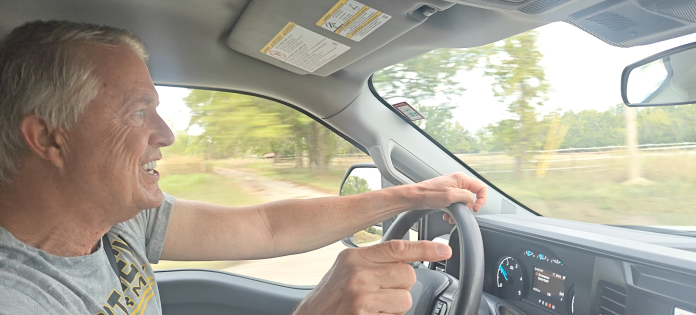
“One of my favorite things is to show people, share with them what I grew up doing and my love for this area. Like, I’m a big hunter and fisherman. I’m not a dude,” he says, using a pejorative term for a city slicker playing outdoorsman. “I really hunt or fish most every week since I was 10 years old.”
The road takes us past the farm where his grandparents kept cows until they could no longer compete with the big dairies.
“I’m in first grade, and I remember the day they sold those cows, and it was the only time I’ve ever seen my granddad and grandma cry,” he says.
We drive by the oil refinery where the young Marshall had a job painting its towers, on past his junior college and the spot where he broke a 40-year javelin record. (190 feet, in case you were wondering.)
His parents’ home in El Dorado is marked by a campaign sign (the only one in the street) and a basketball hoop in the driveway. This is where Marshall spent most of his childhood.
“I don’t know how many hours he spent out there,” his father, known universally as “Chief,” said of the hoop.
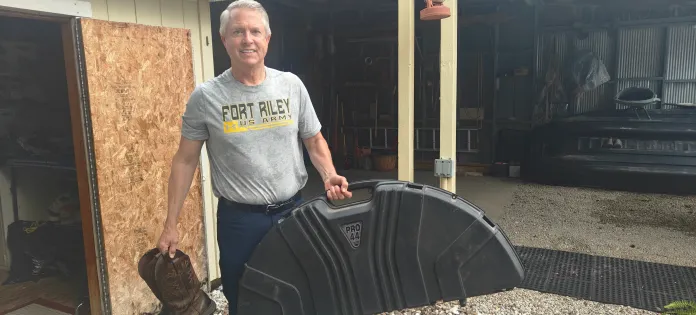
Marshall collects fishing poles, his hunting bow, a pair of rain boots, and a pair of cowboy boots, and we are soon back on the road.
Breakfast for the senator is a sausage, egg, and cheese sandwich from a Jump Start gas station. He points out that its E85 gas, made with a high proportion of ethanol, sells for just $2.38, compared to $4.12 for a regular gallon.
The senator championed a biofuel plant, which can buy up as much as a third of the state’s soybean crop.
“And now you have a lot of the oil guys also invested in ethanol, and a lot of the ethanol guys invested in oil,” he says.
Before long we are pulling on to ranchland among the Flint Hills, following trails Marshall has used since he was 12 and his uncle first brought him to Valley Pond.
“It’s a place I come to relax and just think through things,” he says, before handing Secrets a pole and crunching over freshwater clam shells to the water.
It might seem a strange way to spend the day when you are locked in a tighter than expected reelection battle.
He won the seat in 2020 by 11 points. But recent polls suggest he is trailing Adam Hamilton, a megachurch founder and Democratic candidate, by 1 or 2 points.
As he casts and retrieves, dragging his lure through the water, Marshall does not look like a man fighting for his political life.
“It’s a Saturday morning and there’s not much campaigning I could do. If there was a function or something then we would do it,” he tells Secrets.
“We worked hard all week. We’ve been working 14 hours a day. I’ll do an event tonight,” he adds. “I call this debate prep.”
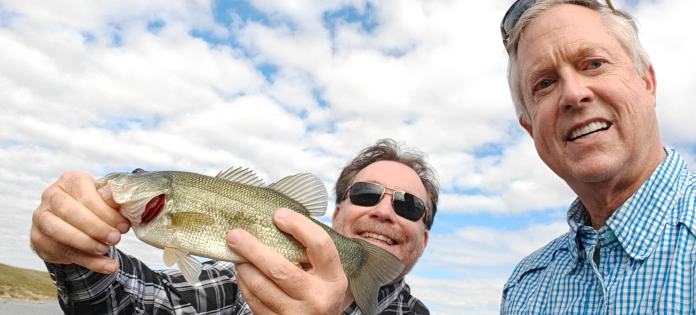
We leave with honors even. Two largemouth bass each.
The excursion comes at the end of a bruising week. Marshall has been on the receiving end of an attack ad that focuses on his decades-long career as an OB-GYN. It features a former patient, Meischa Zimmerman, who claimed she was arrested while eight months pregnant over a missed $50 payment.
His defense is that the collection methods were the industry standard — and essential in a rural practice where he treated anyone without stopping to do a “wallet biopsy” to assess their ability to pay — and that he had nothing to do with arrests.
“Look, I would want no one to be thrown in jail because they owe us money,” he says during the next leg of the drive west.
The allegations stung, he admits, before saying that voters were coming to understand the reality. It was a judge’s decision to issue warrants when people had missed court dates rather than a doctor’s decision.
His campaign took the unusual decision to send a cease-and-desist letter to Hamilton, calling his political ad defamatory, pointing out the patient owed nearly $3,600 not just $50. It kept the story in the headlines longer than it might otherwise have done.
Marshall said there was an important principle at stake: The allegations were at odds with the state’s bill of rights, which bans imprisoning anyone over debts.

“Since it’s against the bill of rights, I mean this is definitely a lie. They knew it was a lie from the start. That’s when it becomes a political answer rather than a logical answer,” he says, before pointing to a track running away to right.
“So my mom’s farm would be three miles down this road. A dead-end road, didn’t have electricity till eighth grade.”
After a lunch of patty melts at Freddy’s regional burger chain, the route takes us toward Great Bend. He and Laina moved there in 1991.
“I could have went anywhere I wanted and was offered jobs at all the usual places, but we go to Great Bend, Kansas, and I tell people … they ask me why I went there. I said, ‘Oh, because someone gave me a bottle of homemade salsa.’”
His previous visit had been to a hospital in Texas where he was offered Dallas Cowboys tickets and country club recommendations. But he opted for home and the post where he would become the only OB-GYN serving a population of about 60,000.
It’s another reason why the attack ad stings. It ignores his decades of service.
“Starting about 15 miles back there,” he says, hitting the brakes as we enter a 40 mph zone on the outskirts of Lyons, “I would have delivered all the babies.”
Before we reach Great Bend he points out an egg farm on the right.
“The guy that runs that Cal-Maine plant went to church with my brother,” he says.
There is no need to spell it out. The point is that while Hamilton lives and works in the most prosperous corner of the state, in the suburbs of Kansas City, the rest of Kansas is Marshall country.
READ MORE: MARSHALL SLAMS MEGACHURCH CHALLENGER FOR LIVING IN A ‘BUBBLE’
His pitch to voters is that he can tell when the soybean crop is ready for harvest by the color of the leaves. One of his first jobs was shoveling manure at a cattle yard. And he has a nodding donkey oil well on his land. If he hasn’t delivered your children, his brother probably goes to church with the doctor that did.
In Great Bend, we swing past a church he helped build and then on to the city’s hospital, where he was one of the founding doctors when it opened in 1998.
“I talked the doctors into buying this 80 acres of wheatland and said, ‘Let’s go build a hospital here.’ Put 22 doctors together, and by gosh, we did it,” he says.
It is half-past-two when we pull onto the track leading to the cabin. A woodpecker and barn owl take flight at the sound of the pickup.
As far as Marshall is concerned, this is home.
“At this stage of my life, I get here two weekends a month on average,” he says. “I wish it were more but I’m on the road a lot.”
He swaps the pickup for a four-wheeler and we set off for a tour of the mile-by-half-mile plot, each with a Coors Light in hand.
Cottonwood trees throw shade over two hides positioned near deer runs. Pheasants and quail are also frequent visitors to what was once pastureland.
“We burned all this grass this spring,” he explains, pointing out fresh growth. “It’s part of better managing the grass.”
The day ends with another spot of fishing. We try the little wooden dock behind the cabin, move to an area shaded by pine trees, and cast further into the green pond. Nothing is biting.
The clock is ticking and Marshall has to get back to the campaign, in the form of Kansans for Life and its dinner.
He has time for only five practice shots with his bow. When will he next be able to go hunting?
“If the election is Tuesday, maybe Wednesday,” he says smiling.
The poles are loaded back into the truck and we are almost ready to hit the road back to Wichita.
“You guys want a beer for the road?” he asks.