
A top Iranian official reportedly admitted that Iran’s economy is in dire straits due to the war and the U.S. blockade of the country.
Mohsen Rezaei, secretary of the Supreme National Security Council and former commander in chief of the Islamic Revolutionary Guard Corps, made the admission Saturday at a high-level government meeting focused on stabilizing the economy. His paraphrased comments were carried by Iran’s IRNA state news agency, reporting that he “described the circumstances as among the most difficult periods the country has faced.”
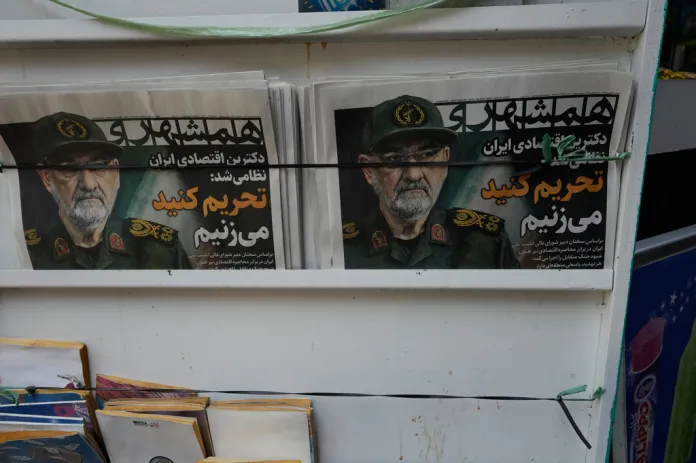
The meeting was also attended by Iranian President Masoud Pezeshkian, who has been much more forthcoming about Iran’s economic issues, among other senior officials. After making the admission, Rezaei said the security council would provide whatever support it could.
Rezaei’s admission is particularly notable as he is one of the most stringent senior hardliners in Iran’s leadership, next to Ahmad Vahidi, the commander in chief of the Guard. He is believed to be one of the de facto heads of Iran, as Iranian Supreme Leader Ayatollah Mojtaba Khamenei remains elusive.
Professor Ali Alfoneh, a senior fellow at the Arab Gulf States Institute and expert on the Guard and succession politics in Iran, told the Washington Examiner in March that Iran was run by “a power-sharing arrangement within a five-member collective leadership composed of the president, the parliamentary speaker, the judiciary chief, and one representative each from the regular Army and the IRGC, either Mohsen Rezaei or Ahmad Vahidi.”
Rezaei was appointed to his current position on Aug. 9, in which he serves as the country’s No. 2 security official and Khamenei’s personal representative on the security council.
Iran’s economy was already in dire straits before the war, with worsening living conditions to the point that it triggered the largest protests in the Islamic Republic’s history. The beginning of the war significantly worsened the situation, but the economy entered a proverbial nosedive in mid-August after the launch of Operation Outcast, which President Donald Trump described as “economic D-Day.” The imposition of secondary sanctions, a rigorous crackdown on illicit financial and smuggling networks, and, most importantly, the maintenance of the U.S. naval blockade, have turned the situation catastrophic.
The rial was able to stay afloat for the opening phase of the war through drawing down reserves or mobilizing assets through back channels. It began its sustained fall on Aug. 20, right after Trump announced Operation Outcast.
Pashizi, a tracker for free-market exchange rates of Iran’s currency, put the closing value of the rial at 2.548 million rials per one U.S. dollar on Tuesday before falling further to 2.7 million to begin this week. Alanchand, another tracker for free-market exchange rates of Iran’s currency, had the rial at 1.111 million one year ago, meaning it has lost 58.9% of its value in one year. Since Aug. 20, it has lost 29.6% of its value.
The main culprit for the degradation of Iran’s economy is the U.S. blockade, depriving Tehran of much-needed oil export revenue. After being lifted in June as part of the peace agreement, it was reinstated on July 14. Analysts noted the drastic effects of the blockade as early as Sept. 1, Reuters reported. Iran is now approaching three months without any new oil tankers reaching Chinese ports, its last main oil customer.
On Thursday, Treasury Secretary Scott Bessent announced on social media that Iran loaded “ZERO crude oil into tankers in September.”
“Operation Economic Outcast is severing the economic lifelines that have allowed Tehran to finance its terrorist agenda,” he added.
Oil Minister Mohsen Paknejad, who vowed that Iran would keep exporting oil around the U.S. blockade, resigned Sunday.
IRANIAN RIAL HITS ALL-TIME LOW AS ECONOMY CONTINUES FREE FALL
Even Iran’s rosiest economic figures, which authorities are willing to admit, are dire. The Statistical Center of Iran, reporting on the first quarter of the Persian calendar running from March 21 to June 20, said the economy had retracted by 10.1% year-on-year. The oil and gas industry was worst hit, contracting by 26.4%, while the mining sector contracted by 14.7%, and services declined by 4.8%.
Iran Central Bank governor Abdolnaser Hemmati put year-on-year inflation in September at 83.8%, down from 84.4% in August. According to a Monday New York Times report, government and private-sector employees have taken to social media to announce they were quitting their jobs because their salaries could not support them. Some retired government employees have begun protesting in recent weeks after failing to receive their full pensions.