
Local media in Minnesota, as well as national news outlets including legacy brands like CNN and ABC, fell for the orations of a Somali immigrant who claimed to be the trusted figurehead for the state’s Somali diaspora.
With the press world’s help, Omar Jamal was anointed as the authoritative voice on all political issues concerning Minnesota’s Somali community and the Somali population at large in America.
Over the past three decades since Jamal secured asylum in the United States, he has acted as the go-to community spokesman, routinely disseminating his own press releases, holding briefings with flocks of reporters, and issuing statements regarding Somali-related matters ranging from Islamic terrorism to fraud in recent years.
It turns out, however, Jamal was a government informant playing both sides of the explosive federal food fraud investigation in Minnesota that has netted the convictions of primarily Somali-born co-conspirators.
‘Shakedown artist’ selling out fraudsters
According to a Minnesota Star Tribune expose, Jamal served as a paid consultant for several fraudsters federally convicted in the Feeding Our Future fraud case.
The outlet reported that Jamal pocketed hundreds of thousands of dollars from at least six Feeding Our Future associates convicted in connection to the sprawling fraud scheme. Dozens of fake food distributors part of the Feeding Our Future fraud ring collectively stole more than $250 million in federal relief funds meant to feed children during the COVID-19 pandemic.
Jamal allegedly promised to protect the Feeding Our Future operatives against the threat of prosecution, took their money, and then turned some of them over to investigators.
“I’m the boss. Nobody’s coming to you guys,” Anab Awad recalled Jamal telling her. “You’re safe.”
Jamal, meanwhile, was allegedly handing over information about his clients to the FBI. Months before the fraud investigation became public in 2022, Jamal met with the FBI on multiple occasions and implicated a dozen individuals or companies that the U.S. attorney’s office eventually indicted, according to meeting notes obtained by the Minnesota Star Tribune.
FEEDING OUR FUTURE MASTERMIND SAYS SOMALI ACCOMPLICES SCAMMED HER
Awad, who said she paid Jamal nearly $100,000 after he touted his connections to local and federal law enforcement, would later plead guilty to stealing $9.7 million from the meal delivery program.
In an FBI interview following her conviction, Awad told federal agents that Jamal flashed a sheriff’s badge and extorted her, saying she had to pay him in order to receive “protection” or else he would call the authorities.
Jamal has held a civilian job since 2020 as a community service officer in the Ramsey County Sheriff’s Office, which covers the metropolitan region surrounding Minneapolis and St. Paul. In that government post paying almost $70,000 a year, Jamal acted as a liaison with the Somali community.
According to Awad, Jamal said the Feeding Our Future food distribution sites were raided by the FBI because they refused to pay his protection fee. Awad accordingly signed a consultation agreement with Jamal. All he did, Awad recalled, was inspect the food sites on occasion and tell those site operators “not to worry, the FBI wasn’t coming.”
Jamal allegedly leveraged his law enforcement connections to squeeze other fraud suspects for monthly payments billed as consultation service charges, turning his promises of protection and veiled threats into a lucrative business.

Aimee Bock, the convicted ringleader of Feeding Our Future, was Jamal’s most prominent client. Invoices show Bock had hired Jamal at a consultation rate of $150 an hour and that she owed him a total of $45,000.
In a jailhouse interview, Bock told the Minnesota Star Tribune that Jamal reported her to federal investigators, saying she was running a criminal enterprise, after she refused to pay him the remaining two-thirds of her bill due. Bock already cut a check and coughed over cash totaling $14,500 in exchange for Jamal negotiating a deal on her behalf with state regulators.
Her criminal defense attorney, Kenneth Udoibok, called Jamal a “shakedown artist.”
One federal official involved in the Feeding Our Future case downplayed Jamal’s contributions to the FBI’s investigative work. “It was intelligence but not evidence,” the official told the Minnesota Star Tribune. “He didn’t have any value to us as a witness, as a cooperator. We were already onto them through the bank records.”
Jamal has not been criminally charged for allegedly accepting payments from now-convicted fraudsters. The accusations also come from convicted fraudsters with potential motives to implicate Jamal.
His attorney, Patrick Boyle, declined to address most of the Minnesota Star Tribune’s findings and he insisted that Jamal has “never worked for the FBI.” However, he acknowledged that Jamal has worked with law enforcement agencies to arrange meetings and raise concerns about issues affecting the Somali community.
Decades of influence in Minnesota and beyond
Jamal, a Somali refugee himself, holds significant sway over members of Minnesota’s East African community in addition to friendly media wanting “an in” with the immigrant enclave that has made Minnesota the country’s largest settlement of Somalis.
Born in Somalia’s capital city of Mogadishu, Jamal secured asylum status in the U.S. in 1998 under false pretenses by denying that he ever was granted permanent residency or asylum in any other country. Jamal gained refugee and permanent resident status in Canada years prior. On his U.S. asylum application, he changed his backstory, including his birth date and clan affiliation.
In 2001, authorities became aware of the discrepancies surrounding Jamal’s immigration history, and he was eventually convicted of lying to immigration officials. Jamal was sentenced to one year of probation and referred for deportation. The standing deportation order has followed Jamal since its issuance in 2011, and he was arrested last summer as the Trump administration started cracking down on illegal immigration in Minnesota.
Upon his release from detention, Jamal convened a news conference where he bragged about his longtime relationship with federal authorities.
“I and the feds have been dealing with each other for the last 20 years,” Jamal said.
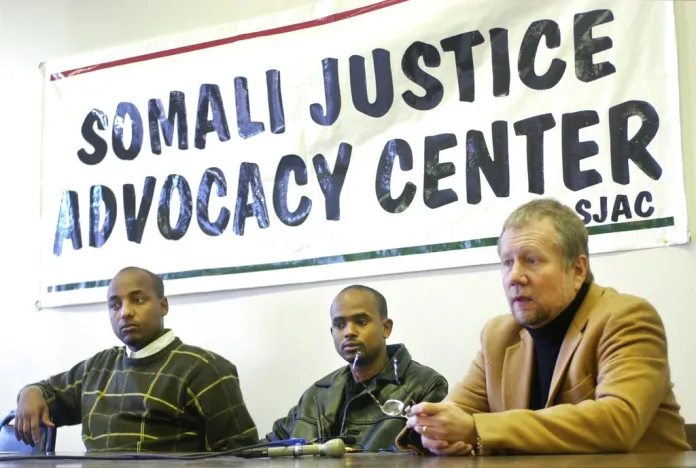
In the years preceding his 2003 indictment for making false immigration claims, Jamal became an outspoken advocate whom local media began to heavily rely on to provide Somali-specific or Muslim-centric commentary.
According to a timeline assembled by MPR News editor Laura Yuen, one of the earliest skeptics of Jamal, the Minnesota Star Tribune and the St. Paul Pioneer Press quoted him more than 50 times the year after the terrorist attacks of Sept. 11, 2001.
During the following years that marked his rise to media stardom, Jamal emerged a national media figure representing the Somali position on a wide range of topics, including overseas piracy and the representation of Somalis in mass media. For instance, while on his “National Tour Against Hate,” he appeared on CNN to oppose the portrayal of Somalis as “savage beasts” in the film Black Hawk Down.
By 2009, Jamal had become such a prolific talking head that the president of Somalia appointed him to serve at the United Nations.
Jamal’s January 2005 conviction did not hinder his press appearances. At the time, he maintained that the U.S. was targeting him for championing the civil rights of Muslims.
In February 2005, one month post-conviction, Jamal spoke to the National Press Club about how U.S. policy is “breeding” Islamic terrorists in his homeland of Somalia.
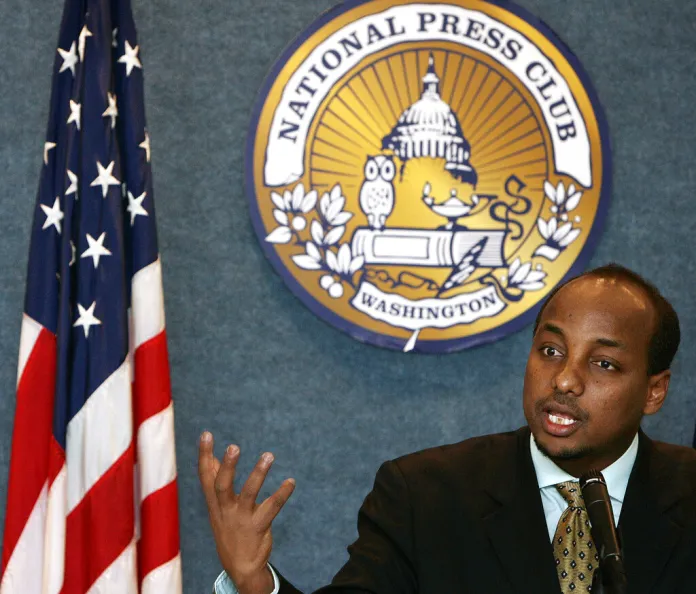
In 2009, when Somali pirates were capturing ships, he claimed to be the go-between who can contact the Somali pirates directly. Jamal convened a press conference proclaiming to be able to communicate by phone with Somali pirates who were holding a Nigerian ship hostage. Although he could not actually reach them, Jamal provided reporters with a phone number for the pirates.
“They always pick up the phone right away,” Jamal said. “I don’t know if it has something to do with the American ship there.”
Later on, he made the reporters promise that they would not dial the pirates’ purported phone number.
Jamal, who co-founded the Somali Justice Advocacy Center, which helps immigrants find pro bono attorneys, also helped retain a lawyer for the Somali teenager charged with piracy in the infamous Captain Richard Phillips hostage-taking.
Ultimately, after he was found out to be a con artist, according to his critics, Minnesota media appears to be more so upset that Jamal was not acting in the Somali community’s best interests.
“We, the media, enabled Jamal,” says an op-ed published on Wednesday by the Minnesota Star Tribune. “We helped create the narcissist he became.”
The article in hindsight decried the media’s reliance on Jamal as a trustworthy source, especially as “Somali Americans are even more misunderstood and maligned.”
In the words of MPR’s Yuen, perhaps his biggest critic, “Jamal has become a mouthpiece for everyone’s worst fears.”
The Washington Examiner contacted Jamal for comment.